Best Food Science and Food History Books in 2026: 12 That Reveal What You're Actually Eating
Every food choice you make is simultaneously an economic decision, a cultural act, a political statement, and a biochemical event. The best food science and food history books are the ones that show you all four layers at once, which is why reading about food turns out to be one of the more politically charged things you can do in a library. This list covers the twelve books that do that most effectively, from Michael Pollan's investigation of the industrial corn system to Harold McGee's chemical breakdown of why bread rises, with the full range of cultural history, fermentation science, and anthropology in between.
None of these books are prescriptive diet manuals. They are works of investigative journalism, food science, cultural anthropology, and history that happen to use your dinner plate as their lens. Read them in any order, though the sequence below moves from supply chain to kitchen science to culture, which tends to be the most disorienting order in the best possible sense.
The Books That Start With Where Food Comes From
The single question that opens most food history is the simplest one: where does this actually come from? The answer, in the industrial food system, is almost always corn, and almost always not where you think.
1. The Omnivore's Dilemma by Michael Pollan

Pollan follows four meals from source to table: an industrial fast-food meal (almost entirely derived from corn through feed and processing), an organic supermarket meal (more complex than its labels suggest), a pastoral meal from a local farm, and a meal of food Pollan hunted and gathered himself. The central revelation is that the American food system runs on a single monoculture, and that every choice a shopper makes in a supermarket is downstream of decisions made in Washington agriculture policy, not in a kitchen.
This is the book that created the modern food politics conversation in English-language nonfiction. Read it first because it gives you the map before the other books fill in the details.
Best for: Anyone who wants to understand the industrial food system before reading anything else about food.
2. In Defense of Food by Michael Pollan
Pollan's follow-up distills a position into seven words: "Eat food. Not too much. Mostly plants." The book is a sustained argument that nutritional science, by breaking food into isolated nutrients (fat, protein, carbohydrate, antioxidant), has made it harder rather than easier to eat well, and that the populations with the worst relationship to food are the ones most saturated with nutritional advice. It is a short book and a persuasive one, and it is the best case ever made for treating food as food rather than as a delivery mechanism for micronutrients.
3. Salt Sugar Fat by Michael Moss
Moss is a Pulitzer Prize-winning journalist who spent four years inside the processed food industry. What he found was a systematic, research-backed effort by food companies to engineer products that override the human satiety system. The chapters on "bliss point" research at Coca-Cola, the "mouth feel" engineering at Kraft, and the internal memo wars at Philip Morris about whether their food division was creating the same addiction liability as cigarettes are the most important food journalism produced in the last twenty years.
This is the book about what the food industry knows about your eating behavior that it would prefer you not know. It is the most politically important book on this list.
Best for: Readers who want the documented evidence behind the claim that processed food is engineered for overconsumption.
Food History: The Long View
Food history is one of the oldest and most neglected fields in popular history. Salt built empires. Kitchen tools changed the structure of meals. A single ingredient can trace a thousand years of trade routes across a single chapter.
4. Salt: A World History by Mark Kurlansky
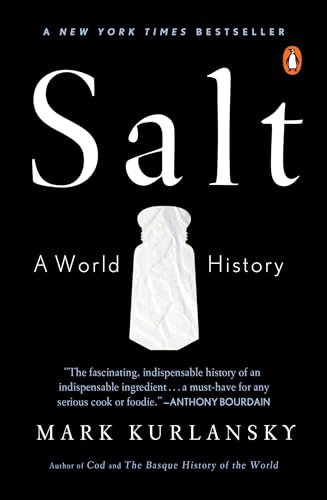
Salt was the first global commodity, the reason cities were built where they were, the reason trade routes ran the way they did, and the reason certain wars were fought and certain empires fell. Kurlansky covers four thousand years of salt history, from the Celtic salt mines of Hallstatt to the role of the salt tax in the French Revolution to Gandhi's Salt March. It is a model of how to write about a single commodity as a lens on all of human civilization.
Salt: A World History by Mark Kurlansky is the book that proves you can write the entire history of human civilization through a single ingredient.
5. Consider the Fork by Bee Wilson
Wilson's history of kitchen tools is more surprising than it sounds. The fork changed how Europeans cut their food, which changed what they cooked, which changed what they ate. The advent of reliable ovens changed the role of women in domestic labor. The introduction of refrigeration restructured where people lived relative to food supply. Wilson traces how each kitchen technology reshaped not just cooking but culture, class, and daily life. This is a book about objects that turns out to be a book about how we became the people we are.
6. The Way We Eat Now by Bee Wilson
Wilson's more recent book documents the food transformation of the last fifty years: the shift from home cooking to processed food, the global spread of Western dietary patterns, the collapse of the communal meal, and the paradox of a world in which more people are both malnourished and obese than at any point in history. She is neither nostalgic nor alarmist, which makes her analysis more credible than most food writing on this topic.
7. First Bite: How We Learn to Eat by Bee Wilson
Wilson's third entry on this list asks a question that gets almost no attention in food writing: how do we learn to like what we like? The answer involves early childhood exposure windows, cultural transmission, the role of siblings and peers, and the way that food preferences are formed long before we make any conscious choices about them. It is the food book that explains why the other food books are hard to act on, which makes it essential context for everything else on this list.
Food Science: What Is Actually Happening in Your Kitchen
Most cookbooks tell you what to do. The books below tell you why it works, which is the level of understanding that makes you a better cook in every situation rather than just a better follower of specific recipes.
8. On Food and Cooking by Harold McGee
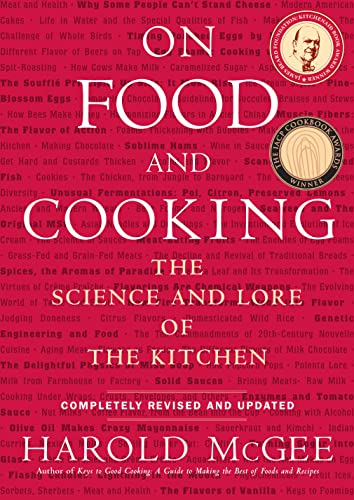
McGee's book is the reference that working professional chefs keep on their shelves. It covers the chemistry of eggs (why they coagulate at different temperatures), the physics of bread (what gluten actually is and why it needs to be developed), the biology of meat (what happens to protein during cooking), the botany of vegetables (why some need to be blanched before freezing), and every other culinary technique, from the molecular level up. It is not a cookbook. It is the science of cooking organized for people who actually cook.
On Food and Cooking by Harold McGee is the book professional chefs use as a reference because it explains the principles behind every technique rather than just the steps.
Best for: Anyone who wants to understand cooking at the level of mechanism rather than instruction.
9. The Art of Fermentation by Sandor Katz
Fermentation is the oldest food technology humans possess, older than cooking, older than agriculture, and it is the process responsible for bread, beer, wine, cheese, yogurt, soy sauce, miso, kimchi, and most of the most complex flavors in human food culture. Katz's book is the comprehensive account of what fermentation actually is biologically, why it works as a preservation method, and how to do it at home with any ingredient in any climate. It is also a cultural history of fermentation as a practice that survived industrialization only at the edges and is now returning.
10. Salt Fat Acid Heat by Samin Nosrat
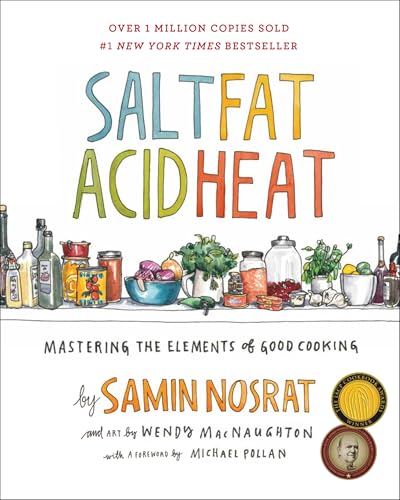
Nosrat's book is the best modern argument that cooking should be taught as principles rather than recipes. She identifies four elements that determine whether food tastes good (salt for flavor, fat for texture and richness, acid for brightness and balance, heat for transformation) and builds an entire approach to cooking from those four variables. It is the book that teaches you how to cook without a recipe because you understand what you are trying to achieve rather than just what you are supposed to do.
Salt Fat Acid Heat by Samin Nosrat teaches cooking as a set of principles rather than a sequence of instructions, which is why it works for every cuisine rather than just one.
The Anthropology and Philosophy of Food
Food taboos are among the most culturally specific phenomena in human society. What counts as food, what counts as sacred, what counts as disgusting, and what counts as a meal vary so dramatically across cultures that they have become a primary object of study in anthropology and philosophy.
11. Purity and Danger by Mary Douglas
Douglas's 1966 study is not primarily a food book. It is an anthropological examination of pollution, taboo, and the categories by which cultures define what is clean and what is dirty, what is sacred and what is profane. But its chapters on food taboos, including a famous analysis of the dietary laws in Leviticus, are the most cited work in the anthropology of food because Douglas shows that what a culture classifies as edible or inedible is always a map of its deeper social categories. The pig is not forbidden in Leviticus because it is unhygienic. It is forbidden because it does not fit the categorical logic of the kosher system. Understanding this changes how you read every food prohibition in every culture.
Best for: Readers who want the theoretical framework that explains why food taboos exist and what they reveal about the cultures that hold them.
12. The Omnivore's Dilemma and Beyond: A Note on Range
The eleven books above cover the major axes of food writing: supply chain, industrial food politics, kitchen science, cultural history of specific ingredients, and anthropology of food practices. If you read them in the order listed, you will move from the macro (where does food come from, how is it made addictive) to the micro (what is happening in your pan) to the cultural (why do we eat this and not that), which is the sequence that makes each book deepen the last.
The through-line across all twelve is the same point: food is never just nutrition. It is politics, culture, history, chemistry, and anthropology simultaneously, and the writers who understand that produce the most important nonfiction of the last thirty years.
Three Food Books Worth Buying Today
These three titles appear most consistently at the top of food nonfiction recommendations across review platforms and academic syllabi:
- The Omnivore's Dilemma by Michael Pollan, the book that mapped where the industrial food system comes from and why it works the way it does.
- On Food and Cooking by Harold McGee, the reference professional chefs use when they want to understand why a technique works.
- Salt Fat Acid Heat by Samin Nosrat, the book that teaches the principles behind cooking rather than the steps of individual recipes.
For the full ranked collection of nonfiction titles by verified reader count, see the history books category at Skriuwer.
Your next good book, in your inbox
We only write when we find a book worth your time. Hand-picked recommendations across history, mythology, true crime and more.
Are you an author?
Get your book in front of readers like these, for free.
- Free book listing →Your own book page with an Amazon button
- Author page →Photo, bio and links to your site
- Featured placement →A spot in our best-of lists, from €29
Free tools we recommend
Get free honest reviewsReview exchange on iWrity, free to join
Books You Might Like

Sapiens: A Brief History of Humankind
Yuval Noah Harari
The Last Kingdom (The Saxon Stories, Book 1)
Bernard Cornwell

Meditations
Marcus Aurelius

The Hiding Place
Elizabeth Sherrill, John Sherrill Corrie ten Boom