Best Geopolitics Books in 2026: 10 That Explain How the World Actually Works
News cycles explain events. Geopolitics explains why those events were always likely to happen. The difference between following international news and understanding international affairs is largely a matter of having the right frameworks, and the books on this list provide those frameworks. They explain why countries behave as they do, why certain conflicts keep recurring regardless of who holds power, and why geography, demography, and history constrain what is politically possible far more than most reporting acknowledges.
1. Prisoners of Geography by Tim Marshall
Marshall's book is the most accessible entry point in the genre and has introduced more general readers to geopolitical thinking than any other book of the past decade. The central argument is simple: the physical geography of a country, its rivers, mountain ranges, coastlines, and access to warm water ports, determines its strategic interests and its vulnerabilities in ways that persist across centuries regardless of ideology or leadership. Marshall walks through ten regions, Russia, China, the United States, Western Europe, Africa, the Middle East, India and Pakistan, Korea and Japan, Latin America, and the Arctic, explaining how geography shapes behavior in each. It is the right book to read first. Buy Prisoners of Geography on Amazon.
2. The Grand Chessboard by Zbigniew Brzezinski

Brzezinski, national security adviser to President Carter, wrote this book in 1997 and it reads like a strategy document rather than a popular work of analysis. The central argument is that Eurasia, the combined landmass of Europe and Asia, is the prize in global geopolitics, and that maintaining US primacy requires preventing any single power from dominating it. The book outlines the strategic importance of Ukraine, the risks posed by a revanchist Russia, and the long-term challenge of managing a rising China with a specificity that has made it eerily predictive. It is dense but worth the effort for anyone who wants to understand how superpower strategy actually works. Buy The Grand Chessboard on Amazon.
3. The Revenge of Geography by Robert Kaplan
Kaplan takes Brzezinski's Eurasian thesis and expands it into a comprehensive argument that the classical geopoliticians of the 19th and early 20th centuries, Mackinder, Spykman, Mahan, were substantially right in ways that the post-Cold War optimism about globalization and liberal democracy obscured. The book argues that physical geography, not ideas or institutions, is the primary determinant of national behavior, and that understanding the map is the first step toward understanding the news. Kaplan is a more fluid writer than Brzezinski and the book is more narrative in structure, making it easier to read without sacrificing analytical depth.
4. The Accidental Superpower by Peter Zeihan
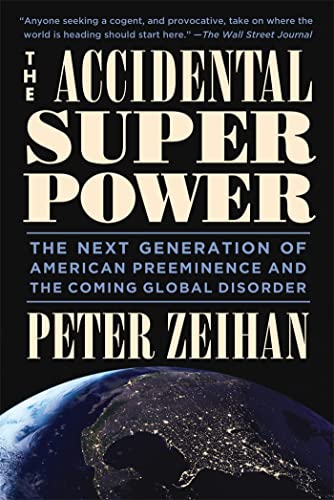
Zeihan's argument is structurally opposite to most geopolitical pessimism about American decline. He contends that the United States is geographically the most fortunate nation in history, with navigable interior waterways, protected coastlines, and a demographic structure that most other major powers lack, and that the coming decades will see American power consolidate as the global order it constructed after 1945 fractures. His analysis of demographic decline in China, Russia, Germany, Japan, and South Korea is particularly detailed and rigorous. You do not have to agree with Zeihan's conclusions to find his framework useful for thinking about what demography means for long-term power. Buy The Accidental Superpower on Amazon.
5. The Power of Crisis by Ian Bremmer

Bremmer, the founder of Eurasia Group, examines three categories of crisis that will define the coming decades: pandemics and health security, climate change and the energy transition, and the technology competition between the United States and China. His argument is not that these crises are inevitable catastrophes but that they present genuine opportunities for international cooperation if political will exists to seize them, and that the failure to cooperate carries serious costs. Bremmer writes for a broad audience and the book is more prescriptive than analytical, but it provides a useful framework for thinking about where geopolitical stress is concentrated right now. Buy The Power of Crisis on Amazon.
6. Connectography by Parag Khanna
Khanna's book makes the case that supply chains, infrastructure networks, and trade corridors are replacing traditional borders as the primary organizing principle of global politics. He argues that connectivity, not sovereignty, is the defining feature of 21st-century geopolitics, and that the countries and cities that sit at the nodes of global supply chains are accumulating a new kind of power that traditional state-centric analysis misses. Connectography is an optimistic counterpoint to the geography-as-destiny school represented by Marshall and Kaplan, and the tension between the two frameworks is worth holding in mind as you read both.
7. The Clash of Civilizations by Samuel Huntington
Huntington's 1996 thesis that the primary source of conflict in the post-Cold War world would be cultural and civilizational rather than ideological or economic was controversial when published and remains contested. The book predicted that fault lines between Western, Islamic, Sinic, Orthodox, and other civilizations would generate persistent conflict, and that the Western assumption of universal liberal values would prove to be a Western particularity rather than a global direction of travel. Whether or not you accept Huntington's framework, it is the most debated geopolitical hypothesis of the past three decades and any serious reader of international affairs needs to have engaged with it.
8. Silk Roads by Peter Frankopan
Frankopan's history recenters the story of civilization on Central Asia rather than on Western Europe, arguing that the trade routes running through Persia, the Steppe, and the Caucasus were the primary drivers of global history for most of recorded time. The book is a corrective to the Eurocentric lens that most Western education applies to history, and it provides essential context for understanding why China's Belt and Road Initiative and the competition for Central Asian energy resources are more historically resonant than they appear in standard reporting. It is the best book on this list for understanding how geography and trade shaped the world before the modern era.
9. Why Nations Fail by Daron Acemoglu and James Robinson
Acemoglu and Robinson are economists rather than geopolitical analysts, but their central argument belongs here: nations succeed or fail based on whether their political and economic institutions are inclusive or extractive, not based on geography, culture, or the quality of their leadership. The book is a direct challenge to geographic determinism and to cultural explanations of development. Its analysis of how colonial powers shaped institutional structures that still determine development outcomes today is one of the most rigorous explanations of global inequality in the economics literature and has practical implications for understanding where political instability is most likely to persist.
10. The End of the World Is Just the Beginning by Peter Zeihan
Zeihan's most recent major work extends the argument of The Accidental Superpower into a specific claim: deglobalization is not a future risk but a current process, and the supply chain structures that have delivered unprecedented global prosperity since 1945 are already unwinding. He examines what this means sector by sector, for agriculture, manufacturing, energy, finance, and transport, and his conclusions are bleak for most of the world and relatively sanguine for the United States. The book is as much a business and economics work as a geopolitics one, but the geographic and demographic analysis that underlies it is the same as in his earlier books.
How to Read These Books
Start with Tim Marshall's Prisoners of Geography for the foundational framework. Then read either The Accidental Superpower or The Revenge of Geography depending on whether you want a more optimistic or more cautionary lens on American power. The Grand Chessboard is the right next step if you want to understand Eurasian strategy specifically. Frankopan's Silk Roads provides the deepest historical context for understanding why the current competition over Central Asia and the Indo-Pacific is so significant. None of these books will make the news make sense overnight. But together, they provide the map that context requires.
Your next good book, in your inbox
We only write when we find a book worth your time. Hand-picked recommendations across history, mythology, true crime and more.
Are you an author?
Get your book in front of readers like these, for free.
- Free book listing →Your own book page with an Amazon button
- Author page →Photo, bio and links to your site
- Featured placement →A spot in our best-of lists, from €29
Free tools we recommend
Get free honest reviewsReview exchange on iWrity, free to join
Books You Might Like

Sapiens: A Brief History of Humankind
Yuval Noah Harari
The Last Kingdom (The Saxon Stories, Book 1)
Bernard Cornwell

Meditations
Marcus Aurelius

The Hiding Place
Elizabeth Sherrill, John Sherrill Corrie ten Boom