Best Historical Fiction Books in 2026: 10 That Put You Right in the Middle of History
Good historical fiction does something that straight history cannot. It puts you inside a moment that is over. The best examples do not just reconstruct the facts. They reconstruct the texture of thought, the things people took for granted, the smells and the power structures and the specific ways ordinary human beings navigated worlds organized completely differently from ours. When Hilary Mantel writes Thomas Cromwell, she is not illustrating facts you could find in a textbook. She is doing something closer to inhabiting a dead man's consciousness.
This list covers ten historical novels that hold up as literature first and historical fiction second. Each one is accurate enough that historians have engaged with it seriously, and each one is good enough that readers who do not care about history have read it anyway.
If you want history filtered through one bloodline across decades rather than one protagonist across a single period, see our guide to the best multigenerational family saga books.
Where to Start
If you have not read widely in historical fiction, start with The Pillars of the Earth. It is the most purely readable novel on this list and the one most likely to turn a skeptic into a committed reader of the genre. Then try Wolf Hall, which is a more demanding read but the strongest piece of prose here. From there, follow your period interests.
Hilary Mantel, Wolf Hall (2009)
The first volume of Mantel's Thomas Cromwell trilogy follows Cromwell's rise from the son of a blacksmith to Henry VIII's most trusted fixer. Written in a present-tense third-person that collapses historical distance, it places you inside Cromwell's political intelligence as he watches the court maneuver around the question of Anne Boleyn. The prose is dense and the cast large, but readers who commit to the first hundred pages consistently report that they cannot stop.
Mantel won the Booker Prize for Wolf Hall and again for its sequel, Bring Up the Bodies. The third volume, The Mirror and the Light, completes the trilogy and was published in 2020, a year before Mantel's death. All three are worth reading in sequence. Wolf Hall alone justifies the reputation.
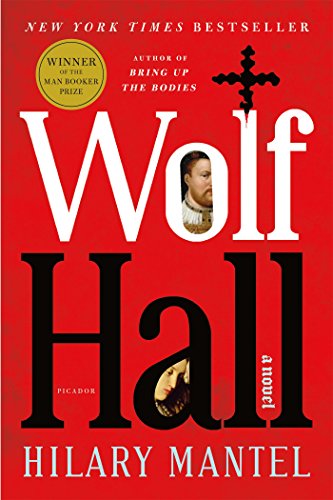 Wolf Hall by Hilary Mantel on Amazon
Ken Follett, The Pillars of the Earth (1989)
Eight hundred pages about the building of a cathedral in twelfth-century England. The subject sounds narrow. The novel is anything but. Follett tracks multiple characters across decades of civil war, religious politics, and architectural ambition, building a narrative that reads like the best popular history and the best thriller simultaneously. Tom Builder, Prior Philip, Jack Jackson, Ellen, Aliena: the characters are drawn with the kind of detail usually reserved for literary fiction.
The research is solid enough that it convinced a generation of readers to visit English cathedrals with new attention. The plot mechanics are tight enough that 800 pages pass without effort. It is the easiest novel to recommend to someone who says they do not usually enjoy historical fiction.
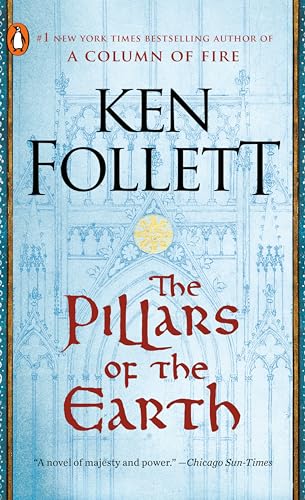 The Pillars of the Earth by Ken Follett on Amazon
Patrick O'Brian, Master and Commander (1969)
The first of O'Brian's twenty-novel Aubrey-Maturin series, following Royal Navy Captain Jack Aubrey and his friend Stephen Maturin, a ship's surgeon and intelligence operative, through the Napoleonic Wars. The friendship between the two men is the engine of the series: Aubrey blunt, physical, emotionally straightforward; Maturin subtle, intellectual, politically complex. The naval detail is exact. The social comedy is genuine.
O'Brian was the most technically accomplished writer on this list and one of the least well-known outside the series' devoted readership. The Aubrey-Maturin novels have been described as the nearest equivalent in English fiction to the complete Napoleonic world-picture that Tolstoy built in Russian. That is not an exaggeration. Start here, understand that the full reward only comes with the full series, and prepare accordingly.
Anthony Burgess, Napoleon Symphony (1974)
A formally unusual novel structured to mirror Beethoven's Eroica symphony, originally composed for Napoleon. Burgess follows Napoleon from Corsica to Saint Helena in four movements, using prose styles that shift with the symphony's tempo and mood. It is part biography, part historical novel, part formal experiment. Burgess was showing off, but he had the talent to justify it.
Less widely read than his more famous A Clockwork Orange, Napoleon Symphony is the more impressive achievement for readers who care about both history and literary technique. It treats Napoleon not as a hero or a monster but as someone whose inner life the prose tries to inhabit honestly, including the vanity, the military genius, and the peculiar sentimentality.
Colm Toibin, Brooklyn (2009)
Eilis Lacey leaves County Wexford in Ireland in the early 1950s to work in Brooklyn. The novel follows her adjustment to New York, her relationship with an Italian-American plumber, and her eventual return visit to Ireland that threatens to pull her back permanently. Toibin's prose is quiet and exact, and the historical setting, postwar Irish emigration, economic constraint, and the specific texture of Brooklyn in that decade, is rendered without sentimentality.
Brooklyn is the most recent novel on this list and the one that fits most easily into contemporary literary fiction. The history is less dramatic here than in the Tudor court or the Napoleonic Wars. The precision with which Toibin reconstructs a particular Irish-American world in a particular decade is what makes it historical fiction rather than general fiction.
Sarah Waters, Fingersmith (2002)
A Victorian crime novel structured around two interlocking first-person narrators who are deceiving each other. Sue Trinder is a thief raised in a house of receivers; Maud Lilly is the ward of a collector of obscene books kept in a country house. The plot mechanics are intricate and the mid-novel reversal is one of the best-executed structural surprises in recent British fiction. The historical texture of Victorian criminality, institutional confinement, and the control of women is not decoration but argument.
Waters researched Victorian sensation fiction and penny dreadful conventions specifically to deploy and subvert them. The result reads as both tribute to and critique of its period sources. It was shortlisted for the Booker Prize and the Orange Prize.
 Fingersmith by Sarah Waters on Amazon
Geraldine Brooks, People of the Book (2008)
A rare book, the Sarajevo Haggadah, is recovered by conservator Hanna Heath in 1996. As she examines it, she finds traces of its history: a wine stain, an insect wing, salt crystals. The novel follows these backward in time through fifteenth-century Spain, Venice during the Inquisition, Sarajevo under the Nazis, and seventeenth-century Venice. Each section reconstructs a moment when someone chose to preserve the book rather than destroy it.
The Sarajevo Haggadah is real. Its survival through exactly the episodes Brooks fictionalizes is documented. The novel adds imagined people to documented facts, which is the essential historical fiction method, executed here with unusual care.
Charles Frazier, Cold Mountain (1997)
Inman, a wounded Confederate soldier, walks home from the Civil War to Cold Mountain in North Carolina and to Ada, the woman he loves. Ada is learning to survive alone on her failing farm. The two narratives alternate until they converge. Frazier's prose is strongly influenced by the naturalist writing of W.P. Kittredge and by Homer, and the journey structure is deliberately Odyssean.
The Appalachian landscape is rendered with documentary precision. The Civil War's violence, particularly its effect on civilians and deserters, is neither glamorized nor reduced to political symbol. It won the National Book Award in 1997 and remains the strongest American Civil War novel of the past thirty years.
Penelope Fitzgerald, The Blue Flower (1995)
A novel about the German Romantic poet Novalis, specifically his engagement to Sophie von Kuhn, a twelve-year-old girl he met when he was twenty-two. Fitzgerald was not writing a defense of the engagement. She was reconstructing a late eighteenth-century German Romantic sensibility in which such a thing was possible, understood by its participants in terms of Platonic idealism, and set against the very different pragmatism of Novalis's family.
It is the shortest novel on this list and the most condensed. Fitzgerald's prose, always spare, operates here at its maximum efficiency. Every sentence is doing work. It is the novel on this list most likely to reward slow rereading.
Umberto Eco, The Name of the Rose (1980)
Brother William of Baskerville, a Franciscan friar, investigates a series of deaths in an Italian monastery in 1327. The plot is a murder mystery. The real subject is the epistemology of the Middle Ages: how people understood truth, authority, and heresy. Eco was a medieval scholar before he was a novelist, and the intellectual texture of the period is not background but substance.
The first hundred pages, densely detailed about monastery architecture and theological disputes, have defeated many readers. Those who persist find that the novel becomes one of the most involving intellectual thrillers ever written. The solution to the central mystery, when it comes, is both satisfying and philosophically exact.
Three Reads to Start With
- The Pillars of the Earth by Ken Follett. The most accessible and purely entertaining novel on this list. Eight hundred pages that pass faster than most four-hundred-page books.
- Wolf Hall by Hilary Mantel. The best prose on this list. Takes patience but pays it back in full.
- Fingersmith by Sarah Waters. The most plot-driven of the literary titles here and the one with the most purely satisfying construction.
What Makes Historical Fiction Work
The books on this list share one quality: their authors did enough historical research that the period stopped being a backdrop and became a constraint. Mantel read everything available about Thomas Cromwell and built her imagined interior life from what that external evidence implied. O'Brian knew Napoleonic naval procedure well enough to catch other writers' errors. Eco wrote medieval theology from the inside. The historical period shapes what the characters can think, not just what they can do.
That is the difference between good historical fiction and historical fiction as costume drama. Costume drama puts modern characters in old clothes. The best historical fiction reconstructs a different cognitive world, a different set of assumptions about what is normal, what is possible, and what matters. When it works, you come back to the present with your sense of the normal shaken slightly, which is one of the things literature is for.
For more reading on related topics, see our guide to the best military history books for non-fiction companions to several novels on this list, and our best books about Napoleon guide for the historical reading that frames Napoleon Symphony and the Aubrey-Maturin series.
Your next good book, in your inbox
We only write when we find a book worth your time. Hand-picked recommendations across history, mythology, true crime and more.
Are you an author?
Get your book in front of readers like these, for free.
- Free book listing →Your own book page with an Amazon button
- Author page →Photo, bio and links to your site
- Featured placement →A spot in our best-of lists, from €29
Free tools we recommend
Get free honest reviewsReview exchange on iWrity, free to join
Books You Might Like

It Ends with Us: A Novel
Colleen Hoover

The Seven Husbands of Evelyn Hugo: A Novel
Taylor Jenkins Reid

The Song of Achilles
Madeline Miller
