Best Sociology and Social Theory Books in 2026: 12 That Explain Why Society Works the Way It Does
HERE IS THE CLAIM that sociology has been making since the 1890s, and that people have been resisting ever since: you are not as free as you think you are. Your tastes, your beliefs, your career choices, your health outcomes, your likelihood of committing suicide, your sense of what is beautiful or disgusting or normal, all of these things that feel most personally your own are shaped by social forces that operated on you before you were old enough to notice. You are, to a significant degree, a product of where and when and among whom you were born.
This is not a comfortable claim. It feels like an attack on personal responsibility, on individual identity, on the sense that your life is yours. It also feels, once you start looking at the evidence, impossible to escape. Suicide rates vary systematically by religion, by marital status, by economic cycle, in ways that cannot be explained by individual psychology alone. Your probability of going to university is strongly predicted by your parents' education. Your taste in music correlates with your class position. These patterns are real, measurable, and persistent.
The books below are the tradition that built this argument, piece by piece, over a century and a half. They disagree about a lot. They agree that individual behavior has social explanations, and that those explanations matter.
Suicide by Emile Durkheim

Published in 1897, this is the founding empirical sociology study. Durkheim chose suicide deliberately because it seems like the most individual of acts, the one thing a person decides entirely alone. He then showed that suicide rates vary systematically across social groups in ways that cannot be explained by individual psychology. Catholic countries have lower suicide rates than Protestant countries. Married people have lower rates than unmarried. People in stable communities have lower rates than people whose communities are disrupted. Durkheim's conclusion: suicide is a social fact, shaped by the degree of social integration and moral regulation that a society provides its members. The book is methodologically dated in places, but its central move, using aggregate statistics to reveal social forces invisible at the individual level, is still the model for what sociology does.
Find Suicide by Durkheim on Amazon
The Protestant Ethic and the Spirit of Capitalism by Max Weber
Weber's 1905 essay asked why capitalism first developed in northern Europe rather than in the more economically sophisticated Mediterranean. His answer was cultural: Calvinist Protestantism created a psychological orientation toward work, thrift, and worldly success as signs of divine election that happened to be exactly what early capitalism required. The argument has been contested almost from the moment it was published. Critics point out that capitalism appeared in Catholic cities like Florence before Weber's thesis can account for. Weber's defenders say he was making a probabilistic claim about cultural affinities, not a monocausal claim about origins. Either way, the essay established that cultural and religious factors could be causes of economic outcomes, which was a genuinely new idea in 1905 and remains contested in 2026.
Find The Protestant Ethic and the Spirit of Capitalism on Amazon
The Sociology of Georg Simmel by Georg Simmel
Simmel was the third founding figure of classical sociology alongside Durkheim and Weber, and the least systematic of the three, which is part of what makes him the most readable. His essays on the stranger, on money, on the metropolis, on fashion, on secrecy, on the sociology of space, anticipate almost everything that came after. His essay "The Metropolis and Mental Life," written in 1903, is still the best single description of what it feels like to live in a modern city: the sensory overload, the blasé attitude that city-dwellers develop as a defense, the paradox of isolation in density. If you have ever felt anonymous in a crowd, Simmel wrote about why a century ago.
The Sociological Imagination by C. Wright Mills

Published in 1959 and still the best introduction to sociology as a discipline. Mills's central concept is the sociological imagination: the capacity to see the connection between personal troubles and public issues. A man unemployed in a city of five percent unemployment has a personal trouble; a man unemployed in a city of fifty percent unemployment has a public issue. The distinction matters because the solutions are different. Mills was writing against the dominant American sociology of his day, which he thought had retreated into either grand theory disconnected from evidence or statistical research disconnected from meaning. His attack on what he called "abstracted empiricism" and "grand theory" is one of the great polemics in intellectual history and still relevant to how social science is practiced.
Find The Sociological Imagination on Amazon
The Presentation of Self in Everyday Life by Erving Goffman
Published in 1959 and still the most cited book in sociology. Goffman's central metaphor is theatrical: social life is a performance. When you interact with others, you are managing an impression, performing a version of yourself, using props, costumes, scripts, and backstage areas where you can drop the performance temporarily. This does not mean you are being fake. It means that social identity is inherently performative, that the "real you" behind all the performances may be a fiction, and that the management of social impressions is a constant and skilled activity that most people perform without noticing they are doing it. Goffman's framework has been applied to medicine, prison, everyday conversation, online identity, and almost every other social domain. Fifty years on, it still generates new research.
Find The Presentation of Self in Everyday Life on Amazon
Distinction by Pierre Bourdieu
Published in French in 1979, translated into English in 1984, and the most ambitious sociology book of the second half of the twentieth century. Bourdieu surveyed French society across class groups and analyzed their cultural tastes: music, food, sport, home decor, reading habits, aesthetic preferences. His finding: cultural taste is not innocent, not natural, not simply a matter of individual preference. It is a mechanism of class reproduction. The tastes associated with the educated upper-middle class are treated as legitimate, refined, universal. The tastes of the working class are treated as vulgar or limited. This judgment naturalizes class hierarchy by making it look like a difference in cultivation rather than a difference in access to resources. The book is dense and long. It is worth it.
Discipline and Punish by Michel Foucault
Foucault opens with a detailed description of a public execution in 1757: a man being tortured and drawn and quartered in Paris. He then asks: why did European societies move from public torture to the modern prison over the next century? Not, he argues, because of humanitarian progress. Because the new methods of control are more effective. The prison is a technology of normalization: it does not just punish but produces docile, controllable subjects. Surveillance, timetabling, examination, normalization, these techniques developed in prisons spread outward to schools, hospitals, factories, and armies. The result is a society in which power operates not through spectacular violence but through constant observation and the internalization of its norms. Foucault's framework has been attacked for overreach and for being impossible to falsify. It has also been applied to almost every institution in modern society with results that are hard to dismiss.
Find Discipline and Punish on Amazon
Modernity and Self-Identity by Anthony Giddens
Giddens argues that late modernity, the world since roughly 1970, has dissolved the traditional frameworks, class, religion, family, regional community, that used to provide stable identities and replaced them with something more anxious and reflexive. In late modernity, identity is a project: something you have to construct and continuously revise rather than inherit. This is liberating and exhausting simultaneously. The self becomes a "reflexive project," constantly examined and updated in light of new information. Giddens connects this to changes in intimacy, to the "pure relationship" maintained only for its own rewards rather than held together by economic necessity or social convention, and to the general condition of living with manufactured risk and uncertainty.
The Philadelphia Negro by W.E.B. Du Bois
Published in 1899, this is the first major empirical sociological study conducted in America, and it was written by a Black scholar about a Black community at a time when both were systematically excluded from academic institutions. Du Bois spent fifteen months in Philadelphia's Seventh Ward interviewing residents, compiling statistics, and documenting the social conditions of the Black community there. The book is a masterpiece of empirical research and a quiet polemic: Du Bois shows, with evidence, that the poverty and social disorganization of the Seventh Ward is not a product of racial inferiority but of systematic discrimination, exclusion from economic opportunity, and the legacy of slavery. American sociology spent the next fifty years ignoring this argument. It eventually caught up.
Liquid Modernity by Zygmunt Bauman
Published in 2000, Bauman's diagnosis of the contemporary condition: the solid institutions of modernity, the state, the corporation, the church, the family, the stable career, have dissolved. We live now in "liquid" conditions, where nothing is fixed, commitments are contingent, and identity is permanently provisional. Freedom has increased and so has anxiety. The flexibility that the market celebrates as a virtue is experienced by workers as insecurity. Community, which used to provide belonging and constraint simultaneously, has been replaced by networks, which provide connection without obligation. Bauman was writing in 2000, before social media, before the gig economy became ubiquitous. The book has become more relevant, not less.
Bowling Alone by Robert Putnam
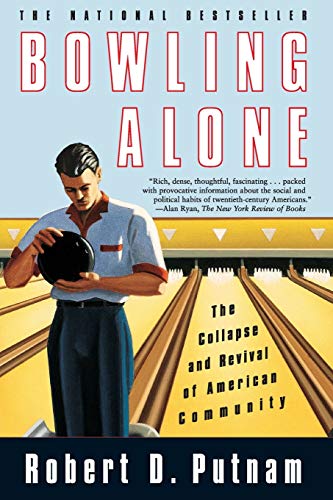
Putnam's 2000 study of the decline of civic engagement in America documented something that most Americans had noticed without being able to name: people were less involved in the institutions of civil society, church groups, political parties, bowling leagues, parent-teacher organizations, neighborhood associations, than they had been a generation earlier. They were, literally and metaphorically, bowling alone. Putnam's concept of social capital, the networks of trust and reciprocity that communities depend on, became one of the most used and misused concepts in social science. The book is empirical and accessible, though its thesis about what caused the decline, primarily television and generational change, has been contested.
Why This Tradition Matters
The resistance to sociology comes from two directions. Conservatives argue that it undermines personal responsibility by attributing individual behavior to social causes. Radicals argue that it describes social structures without providing adequate grounds for changing them. Both criticisms have some force. But the alternative, explaining social patterns purely in terms of individual choices, leaves most of what matters about human life unexplained.
When health outcomes, educational achievement, and life expectancy vary dramatically by zip code, class, and race in ways that have persisted for generations, you are not looking at the sum of individual choices. You are looking at structural patterns that require structural explanations. Sociology, at its best, provides those explanations without reducing people to mere products of their circumstances. That balance is genuinely difficult to maintain. These books show what it looks like when it is done well.
Your next good book, in your inbox
We only write when we find a book worth your time. Hand-picked recommendations across history, mythology, true crime and more.
Are you an author?
Get your book in front of readers like these, for free.
- Free book listing →Your own book page with an Amazon button
- Author page →Photo, bio and links to your site
- Featured placement →A spot in our best-of lists, from €29
Free tools we recommend
Get free honest reviewsReview exchange on iWrity, free to join
Books You Might Like

Sapiens: A Brief History of Humankind
Yuval Noah Harari

The Last Kingdom (The Saxon Stories, Book 1)
Bernard Cornwell

Meditations
Marcus Aurelius

The Power of Now
Eckhart Tolle