Best Survival and Extreme Adventure Books in 2026: 10 That Will Make Your Daily Problems Feel Small
There is a category of book that makes you put it down, stare at the wall, and recalibrate. These are not books about obstacles. They are books about people who faced death in extreme environments, where cold or altitude or starvation or human error reduced every decision to the most fundamental question: do you keep going or do you stop? The best survival writing does not glamorize what happened. It reports it. The result is often more useful than a decade of self-help.
1. Into Thin Air by Jon Krakauer
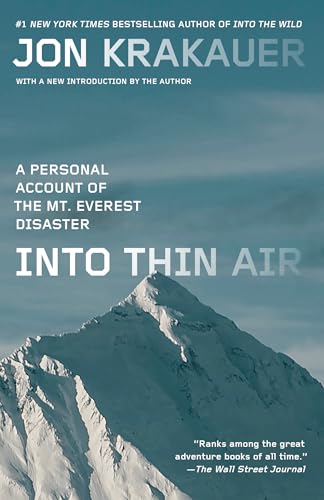
In May 1996, a freak storm hit Everest during a crowded climbing season and killed eight people in a single day. Krakauer was on the mountain as a journalist and turned his account into one of the most gripping books ever written about mountaineering. What makes Into Thin Air more than a disaster narrative is the question running through every chapter: how much did the commercial expedition model contribute to what happened? People who had no business being that high on that mountain were being guided toward the summit for money. Krakauer asks the question and does not offer a clean answer.
2. Alive by Piers Paul Read
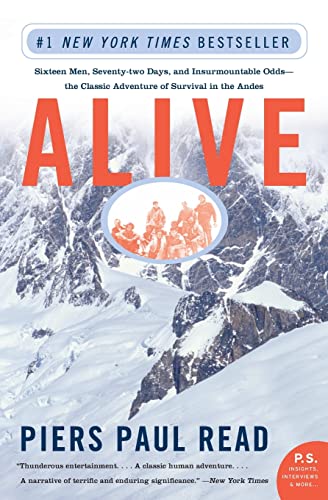
In October 1972, a Uruguayan rugby team's plane crashed in the Andes. The survivors waited weeks for a rescue that never came, faced temperatures that killed the weakened, and eventually made a decision that has defined the story ever since: they ate the flesh of the dead to survive. Piers Paul Read was given full access to the survivors and wrote the account with their cooperation. The moral weight of the book is handled carefully. Read does not sensationalize and he does not excuse. He simply describes, in extraordinary detail, what it takes to keep a human body alive when every resource is gone.
3. Deep Survival by Laurence Gonzales
Gonzales spent years studying who survives wilderness emergencies and who does not. The answer, it turns out, has less to do with training or physical fitness than with how people process information under extreme stress. Deep Survival draws on neuroscience, accident reports, and interviews to build a theory of survival psychology. The chapters move between gripping accident narratives and explanations of the cognitive and emotional processes underneath them. One of the core findings is counterintuitive: the people who are most confident in their expertise often die, because they stop noticing what is actually happening in front of them.
4. Touching the Void by Joe Simpson
In 1985, Joe Simpson and Simon Yates attempted the west face of Siula Grande in the Peruvian Andes. On the descent, Simpson broke his leg. Yates lowered him down the mountain on ropes until Simpson disappeared over an unseen cliff edge, hanging in a crevasse in the dark. Yates cut the rope. Simpson, alone, with a shattered leg, at high altitude, without food or water, then crawled back to base camp. The book is short, under two hundred pages, and reads like something that could not possibly be true. Yates's decision to cut the rope is still debated by climbers today.
5. Tribe by Sebastian Junger
Junger's book is the intellectual outlier on this list, a short, dense argument about why soldiers struggle to reintegrate into civilian life after combat and what that tells us about what humans actually need. The core claim is that modern Western society has eliminated most of the conditions, shared hardship, close community, clear purpose, that made human life bearable for most of our evolutionary history. Junger draws on psychology, anthropology, and his own experience embedded with combat units in Afghanistan. The book is under two hundred pages and it reframes the survivor story in a way that applies to everyone, not just veterans.
6. In the Heart of the Sea by Nathaniel Philbrick

In 1820, the whaling ship Essex was rammed and sunk by a sperm whale in the Pacific Ocean. The crew spent months in small boats crossing thousands of miles of open ocean. The story was the real-world source for Melville's Moby-Dick. Philbrick is a maritime historian and he reconstructs the disaster with forensic care: the decisions made in the boats, the hierarchy among the officers, the gradual physical and psychological collapse of men who had been at sea for years before the sinking even began. The final chapters cover what the survivors chose not to discuss publicly when they returned home.
Find In the Heart of the Sea on Amazon
7. The Last Season by Eric Blehm
Randy Morgenson was one of the most experienced backcountry rangers in the Sierra Nevada, a man who had spent decades alone in some of the most remote wilderness in North America. In 1996 he disappeared. Eric Blehm spent years researching the search for Morgenson, interviewing colleagues, reading his extensive journals, and retracing his routes. The result is part wilderness mystery, part biography of a man who had given his life to a landscape, and part meditation on what solitude does to a person over time. It is quieter than most books on this list but no less affecting.
8. Endurance by Alfred Lansing

In 1914, Ernest Shackleton led an expedition to Antarctica with the goal of making the first land crossing of the continent. The ship became trapped in pack ice before it ever reached land, drifted for months, and was eventually crushed. Twenty-eight men were then stranded on the ice, hundreds of miles from any human being, for nearly two years. Every single one of them survived. Lansing wrote the account in 1959 based on diaries and interviews with survivors. It is one of the great leadership stories in history and also one of the great survival stories, because the two turned out to be inseparable.
9. A Walk in the Woods by Bill Bryson
The tonal outlier. Bryson's account of attempting to hike the Appalachian Trail is funny, digressive, and occasionally alarming. He is not a trained outdoorsman, he brings a friend who is even less prepared, and the two of them manage to cover roughly a third of the trail before calling it done. What Bryson does better than almost anyone is embed genuine natural history and ecological argument inside comedy. The chapters on bear behavior, the history of trail maintenance, and the politics of the National Park Service are as informative as anything in a straight nature book, and considerably more entertaining.
10. The Perfect Storm by Sebastian Junger
In October 1991, the Andrea Gail, a swordfishing boat out of Gloucester, Massachusetts, sailed into a convergence of weather systems that became one of the most powerful storms ever recorded on the North Atlantic. No one on board survived. Junger reconstructed what likely happened based on meteorological data, accounts from other boats, and interviews with families and survivors of nearby disasters. The book alternates between the story of the boat and extended chapters on the science of waves and storms. What stays with you is not the action sequences but the account of what drowning actually does to a human body.
The Through Line
The books on this list share something beyond the subject matter. The best survival writing is fundamentally about attention: the survivors in these stories, whether on Everest, in the Andes, or on the Southern Ocean, tended to be people who stayed curious about what was actually happening around them rather than what they expected to be happening. That is a useful thing to carry back from reading into a life that will never demand this kind of reckoning. For more non-fiction reading, browse the full non-fiction collection.
Your next good book, in your inbox
We only write when we find a book worth your time. Hand-picked recommendations across history, mythology, true crime and more.
Are you an author?
Get your book in front of readers like these, for free.
- Free book listing →Your own book page with an Amazon button
- Author page →Photo, bio and links to your site
- Featured placement →A spot in our best-of lists, from €29
Free tools we recommend
Get free honest reviewsReview exchange on iWrity, free to join
Books You Might Like


Real Spies Don't Use Rowboats
Hope, Jeffrey H
