Best World War I History Books in 2026: 12 That Explain How the World Destroyed Itself in Four Years
World War I killed roughly seventeen million people, destroyed four empires, redrew the map of Europe and the Middle East, and set the conditions for everything that followed in the twentieth century. It is also, by some distance, the most written-about war in history. The challenge for a new reader is not finding books but knowing which ones actually explain what happened and which ones only describe it.
This list covers the best World War I history books in 2026, organised from the outbreak through to the peace settlement. It mixes military history, personal memoir, frontline literature, and diplomatic analysis, because understanding the First World War requires all of those lenses at once. No single genre has the whole picture.
Understanding the Outbreak: How a Shooting Became a World War
The first question most people want answered is how the assassination of one archduke in Sarajevo on 28 June 1914 produced four years of industrial slaughter. The answer is complicated and these two books give it in very different ways.
1. The Guns of August by Barbara Tuchman
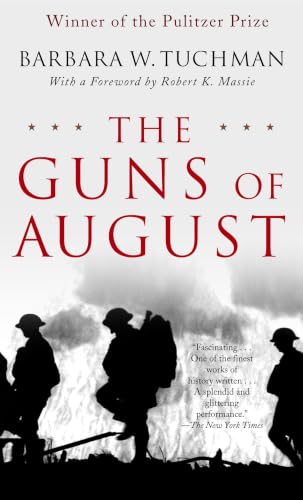
Published in 1962 and still the most widely read account of how the war began, Barbara Tuchman's book covers the first thirty days of the conflict in detail so precise it reads like a thriller. She follows the mobilisation plans, the diplomatic failures, the generals who could not deviate from pre-written schedules, and the sheer mechanical momentum that turned a crisis into a catastrophe. John F. Kennedy kept it on his desk during the Cuban Missile Crisis as a reminder of how quickly miscalculation escalates. That recommendation did not hurt its readership.
The book has critics. Some historians argue Tuchman overemphasises German aggression and underweights the structural pressures on all sides. Read it first for the narrative, then read MacMillan or Strachan for the context Tuchman compressed.
The Guns of August by Barbara Tuchman remains the essential first book on how the war started.
2. The First World War by Hew Strachan (one-volume abridgment)
Hew Strachan spent years writing a multi-volume academic history of the First World War; this is the one-volume version he condensed for general readers. It is global in scope in a way that most WWI histories are not: Strachan covers not just the Western Front but the Eastern Front, the Middle East, Africa, and the war at sea. If you want to understand why this was a world war rather than a European one, this is the book that shows you.
The Military Histories: What the War Actually Looked Like
3. The First World War by John Keegan
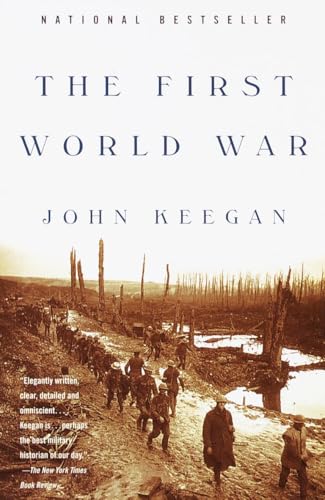
John Keegan was arguably the finest military historian of the twentieth century, and his one-volume history of the First World War is the standard against which others are measured. Keegan is particularly good on the gap between what commanders planned and what actually happened at the level of infantry in mud. He wrote the definitive account of the Battle of the Somme in an earlier book; here he places that battle in its full four-year context. The prose is clear, the analysis is unsentimental, and the book never loses sight of individual experience inside the larger operational picture.
The First World War by John Keegan is the one-volume military history most serious readers return to first.
4. Somme by Lyn Macdonald
The Battle of the Somme on 1 July 1916 produced 57,470 British casualties in a single day, the worst loss in British military history. Lyn Macdonald's account is built almost entirely from the testimony of survivors: veterans, nurses, stretcher-bearers, and chaplains who were interviewed in the decades after the war. The method produces a book that is harrowing in a way that operational histories cannot be. Macdonald does not tell you about the Somme; she puts you in it.
5. Forgotten Victory by Gary Sheffield
The standard popular narrative of the First World War treats the British Army as butchers and bunglers sending men to pointless deaths. Gary Sheffield, one of the leading British military historians of his generation, wrote this book to challenge that reading. His argument is that the British Expeditionary Force of 1918 was a different and much more effective fighting force than the one of 1916, and that the Hundred Days offensive that ended the war was one of the most significant military achievements in British history. Whether you agree with his revisionism or not, the argument is serious and well-evidenced.
The Personal Accounts: The War from Inside It
No military history, however good, captures what it was actually like to be there. These accounts do.
6. Storm of Steel by Ernst Junger
Ernst Junger served four years on the Western Front as a German officer, was wounded multiple times, and wrote this memoir in 1920 from his diaries. It is one of the most controversial books about the First World War because Junger does not moralise about the carnage. He describes combat with a cold precision that some readers find repellent and others find more honest than the outrage-laden memoirs written for a home audience. Whatever you think of Junger's political views, Storm of Steel is unlike any other account of the Western Front.
7. Goodbye to All That by Robert Graves
Robert Graves was a British officer who served at the Somme, was reported dead, survived, and wrote this memoir in 1929 primarily to raise money to leave England. It is funny in places, brutal in others, and written at the speed of a man who wanted to be done with the whole business of memory. Graves is candid about the incompetence of his own side, the class system that governed who gave the orders, and the psychological damage that followed him home. It is the most readable British officer memoir of the war.
8. All Quiet on the Western Front by Erich Maria Remarque
Fiction rather than memoir, but based so directly on Remarque's own experience as a German conscript that it functions as historical testimony. The novel follows Paul Baumer, a young German soldier, from his first enthusiasm for the war through to its conclusion. Published in 1929, it sold two and a half million copies in its first year, was banned and burned in Germany by 1933, and remains one of the most widely read antiwar novels ever written. It belongs on this list because no nonfiction account of the ordinary soldier's experience matches it for emotional truth.
All Quiet on the Western Front by Erich Maria Remarque is the novel that changed how the twentieth century thought about war.
9. The War Poems of Wilfred Owen (collected edition)
Wilfred Owen served on the Western Front, was treated for shell shock at Craiglockhart, returned to the front, and was killed one week before the Armistice in November 1918. His poems were published posthumously and now define how the English-speaking world thinks about the First World War's cost. "Dulce et Decorum Est" and "Anthem for Doomed Youth" are the most widely quoted; the less famous poems are equally important. No library on the First World War is complete without them.
The Diplomatic History: How the War Ended and What It Left Behind
10. To End All Wars by Adam Hochschild
Adam Hochschild structures his account around a central irony: many of the families who sent men to fight the First World War also contained members who publicly opposed it. He follows pairs of brothers, fathers and sons, husbands and wives who ended up on opposite sides of the question of whether the war was worth fighting. The result is a book about the moral texture of the war as much as its military conduct, and it covers the British antiwar movement in more depth than any comparable popular history.
11. Paris 1919 by Margaret MacMillan
The Paris Peace Conference of 1919 produced the Treaty of Versailles, the redrawing of the Middle East, the creation of new European states, and a set of resentments that contributed directly to the Second World War. Margaret MacMillan's account of the conference is meticulous, readable, and fair to all parties: she does not reduce Versailles to a simple story of Allied vengeance. The book is also a study of how exhausted men making decisions under enormous time pressure get things badly wrong in ways that outlast them by decades.
The Book Most Lists Miss
12. The Pity of War by Niall Ferguson
Niall Ferguson's 1998 revisionist history argues against most of the standard explanations for why the war happened, why it lasted so long, and what it achieved. His central provocation is that Britain did not need to enter the war in August 1914 and that its intervention prolonged rather than shortened the conflict. The book attracted fierce criticism from other historians, but the questions it forces you to answer are genuinely important. Read it alongside Keegan and Tuchman, not instead of them.
Three WWI Books Worth Buying Today
- The Guns of August by Barbara Tuchman — the best narrative account of how the war began, still unmatched for pace and clarity after sixty years.
- The First World War by John Keegan — the standard one-volume military history, essential for anyone who wants the full operational picture.
- All Quiet on the Western Front by Erich Maria Remarque — the novel that defined how the world thought about the ordinary soldier's experience of the Western Front.
For more history reading, see our full history collection. Our World War II reading list covers the conflict that grew directly out of the unfinished business of the first one.
Your next good book, in your inbox
We only write when we find a book worth your time. Hand-picked recommendations across history, mythology, true crime and more.
Are you an author?
Get your book in front of readers like these, for free.
- Free book listing →Your own book page with an Amazon button
- Author page →Photo, bio and links to your site
- Featured placement →A spot in our best-of lists, from €29
Free tools we recommend
Get free honest reviewsReview exchange on iWrity, free to join
Books You Might Like

Sapiens: A Brief History of Humankind
Yuval Noah Harari
The Last Kingdom (The Saxon Stories, Book 1)
Bernard Cornwell

Meditations
Marcus Aurelius

The Hiding Place
Elizabeth Sherrill, John Sherrill Corrie ten Boom