Conspiracy Theory Meaning: What It Actually Is, Where the Label Came From, and Why It Matters (2026)
The phrase "conspiracy theory" gets thrown around constantly, sometimes to describe genuine suspicion of hidden power structures, other times to shut down inconvenient questions. But what does it actually mean? Understanding the conspiracy theory meaning requires more than a dictionary entry. It demands a closer look at how the term originated, how it's been weaponized, and why millions of otherwise rational people find certain theories compelling.
Here's the thing most surface-level explanations miss: the line between a "conspiracy theory" and a proven conspiracy is often just time. Governments have conducted secret experiments on their own citizens. Corporations have buried evidence of harm for decades. Intelligence agencies have toppled elected leaders abroad. These aren't theories, they're documented historical events that were once dismissed as paranoid fantasy.
That gray zone between dismissal and discovery is exactly why we publish the books we do at Skriuwer. As an independent publisher specializing in non-mainstream literature and untold history, we exist because certain stories don't get a fair hearing through conventional channels. We don't ask readers to believe everything, we ask them to think critically about everything.
This article breaks down what a conspiracy theory actually is, where the term comes from, the psychology behind why people believe them, how to tell the difference between speculation and substantiated conspiracy, and why that distinction matters more than ever. Whether you're a skeptic, a curious reader, or someone who simply wants a straight answer without the spin, you're in the right place.
Why the meaning of conspiracy theory matters
Words shape how you think. When a term gets used carelessly, or deliberately, to dismiss, mock, or silence, it stops being a neutral descriptor and becomes a tool of control. The conspiracy theory meaning has shifted dramatically over the past 60 years, and understanding that shift tells you something important about how public discourse works. This isn't a minor semantic debate. How you define something determines whether you investigate it or ignore it, and that has real consequences.
The word carries real weight
Language frames your reality before you even realize it. Call something a "conspiracy theory" and you've already loaded the conversation with skepticism, even if the claim hasn't been examined yet. That's not an accident. The phrase signals to listeners that they should discount what follows, regardless of what evidence might support it. Researchers studying political communication have noted this framing effect for decades, and it applies whether the topic is pharmaceutical trials, government surveillance, or corporate fraud.
The label "conspiracy theory" has become one of the most effective tools for stopping a conversation before it starts.
You've probably seen this in action. Someone raises questions about a corporate cover-up, a political decision, or an unexplained historical event, and the response isn't to examine the evidence. The response is to invoke the label and move on. That pattern is worth noticing, because it conflates two very different things: baseless speculation and genuine, evidence-based questioning of authority.
How the label gets used as a weapon
The CIA formally promoted the term "conspiracy theory" as a rhetorical tool in the 1960s, specifically to undercut criticism of the Warren Commission's findings on the Kennedy assassination. A 1967 CIA dispatch encouraged agents and media contacts to use the label against skeptics. This is documented. It's not speculation. And it fundamentally changed how Western media and political culture responded to dissent.
That history matters because it means you're operating inside a system where the term was designed to protect powerful institutions from scrutiny. That doesn't mean every conspiracy theory is true. It means you need to understand the loaded history of the phrase before you can use it accurately. Getting the conspiracy theory meaning right isn't pedantic. It's the foundation of clear thinking.
Getting the definition right changes how you think
Once you understand that the term carries political and historical baggage, you start asking better questions. Instead of asking "is this a conspiracy theory?" you start asking "what evidence exists, who benefits from suppressing it, and what's the track record of the source making the claim?" Those are more productive questions, and they're more honest.
Accurate definitions protect you from two kinds of error: dismissing something real because it sounds fringe, and accepting something false because it feels like suppressed truth. Both errors are common, and both are costly. The first can leave you blind to genuine wrongdoing. The second can lead you down paths that distort your understanding of the world and erode your ability to trust legitimate information.
At Skriuwer, we publish books that sit in exactly this contested space, titles that question official histories, examine suppressed research, and document events that mainstream publishers avoid. We don't publish fiction dressed as fact, but we do believe that the reflex to label and dismiss is one of the more damaging habits in modern public life. Understanding what a conspiracy theory actually is, rather than what the label implies, is where that habit starts to break down.
What a conspiracy theory is in plain English
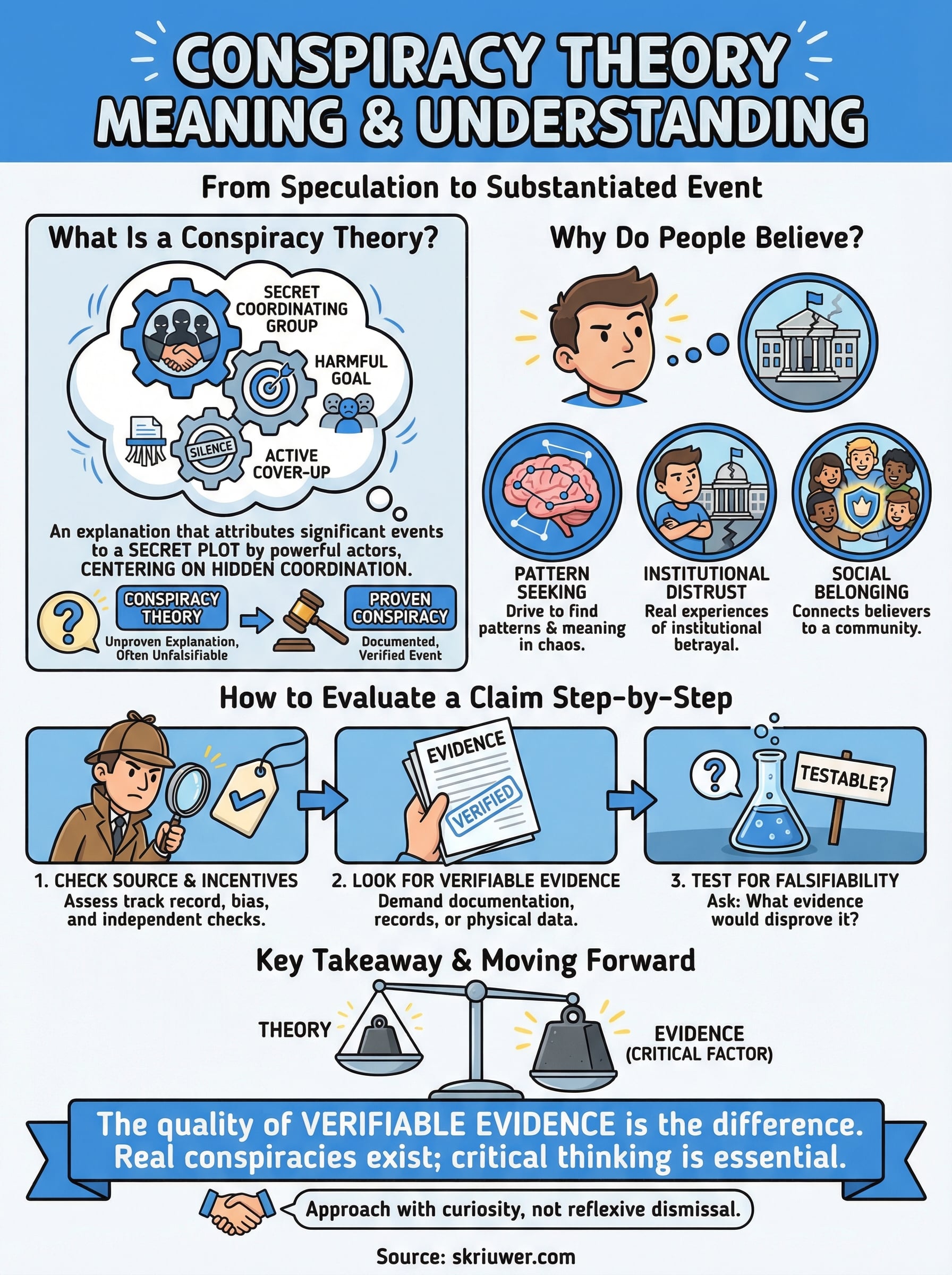
A conspiracy theory, stripped of its political baggage, is an explanation that attributes a significant event or ongoing situation to a secret plot organized by a group of powerful actors who are deliberately concealing their role from the public. The explanation doesn't have to be false to qualify as one. It simply needs to center on hidden coordination between parties working against the general interest while covering their tracks. That is the conspiracy theory meaning at its most basic, before any judgment about truth or credibility enters the conversation.
The core definition broken down
Researchers who study conspiracy theories formally point to three recurring components: a secret coordinating group, a goal that harms ordinary people while benefiting the conspirators, and a cover-up that prevents the public from discovering what's actually happening. The group can be a government, a corporation, an intelligence agency, or any combination of powerful institutions. The cover-up component matters most because it's what makes these theories so resistant to standard scrutiny. Any absence of confirming evidence doesn't weaken the theory; it gets absorbed into the narrative as proof that the concealment is working.
A conspiracy theory doesn't invite you to trust the official account. It starts from the assumption that the official account is incomplete, distorted, or entirely manufactured.
This internal logic is what separates a conspiracy theory from a standard alternative hypothesis. A regular alternative hypothesis invites testing, adjusts when contradicting evidence appears, and treats disconfirmation as useful data. A conspiracy theory, by design, folds counter-evidence back into itself, treating it as further confirmation that powerful forces are actively suppressing the truth. That self-sealing quality makes these theories remarkably difficult to challenge through facts alone, which is something worth understanding before you attempt it.
What the term does not mean
Understanding the conspiracy theory meaning also requires knowing what the term does not imply. It does not mean the claim is automatically false. Confirmed historical conspiracies, including government medical experiments on civilians without consent and coordinated industry campaigns to suppress research on product dangers, were once dismissed as exactly this kind of thinking. The term describes a structure of belief, specifically one that centers on secret harmful coordination, but it says nothing definitive about accuracy. When you hear someone labeled a conspiracy theorist, you learn something about how they interpret events, but you learn nothing about whether their conclusion is right or wrong.
The five elements that show up in most theories
Studying the conspiracy theory meaning across different research traditions reveals a consistent pattern. Whether the theory involves pharmaceutical companies, government agencies, or shadowy global elites, the same structural elements appear repeatedly. Recognizing these elements doesn't tell you whether a given theory is true or false, but it does help you identify how the theory works and where its weak points are.
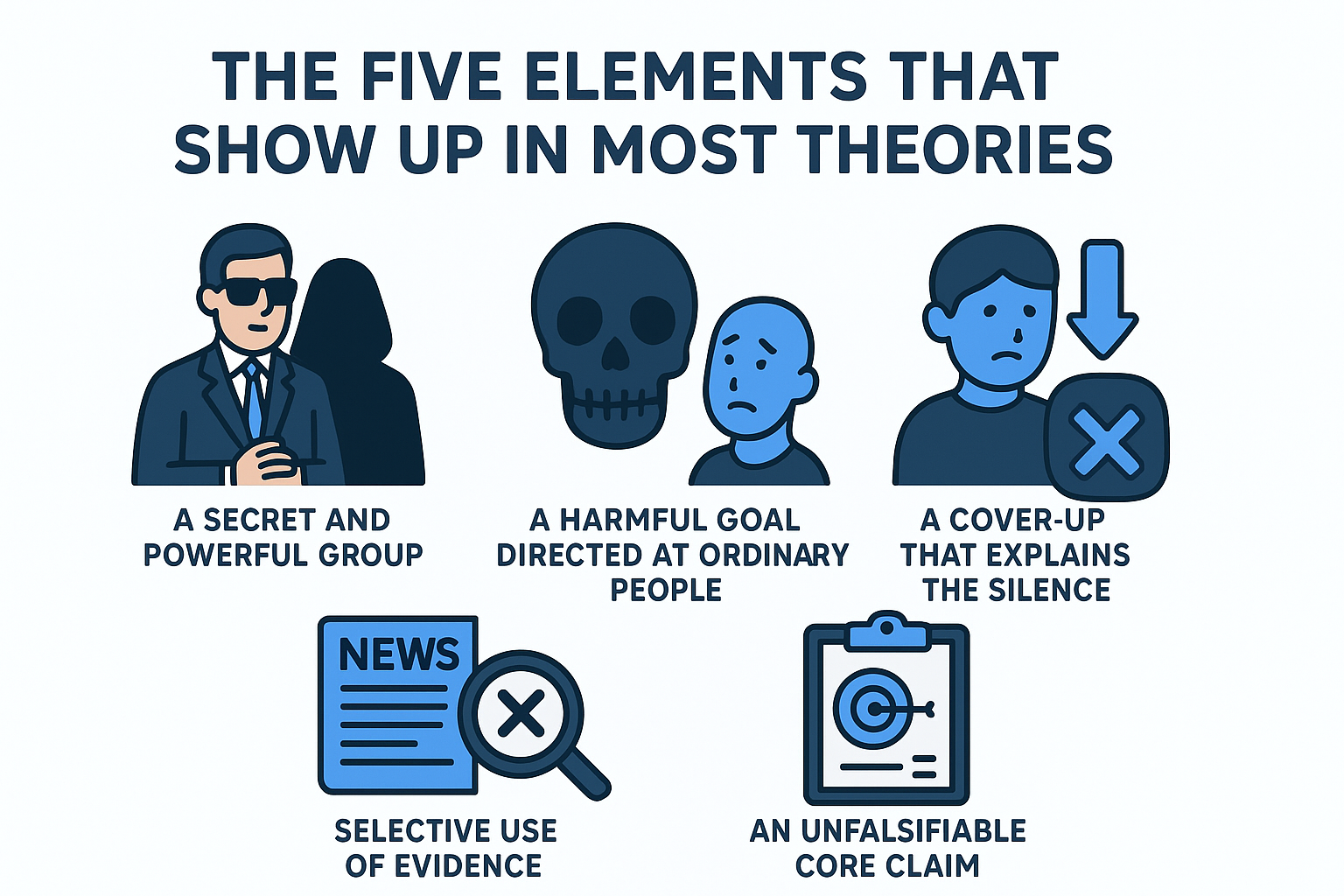
A secret and powerful group
Every conspiracy theory starts with a coordinating group that operates out of public view. This group has the resources, the connections, and the motive to pull off something large-scale without getting caught. The group is almost always portrayed as more organized and more competent than any real-world institution actually operates, which is one of the first things worth examining when you encounter a new theory.
A harmful goal directed at ordinary people
The conspirators aren't just secretive, they're malicious. The theory requires a clear victim class, usually the general public, a specific community, or humanity as a whole. This element is what gives conspiracy theories their emotional force. Believing you're being deliberately harmed by hidden forces generates urgency and a sense of moral clarity that keeps believers engaged and resistant to alternative explanations.
The combination of a powerful hidden enemy and a vulnerable victim population is what makes conspiracy theories feel so personally urgent to the people who hold them.
A cover-up that explains the silence
If the conspiracy is real, why isn't it everywhere in the news? The cover-up element answers that question before it's even asked. Mainstream media, official institutions, and credentialed experts get folded into the conspiracy itself, which means their silence or denial becomes confirmation rather than counter-evidence. This self-sealing mechanism is the hardest structural feature to argue against directly.
Selective use of evidence
Conspiracy theories don't ignore evidence entirely. They select what fits and reframe everything that doesn't. A document that contradicts the theory gets dismissed as fabricated. A source who disagrees becomes a paid operative. This selective processing produces a picture of certainty that doesn't survive open scrutiny, even when it feels airtight from the inside.
An unfalsifiable core claim
The fifth element ties the others together. The central claim cannot be disproven because any attempt to disprove it gets absorbed into the cover-up narrative. This is what separates a conspiracy theory structurally from a legitimate investigation, where disconfirming evidence actually changes the conclusion rather than reinforcing it.
Conspiracy vs conspiracy theory: key differences
The words "conspiracy" and "conspiracy theory" get treated as synonyms in casual conversation, but they describe fundamentally different things. A conspiracy is a real, documented event where people secretly coordinate to achieve something illegal or harmful. A conspiracy theory is an explanation or belief about events that may or may not reflect what actually happened. Collapsing the two together is one of the most common errors you'll make when trying to evaluate a claim, and it tends to push you toward the wrong conclusion in both directions.
Treating "conspiracy" and "conspiracy theory" as the same thing is how you end up either believing everything or dismissing everything.
When a conspiracy is just a conspiracy
A conspiracy requires actual evidence of coordination: documents, testimony, financial records, or some other verifiable trail. The Watergate break-in was a conspiracy. The tobacco industry's decades-long campaign to hide the health effects of smoking was a conspiracy. Both involved real people making deliberate, secret decisions to deceive the public, and both were proven through investigation, not speculation. You don't call these "conspiracy theories" once the evidence lands on the table. At that point, they're established historical facts about coordinated wrongdoing, not theories.
Conspiracies happen regularly at every level of society, from corporate boardrooms to government agencies. They don't require vast numbers of participants. In fact, most proven conspiracies involve relatively small groups who kept the circle tight to reduce exposure risk. When you understand this, the word "conspiracy" stops feeling inherently implausible and starts functioning as the precise, evidence-based descriptor it actually is.
Why the distinction changes how you evaluate claims
Understanding the conspiracy theory meaning properly means recognizing that the key variable is evidence, not plausibility. A conspiracy theory becomes a confirmed conspiracy the moment sufficient verifiable evidence comes forward. The theory itself doesn't change. What changes is the evidentiary foundation beneath it. That shift from speculation to documentation is exactly what separates the two categories.
When you encounter a new claim, the productive question isn't "does this sound like a conspiracy theory?" That framing pre-loads your judgment before you've examined anything. The better question is "what verifiable evidence supports or contradicts this specific claim?" Keeping that question central respects the real distinction between the two terms, grounds your thinking in what can actually be demonstrated, and protects you from reflexive belief and reflexive dismissal alike.
When conspiracies are real and why that matters
Real conspiracies are not rare historical oddities. They happen at every level of institutional power, and the documented evidence for them sits in government archives, court records, and congressional testimony. The conspiracy theory meaning debate often gets stuck on fringe claims, but understanding what makes a conspiracy real is just as important as understanding what keeps a theory firmly in the realm of speculation. Knowing the difference starts with examining the historical record, not with deciding in advance what sounds plausible.
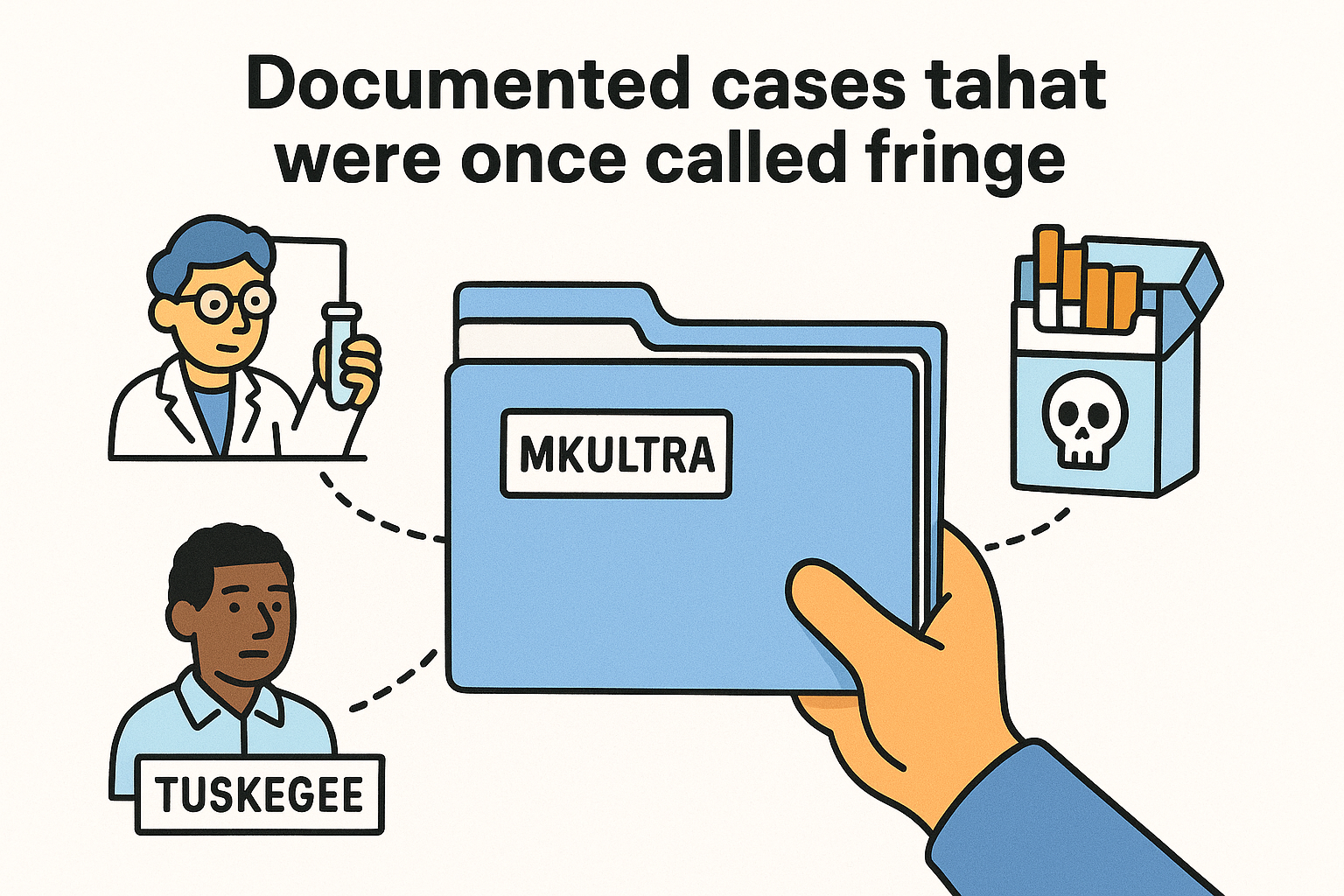
Documented cases that were once called fringe
The U.S. government's MKUltra program ran covert mind-control experiments on American citizens without their knowledge or consent for over two decades. When researchers and journalists first raised questions about it, the response was dismissal. Congress confirmed its existence in 1977 through Senate hearings and declassified government documents. Similarly, the tobacco industry's internal research showed executives knew nicotine was addictive and cigarettes caused cancer years before that information reached the public. Both cases were coordinated, secretive, and deliberately designed to deceive.
Real conspiracies don't become real because someone believed strongly enough. They become real because evidence eventually surfaces that can be independently verified.
Other confirmed examples include:
- COINTELPRO: The FBI's secret program to surveil, infiltrate, and disrupt domestic political organizations from 1956 to 1971
- Operation Northwoods: A declassified 1962 U.S. military proposal to stage false flag attacks to justify war with Cuba
- The Tuskegee Syphilis Study: A 40-year U.S. Public Health Service program that withheld treatment from Black men to study disease progression without their informed consent
None of these were revealed by people who simply had a hunch. Each was confirmed through documentation, whistleblowers, or formal official investigations that produced verifiable evidence. The single most-contested case in this entire territory, of course, is the assassination of John F. Kennedy in 1963, where the gap between the Warren Commission's official conclusion and the alternative literature has occupied serious readers for sixty years; the ranked best books about the JFK assassination sorts that vast literature by school of thought so you can read across the disagreement instead of being swept into one camp by the first book you happen to open.
Why this changes how you approach new claims
Understanding that real conspiracies exist forces you to apply a more careful standard when evaluating unfamiliar claims rather than a reflexive one. The goal is not to believe everything or accept nothing. It is to ask what verifiable evidence the claim rests on, who has investigated it independently, and whether the source benefits from making you believe it.
Knowing governments and corporations have hidden harmful programs for decades means blanket dismissal stops being a reasonable response. What you need instead is a clear method for distinguishing documented wrongdoing from unsupported speculation, and that method begins with understanding why people find these theories compelling in the first place.
Why people believe conspiracy theories
People don't believe conspiracy theories because they are unintelligent or irrational. The psychological and social mechanisms behind belief are well-documented, and they apply to virtually everyone under the right conditions. Understanding the conspiracy theory meaning at a psychological level means recognizing that belief isn't random. It follows predictable patterns rooted in how human cognition actually works, which is why dismissing believers as simply gullible rarely moves the conversation anywhere useful.
The drive to find patterns and meaning
The human brain is built to detect patterns. This ability kept your ancestors alive, helping them identify threats before those threats became fatal. The problem is that the same cognitive system that serves you in genuine danger situations also generates false positives. When something significant and confusing happens, like a political assassination, a financial collapse, or a pandemic, your brain looks for a cause that matches the scale of the event. A single unstable person or a naturally occurring virus feels like an inadequate explanation for something that changed millions of lives. A coordinated, powerful hidden group feels like a more proportionate answer, even when the evidence doesn't support it.
Researchers call this proportionality bias: the tendency to assume that large events must have large, intentional causes.
Distrust built from real experience
Institutional betrayal is not imaginary. Governments have lied to their citizens. Corporations have concealed evidence of harm for profit. Intelligence agencies have operated secret programs that violated civil rights. When you or someone you trust has experienced the cost of relying on an institution that later proved dishonest, the reflex to question official accounts isn't paranoia. It is a learned response with a rational basis, even if it sometimes gets applied too broadly and in directions the evidence doesn't support.
Research consistently shows that people with prior experience of institutional deception score higher on measures of conspiracy belief. That connection is logical. The issue isn't that distrust exists. The issue is that generalized distrust without a method for evaluating individual claims produces errors just as significant as naive trust does.
Social identity and belonging
Believing a particular theory connects you to a community of people who share your framework for making sense of the world. That social function is separate from the factual content of the belief. Research in social psychology shows that group identity reinforces belief more powerfully than evidence in either direction, which means correcting someone's facts rarely changes their mind when the belief is tied to who they understand themselves to be. The theory provides not just an explanation but a sense of purpose, membership, and significance that straightforward information rarely offers.
How conspiracy theories spread and evolve online
The internet didn't invent conspiracy theories, but it fundamentally changed how fast they travel and how deeply they embed themselves in communities. What once took years to circulate through pamphlets and word of mouth now spreads globally within hours. Understanding this dynamic is a core part of grasping the full conspiracy theory meaning in the modern context, because a theory that nobody encounters stays harmless while one that reaches millions shapes how people vote, what they buy, and who they trust.
Why algorithms amplify fringe ideas
Recommendation systems on major platforms are built to maximize engagement, not accuracy. Content that provokes strong emotions, fear, outrage, and suspicion performs better in algorithmic rankings than content that is measured or uncertain. This means a conspiracy video or post that triggers strong reactions gets pushed to more users faster than a careful, evidence-based piece that reaches a more moderate conclusion. You don't have to search for fringe content for it to find you. The platform does that work on your behalf.
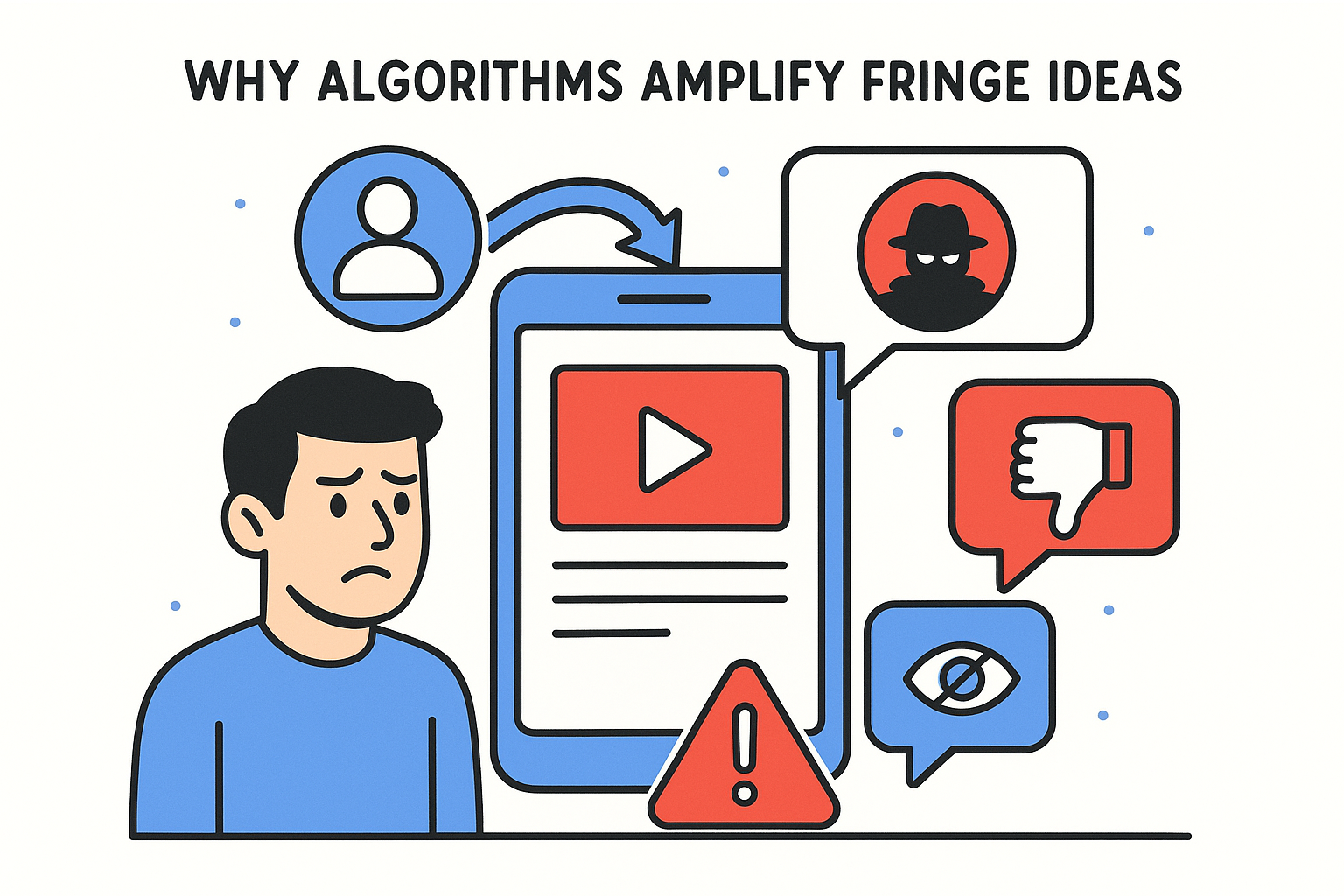
Algorithms optimize for time-on-platform, and conspiracy content is exceptionally good at holding attention precisely because it generates anxiety that demands resolution.
Research has shown that users on major video platforms can move from mainstream political content to increasingly extreme material within a small number of automatic recommendations. Each step feels like a minor shift, but the cumulative drift can be significant. By the time someone reaches genuinely false or harmful content, the journey there felt natural and logical, which makes the destination harder to question.
How theories mutate as they travel
A conspiracy theory rarely stays fixed as it spreads. Each person who shares it adds context, adjusts details, or fuses it with a separate theory they already believe. This process produces hybrid narratives that are more personalized and therefore more persuasive to specific communities. The original claim might focus on one institution, but by the third or fourth wave of sharing, it has absorbed adjacent grievances and grown into something broader and harder to pin down.
This mutation also makes direct refutation difficult. By the time a fact-check reaches a theory, the theory has often already changed shape, meaning the correction addresses a version most believers no longer hold. You end up correcting yesterday's claim while today's version continues circulating unchallenged. Recognizing this drift matters if you ever want to engage with someone who holds a belief that has clearly evolved far from its original source.
What conspiracy theories do to trust and behavior
Understanding the full conspiracy theory meaning requires looking past the beliefs themselves and examining what happens to people who hold them over time. Conspiracy theories don't just sit quietly in someone's head. They actively reshape how that person relates to institutions, other people, and information. The effects run deeper than most casual observers expect, and they operate at both the individual and the collective level.
How belief erodes institutional trust
When someone accepts a conspiracy framework, every institution connected to the supposed cover-up loses credibility in that person's eyes simultaneously. Doctors, journalists, scientists, and elected officials get folded into the same narrative of coordinated deception. This wholesale distrust is qualitatively different from healthy skepticism. Healthy skepticism evaluates each institution and claim separately, adjusting as evidence shifts. Conspiratorial distrust operates as a package deal: once you accept the framework, you inherit a preset list of who to distrust and why.
The problem isn't distrust itself. It's the replacement of case-by-case evaluation with a fixed worldview that treats all official sources as suspect by default.
Research on public health behavior shows this effect clearly. Communities with high rates of institutional distrust, often built on real historical grievances, show significantly lower uptake of medical interventions, even ones with strong evidence of safety and benefit. The distrust that started with a specific betrayal generalizes outward until it covers institutions that had no role in the original harm.
How theories change what people do
Belief in conspiracy theories doesn't stay theoretical. It translates directly into changed behavior, sometimes in ways that hurt the believer and the people around them. People who accept claims about hidden dangers in standard medical treatment delay or avoid care. Those who believe elections are systematically manipulated disengage from civic participation entirely. The conspiracy theory meaning, at this level, is less about what's true and more about what the belief makes someone do differently.
This behavioral dimension is why the stakes are real. Someone who stops trusting a particular politician affects only their own vote. Someone who stops trusting all medical advice, based on a theory that treats every contradicting study as fabricated, faces a different risk profile entirely. Behavior follows belief, which is why the quality of the beliefs you hold about powerful institutions has direct consequences for decisions you make every day.
How to evaluate a conspiracy claim step by step
Applying the conspiracy theory meaning correctly requires more than knowing the definition. You need a repeatable method for assessing specific claims, one that protects you from reflexive dismissal and uncritical acceptance simultaneously. The steps below work regardless of how the claim sounds on the surface, because how a claim sounds tells you nothing about whether it holds up under scrutiny.
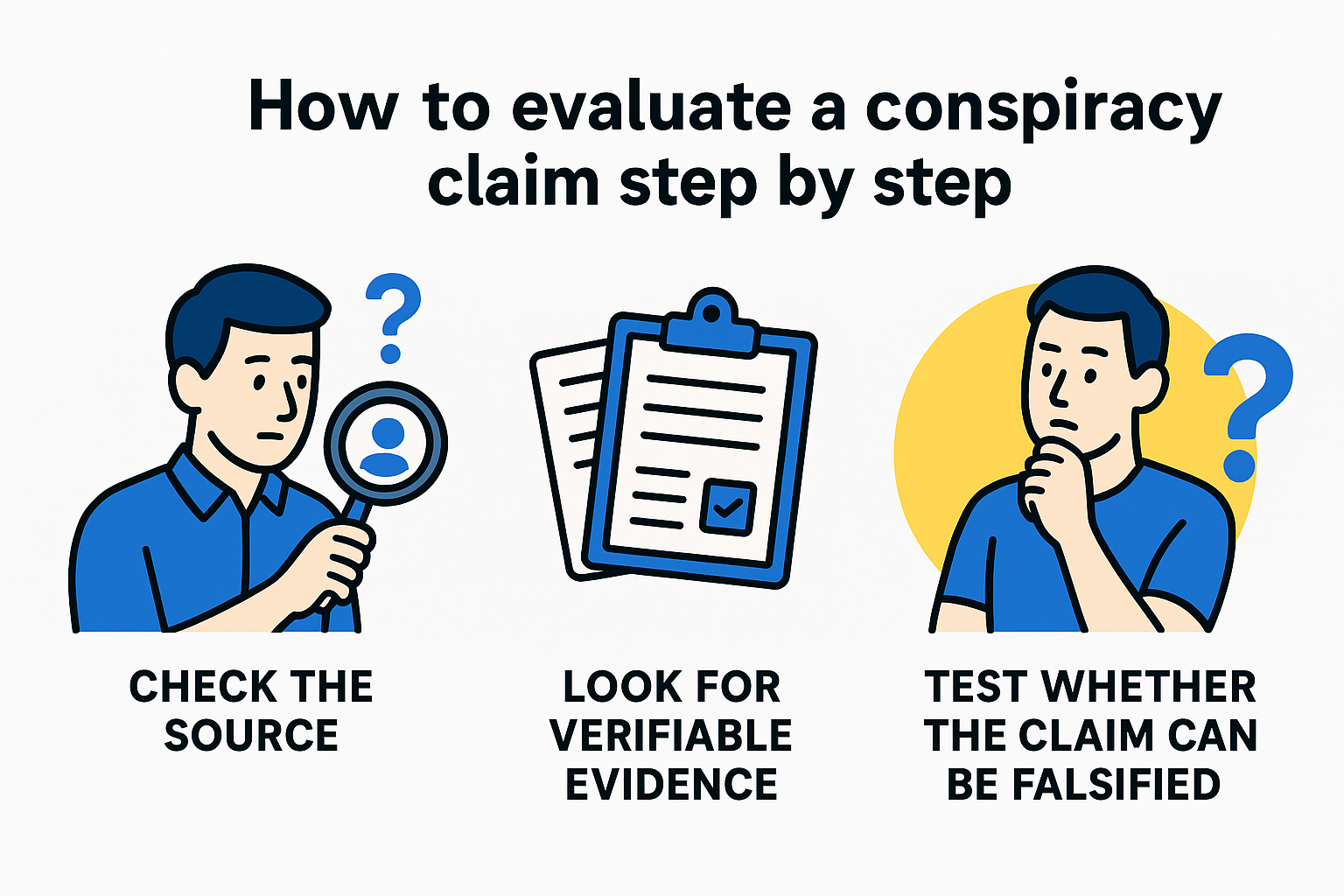
Check the source and its incentives
Start by identifying who is making the claim and what they stand to gain from you believing it. A source that profits financially, politically, or socially from spreading a particular narrative deserves additional scrutiny, not automatic rejection, but harder questions. Ask whether the source has a track record of accuracy across other claims, not just the one currently in front of you. A single credible detail does not validate an entire framework, and a single error does not invalidate everything a source has ever said.
Look into whether independent outlets, researchers, or investigators have examined the same claim and reached different conclusions. Independent corroboration is one of the strongest signals that something deserves serious attention rather than a dismissive wave.
Look for verifiable evidence
Evidence that only exists inside the theory, accessible only to believers, is not evidence you can actually evaluate.
Verifiable evidence means documents, records, testimony, or physical data that someone outside the theory's community can independently examine. Ask whether the claim rests on named sources with a documented track record, or on anonymous insiders who cannot be confirmed. A claim supported only by other unverified claims is a chain with no anchor, and pulling on any link reveals that nothing is actually holding it together. Peer-reviewed research, government documents obtained through freedom of information requests, and court records all meet the threshold. Viral videos and anonymous forum posts generally do not.
Test whether the claim can be falsified
This step separates genuine inquiry from unfalsifiable belief. Ask what evidence would change your mind about the claim if it existed. If no answer comes to you, or if every possible counter-example gets absorbed into the cover-up narrative, you are no longer evaluating a claim. You are operating inside a closed system designed to be immune to challenge. Identifying that structure early saves you significant time and helps you locate what the actual evidence shows versus what the theory needs you to believe.
How to talk to someone who believes a theory
Changing someone's mind about a conspiracy belief is rarely a matter of presenting better information. Research in social psychology consistently shows that direct contradiction tends to backfire, causing people to hold their original position more tightly rather than reconsider it. Understanding the conspiracy theory meaning at a human level means accepting that belief is about more than facts, which is why the most effective conversations start with connection rather than correction.
Focus on the relationship, not the debate
Before you say anything about the theory itself, recognize that the person in front of you is not their belief. Treating someone as foolish or gullible for holding a particular view shuts the conversation down immediately. Your goal is to keep the dialogue open, and that requires separating your assessment of the claim from your respect for the person making it. People change their minds most reliably in environments where they feel safe, not attacked.
The fastest way to end a productive conversation is to make the other person feel stupid for starting it.
Ask questions instead of presenting counter-evidence
Questions accomplish something that counter-evidence rarely does: they invite the other person to examine their own reasoning rather than defend against yours. Ask how they first encountered the claim, what would change their mind if anything could, and which sources they find credible outside of the theory's community. These questions don't signal that you agree, but they do signal that you're genuinely curious rather than dismissive, which is the condition most likely to produce honest reflection.
Specific questions that tend to open rather than close the conversation include asking what evidence originally convinced them, whether they've looked for information that contradicts the claim, and what the theory predicts should happen next. That last question is particularly useful because unfalsifiable theories tend to make vague or everchanging predictions, and noticing that pattern can be more persuasive than any external fact you bring in.
Know when to step back
Not every conversation will move anywhere useful, and pushing harder when someone has stopped engaging only damages the relationship without changing the belief. Recognize when you've reached that point and let the conversation rest. Continued contact over time, built on genuine respect, does more to shift someone's framework than a single exhausting argument ever will. Your long-term presence as someone who reasons carefully matters more than winning any individual exchange.
Key takeaways
The conspiracy theory meaning comes down to one core idea: an explanation that attributes significant events to secret, harmful coordination by powerful actors who are actively hiding their role. That structure alone tells you nothing about whether the claim is true or false. Real conspiracies exist and have been proven through documentation, whistleblowers, and formal investigations. The difference between a confirmed conspiracy and an unproven theory is always the quality of the verifiable evidence underneath it.
People believe these theories for reasons rooted in genuine cognitive patterns, real institutional betrayal, and social belonging, not stupidity. Evaluating a claim well means checking sources, demanding verifiable evidence, and testing whether the claim can actually be falsified. Talking to someone who holds a conspiracy belief works better when you lead with curiosity rather than correction. If you want to go deeper on the histories and controversies that sit at the edge of the official record, explore our full catalog at Skriuwer.
Recommended Reading
Want to explore conspiracy theories in more depth? These curated lists go further:
- The best books on MK-Ultra and CIA mind control, a documented case study of state-level secret coordination.
- The 9 best books about cults, on the smaller-scale undue-influence groups that operate by similar mechanisms.
- 12 dark history facts most people were never taught, the wider context for how official narratives get constructed.
- The best books about secret societies, which separates the documented institutional histories (Freemasons, Templars, Skull and Bones) from the conspiracy-theory inventions that look identical from outside.
Your next good book, in your inbox
We only write when we find a book worth your time. Hand-picked recommendations across history, mythology, true crime and more.
Books You Might Like


Behold! a Pale Horse
Milton Cooper

Manufacturing Consent: The Political Economy of the Mass Media
Noam Chomsky and Edward S. Herman
