What Is Eugenics? The American Roots, the Nazi Endgame, and Why It Still Matters (2026)
If you've ever asked what is eugenics, the short answer is this: it's the belief that humanity can be "improved" through selective breeding, deciding who should reproduce and who shouldn't. The longer answer is far darker. Eugenics shaped immigration law in the United States, justified forced sterilizations of tens of thousands of Americans, and handed Nazi Germany a blueprint for some of the worst atrocities in recorded history.
Yet for a movement with such far-reaching consequences, eugenics rarely gets the full, honest treatment it deserves in mainstream accounts. The connections between American eugenics programs and Nazi racial policy are well-documented by historians but remain largely absent from popular education. That's exactly the kind of gap Skriuwer exists to fill, we publish and distribute books that confront uncomfortable history head-on, without sanitizing it for mass appeal.
This article breaks down the origins of eugenics, traces its implementation across the U.S. and Germany, examines its deep ties to scientific racism, and asks where these ideas stand now. You'll find no softened version of events here. From compulsory sterilization laws to modern genetic ethics debates, the goal is to give you a complete, unfiltered account, the kind of history that deserves to be read, discussed, and remembered.
Why eugenics still matters today
Understanding what is eugenics isn't a purely academic exercise. The programs that carried out forced sterilizations and racially motivated restrictions on reproduction were dismantled, but the thinking behind them didn't simply vanish when the laws changed. Ideas about human worth tied to genetics have resurfaced repeatedly in political language, scientific debates, and social policy since World War II, sometimes openly, more often dressed in new terminology.
The ideas didn't disappear with the programs
After the Nazi defeat in 1945, eugenics became a term most institutions distanced themselves from publicly. But researchers who had worked within eugenic frameworks often continued their careers under rebranded fields. "Population control," "genetic counseling," and "human betterment" became the new language carrying similar assumptions about which populations should grow and which should not. Academic journals that had published explicit eugenics research quietly shifted their focus without fully rejecting the underlying premises.
The continuity isn't just theoretical. Coercive sterilization of marginalized groups, including Indigenous women in the United States and Canada, continued well into the 1970s, often carried out without genuine informed consent. These weren't fringe acts performed by rogue actors. They happened inside established medical systems backed by institutional authority, which is exactly why you need to understand where those medical and political systems came from before you can evaluate where they stand now.
The line between historical eugenics programs and later coercive population policies is far shorter than most official histories acknowledge.
Genetic technology brings old questions back
Advances in genetic screening, gene editing, and embryo selection have made eugenics relevant in ways the original movement could not have anticipated. Technologies like CRISPR allow scientists to modify genetic sequences with a precision that was unthinkable a generation ago. Prenatal screening now lets parents detect a wide range of conditions before birth, raising hard questions about which lives are considered worth living and who gets to make that call.
These aren't hypothetical dilemmas waiting for a future that hasn't arrived. Reproductive clinics already offer testing panels covering dozens of conditions, some life-threatening, others minor or simply associated with non-conforming traits. When you layer commercial incentives and cultural biases onto those choices, the pattern starts to look less like individual medical decision-making and more like a soft, market-driven form of selection. Historians and bioethicists have used the term "neo-eugenics" to describe exactly this dynamic.
Why this history belongs in your reading
Most people learn about eugenics, if they learn about it at all, through a narrow lens: Nazi Germany, discredited science, and a closed chapter of the past. That framing misses the American origins of many Nazi racial policies, the persistence of coercive sterilization programs long after the war, and the way current biotechnology reopens questions that were never fully settled in the first place.
Reading the full history gives you the context to evaluate modern debates honestly, whether those debates concern genetic screening, immigration restriction, or disability rights. Without that context, you're working from an incomplete record, one that leaves out the most consequential parts. The sections ahead trace exactly how eugenics moved from a fringe idea to state-sponsored policy on two continents, and what the evidence shows about where it led.
How eugenics takes shape in policy and practice
When you ask what is eugenics in practical terms, the answer lies in how governments translated the theory into specific rules controlling reproduction, immigration, and social participation. The movement didn't stay confined to university lecture halls. It moved into legislatures, courtrooms, and hospitals, where it became official policy backed by the full authority of the state.
Laws that targeted reproduction and immigration
Compulsory sterilization laws represent the most direct form of eugenics in practice. The United States passed the first such law in Indiana in 1907, and by the 1930s, more than thirty states had enacted similar legislation. Courts enforced these laws against people labeled "feebleminded," epileptic, or criminally deviant, categories applied disproportionately to poor people, immigrants, and racial minorities. The 1927 Supreme Court decision in Buck v. Bell upheld compulsory sterilization as constitutional, with Justice Oliver Wendell Holmes writing that "three generations of imbeciles are enough." That ruling was never overturned.
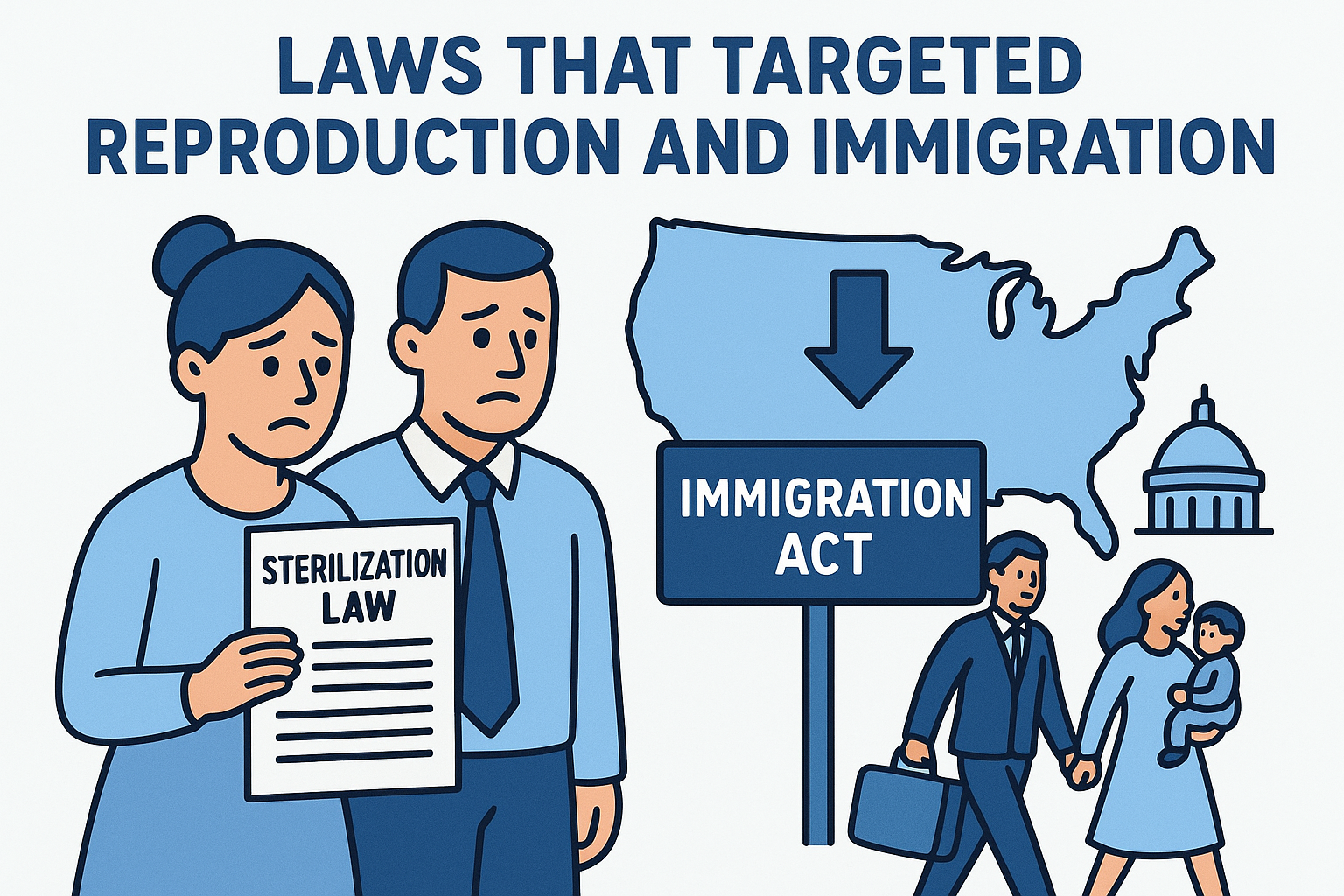
The legal machinery of eugenics did not disappear after World War II. Buck v. Bell remains technically valid precedent in the United States.
Eugenics also shaped who was allowed to enter the country at all. The Immigration Act of 1924 set strict quotas based on national origin, drawing explicitly on eugenic arguments about which ethnic groups carried "desirable" traits. Lawmakers cited figures like Madison Grant and Charles Davenport, who argued that immigration from Southern and Eastern Europe would dilute the population's genetic quality. This wasn't fringe thinking at the time. It received prominent coverage in mainstream newspapers and serious treatment in academic journals.
How institutions carried out eugenic policy
State institutions for people with mental illness or intellectual disabilities became sites of systematic eugenic enforcement throughout the first half of the twentieth century. Residents were often sterilized without their knowledge or any genuine form of consent. Physicians and administrators carried out these procedures under the protection of state law and professional norms, which meant there was rarely any legal accountability for what happened inside those facilities.
You can draw a direct line from the academic theories discussed in universities to the operating rooms where those theories were applied to people who had no meaningful way to object. The gap between eugenic ideology and eugenic practice was often just a signed order from a state official. Understanding that gap matters, because it tells you exactly how quickly a set of ideas can become a system of harm when institutions choose to adopt them.
Where eugenics came from and how it spread
To understand what is eugenics at its root, you need to go back to Victorian England and one man's ambition to apply livestock breeding logic to human beings. The movement didn't emerge from a fringe corner of science. It came from the mainstream academic establishment and spread because institutions gave it credibility and funding.
Francis Galton and the founding idea
Francis Galton, a cousin of Charles Darwin, coined the term "eugenics" in 1883 from the Greek meaning "well-born." Galton believed that human intelligence, character, and social fitness were largely inherited, and that society could improve itself by encouraging reproduction among people with "desirable" traits while discouraging it among those deemed inferior. He called these approaches "positive" and "negative" eugenics. His ideas attracted serious academic attention almost immediately, and by the early twentieth century, eugenics had chairs at major universities and dedicated research institutions in both Britain and the United States.
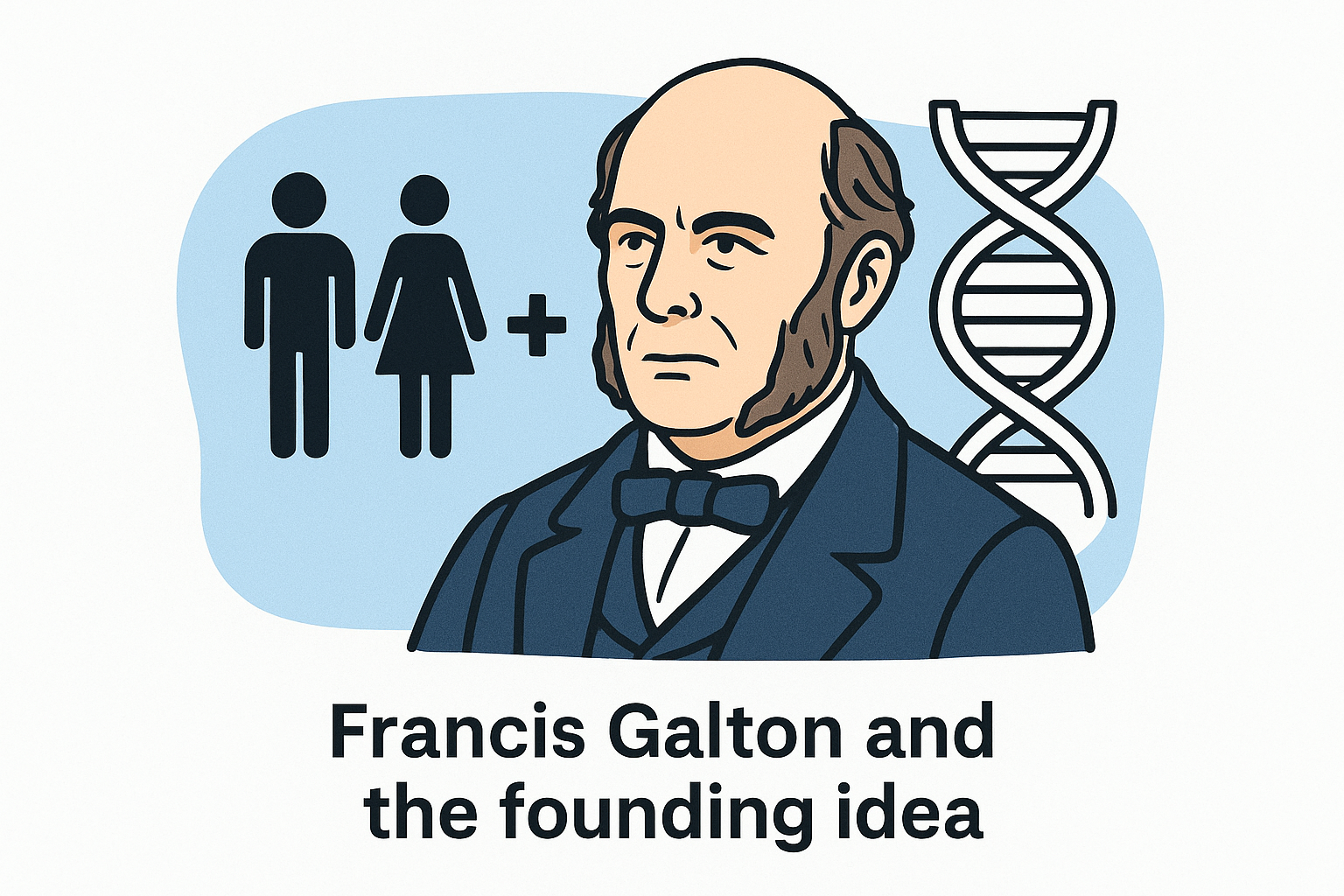
Galton built his theory on selective data and circular reasoning, yet the institutional prestige attached to his name gave his conclusions an authority they had never earned.
How eugenics crossed borders
The movement spread through a combination of scientific publishing, international conferences, and political lobbying. Researchers in the United States, Germany, Scandinavia, and Brazil all adopted eugenic frameworks and adapted them to their own national contexts. The First International Eugenics Congress was held in London in 1912, drawing delegates from across Europe and North America. These gatherings formalized the exchange of research and gave national programs a sense of shared scientific legitimacy.
In the United States, the Eugenics Record Office at Cold Spring Harbor became the central hub for collecting family pedigrees and pushing for state-level legislation. Its director, Charles Davenport, corresponded directly with German researchers who were building their own racial hygiene programs. This wasn't a coincidence. American eugenicists actively promoted their methods abroad, and German scientists cited American laws and institutions when arguing for their own policies in the 1930s. The ideas traveled in both directions, with each country watching the other's legislative experiments and borrowing what suited its political goals. By the time the movement reached its peak in the 1930s, eugenics was no longer a theory circulating in academic journals. It was a set of active government programs operating on three continents.
How eugenics operated in the United States
Understanding what is eugenics in the American context means looking past the theoretical and into the concrete institutions, laws, and individuals that made it a functioning system. The United States didn't just debate eugenics in lecture halls. It built dedicated research centers, passed enforceable legislation, and sterilized tens of thousands of people in state-run facilities, all before the Nazi regime applied comparable methods in Germany. That sequence matters.
The institutions that built the movement
The Eugenics Record Office at Cold Spring Harbor, New York, founded in 1910 and funded largely by the Carnegie Institution and the Harriman railroad fortune, served as the operational center of American eugenics. Its staff collected family pedigree data from across the country, building a database that researchers and legislators used to push for sterilization laws and immigration restriction. Charles Davenport, who directed the office, framed poverty, criminality, and mental illness as inherited defects to be eliminated through selective policy, not as outcomes shaped by environment, inequality, or lack of access.
State governments followed that research with legislation. By the 1930s, more than thirty states had compulsory sterilization laws on the books, targeting people classified as feebleminded, epileptic, or morally defective. Those categories consistently fell on the same groups: poor rural whites, Black Americans, and recent immigrants who were confined to state institutions with no realistic way to challenge the diagnoses applied to them.
The role of the courts
The Supreme Court's 1927 decision in Buck v. Bell gave state sterilization programs federal judicial cover. Carrie Buck, a young Virginia woman labeled feebleminded by state officials, became the test case. Justice Oliver Wendell Holmes wrote the majority opinion upholding her forced sterilization, declaring that "three generations of imbeciles are enough." Later research showed that Buck was not intellectually disabled and had been institutionalized partly to conceal a pregnancy resulting from assault by a relative of her foster family.
The Supreme Court handed eugenics a constitutional shield in 1927, and that shield was never legally removed.
Buck v. Bell was never formally overturned and technically remains valid precedent in the United States today. Knowing that tells you something direct about how thoroughly the legal and political establishment absorbed eugenic reasoning during this period, treating it not as a radical position held by outsiders, but as settled public health policy backed by the highest court in the country.
How Nazi Germany used eugenics and race science
Anyone researching what is eugenics will eventually arrive at the same destination: the Nazi state's racial hygiene program, which stands as the most systematically documented example of eugenic policy carried to its logical extreme. The Nazis didn't invent eugenics, and they were direct about saying so. They built on American legal frameworks, German academic research, and decades of published eugenic science, combining them into a program that moved from forced sterilization to genocide in less than a decade.
The legal foundation of Nazi racial hygiene
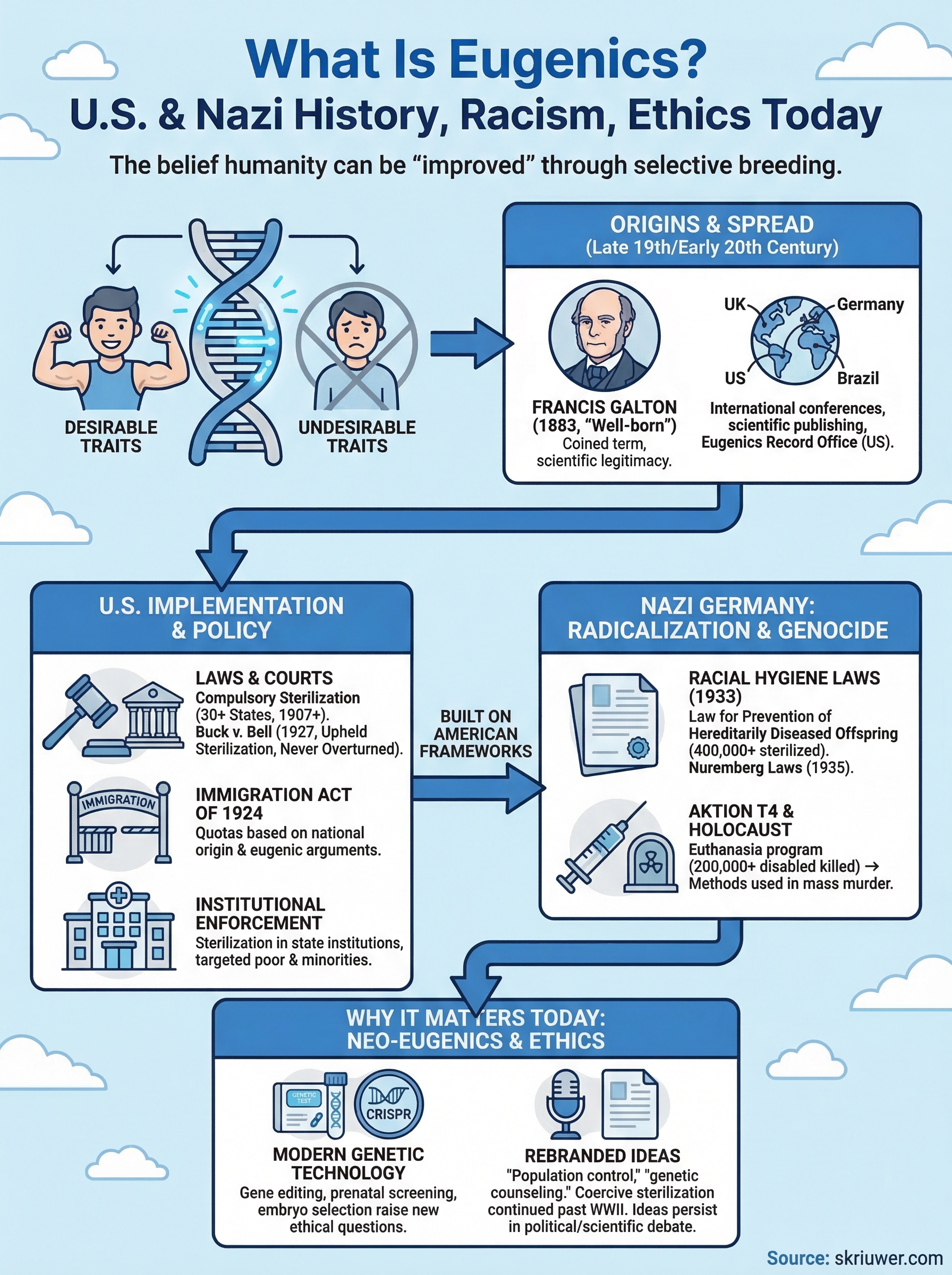
The Law for the Prevention of Hereditarily Diseased Offspring, passed in July 1933, came into force just months after Hitler took power. It mandated compulsory sterilization for people diagnosed with a range of conditions including schizophrenia, hereditary epilepsy, severe alcoholism, and hereditary blindness or deafness. Nazi legal scholars cited the United States explicitly when drafting this legislation, pointing to American sterilization statutes and the Buck v. Bell decision as evidence that compulsory sterilization was an accepted tool of modern governance. By 1945, the Nazi program had forcibly sterilized an estimated 400,000 people.
Nazi racial hygienists didn't consider themselves radicals. They considered themselves scientists applying methods that democratic governments had already legitimized.
The Nuremberg Laws of 1935 extended the racial hygiene framework to include citizenship and marriage. Jews, Roma, and Black Germans were stripped of citizenship and prohibited from marrying or having sexual relations with people classified as ethnic Germans. These laws weren't presented as persecution. They were framed within the language of public health and biological protection, which is exactly how eugenics had been marketed in the United States for decades before.
From sterilization to mass murder
The shift from sterilization to killing followed a bureaucratic logic. Aktion T4, the Nazi euthanasia program launched in 1939, targeted people with physical and mental disabilities inside German institutions. Physicians and administrators selected patients for death using the same professional authority that American doctors had used to recommend sterilization. Roughly 200,000 people were killed under this program before it was officially halted in 1941, though killings continued informally.
The methods developed under T4, including gas chambers and coordinated killing facilities, were later scaled up and applied to the Holocaust. The connection between eugenics and genocide is not metaphorical. It is operational and documented, traced through personnel, infrastructure, and institutional decisions made by people who believed they were acting on scientific principles.
What to remember going forward
The full answer to what is eugenics is not a single definition. It is a documented history of institutions, laws, and professionals who caused enormous harm while operating inside legitimate systems of government and medicine. The American sterilization programs came first, the Nazi racial hygiene laws followed directly, and the ideas that powered both never fully disappeared from political and scientific culture after 1945. Knowing that history in detail is the only way to recognize when similar reasoning reappears in new forms.
You now have the framework to read modern debates about genetic technology, immigration policy, and reproductive rights with a clearer understanding of where those conversations have been before. That kind of informed reading matters. If you want to go deeper into the history that mainstream publishers tend to avoid, explore the full catalog at Skriuwer for books that cover forbidden history, scientific controversies, and untold accounts without softening the record.
For more on the patterns that produced this history, see our explanation of social engineering as a political tool, our overview of apartheid as state-administered racial classification, and the full dark history books collection.
Your next good book, in your inbox
We only write when we find a book worth your time. Hand-picked recommendations across history, mythology, true crime and more.
Books You Might Like

The Hiding Place
Elizabeth Sherrill, John Sherrill Corrie ten Boom

Helter Skelter: The True Story of the Manson Murders
Curt Gentry Vincent Bugliosi
Cultish: The Language of Fanaticism
Amanda Montell