What Is Feudalism? How Medieval Europe Actually Ran (2026 Guide)
If you've ever asked what is feudalism, you've likely been met with oversimplified textbook answers about kings and knights. The reality is far more layered. Feudalism was a decentralized system of power built on land grants, personal loyalty oaths, and mutual obligation, a political and economic arrangement that shaped Europe for centuries and left marks we can still trace today.
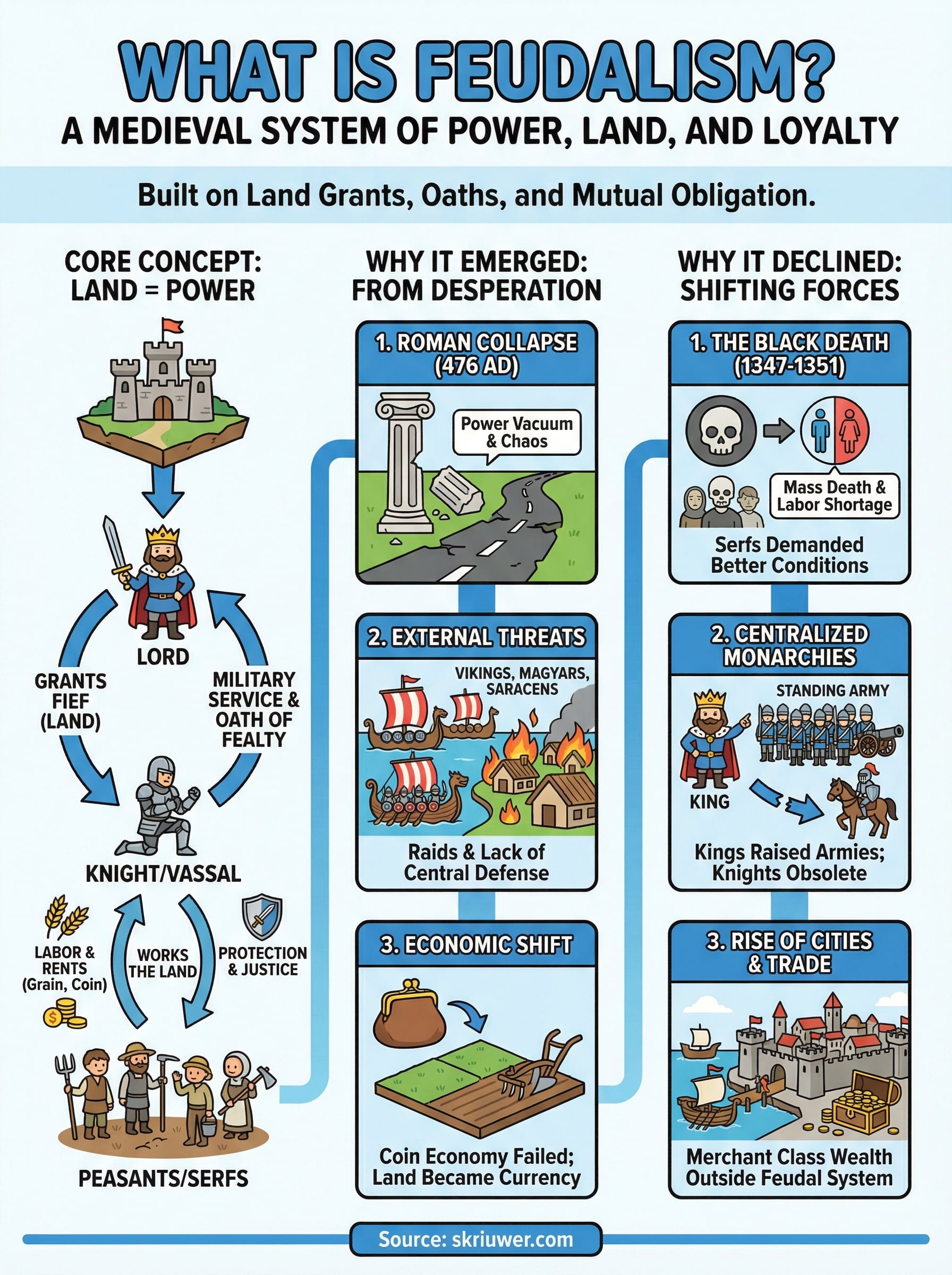
At its core, feudalism defined who owned what, who owed whom, and who held the authority to wage war, collect taxes, and dispense justice. Lords granted parcels of land called fiefs to vassals in exchange for military service and political allegiance. Peasants worked that land under conditions that ranged from burdensome to brutal. It was a hierarchy engineered to maintain control during an era of constant threat and fragile central authority.
At Skriuwer, we publish the kind of history that doesn't get sanitized for mass appeal, and feudalism is one of those subjects that deserves a closer, more honest look. This article breaks down how the feudal system actually operated, who benefited, who suffered, and why this medieval power structure eventually collapsed. Whether you're a student of history or someone drawn to the mechanics of power and control, you'll find a complete and grounded overview ahead.
Why feudalism emerged in medieval Europe
To understand what is feudalism, you need to understand the conditions that made it necessary. Medieval feudalism didn't emerge from a single decision or decree. It grew out of desperation, as Roman infrastructure crumbled, central authority evaporated, and ordinary people needed protection that no distant king could reliably provide. The system was a response to a world where violence was constant and survival depended on local power.
The collapse of Roman order
Rome's fall in 476 AD did not happen overnight, but the consequences unfolded fast. The Western Roman Empire had maintained roads, trade networks, legal systems, and standing armies. When those structures collapsed, the power vacuum it left behind was enormous. Local strongmen filled it. In the absence of any functioning central government, whoever controlled the land and the armed men on it held real authority.
Without Rome's unifying infrastructure, Europe fractured into hundreds of competing territories, each demanding its own system of order and protection.
Germanic kingdoms rose across former Roman territory, and Frankish rulers like Charlemagne tried to reassemble something resembling centralized power. But even Charlemagne's empire broke apart after his death in 814 AD, split among his heirs through the Treaty of Verdun in 843 AD. Every fragmentation pushed power further down the chain, toward local lords who could actually enforce order on the ground.
External threats accelerated the shift
Viking raids from the north, Magyar incursions from the east, and Saracen attacks from the south hit Europe in relentless waves between the 8th and 10th centuries. These threats were not theoretical. Coastal villages were burned, monasteries were looted, and no king sitting hundreds of miles away could respond quickly enough to stop any of it. Communities needed local armed protection, and they needed it immediately.
That urgency pushed ordinary people toward the nearest lord who could build walls, arm soldiers, and organize a defense. In exchange for that protection, they surrendered land rights, labor, and personal freedom. The transaction was not always explicit, but the logic was brutally clear: offer your submission now or face the raiders alone.
Why land replaced money as the foundation of power
Coin-based economies had largely collapsed across Europe after Rome's fall. Long-distance trade shrank, urban centers hollowed out, and currency became scarce. Land was the one resource that remained constant and productive. A lord could not pay a knight in coins he did not have, but he could grant a parcel of farmland that generated annual income through peasant labor.
That land grant, the fief, became the engine of the entire feudal arrangement. It tied military service to territorial control, created inherited obligations across generations, and gave the whole system its structural logic. Feudalism, at its root, was a practical workaround for a broken economy and a fractured political order.
How feudalism worked day to day
Understanding what is feudalism in practice means looking past the political theory and into the actual routines that held the system together. Every relationship in the feudal order was formalized through ritual and obligation. Lords held courts, collected dues, and commanded military service. Vassals managed their granted lands, answered their lord's summons, and passed those same obligations down to the people below them. The system ran on reciprocal duty, not on written law or central enforcement.
The oath of fealty
The formal starting point of any feudal relationship was the oath of fealty, a sworn pledge of loyalty made by a vassal to his lord. This ceremony was not symbolic theater. It carried legal and social weight that both parties recognized and that the community witnessed. The vassal knelt, placed his hands inside the lord's hands, and swore his service. In return, the lord granted a fief and promised protection.
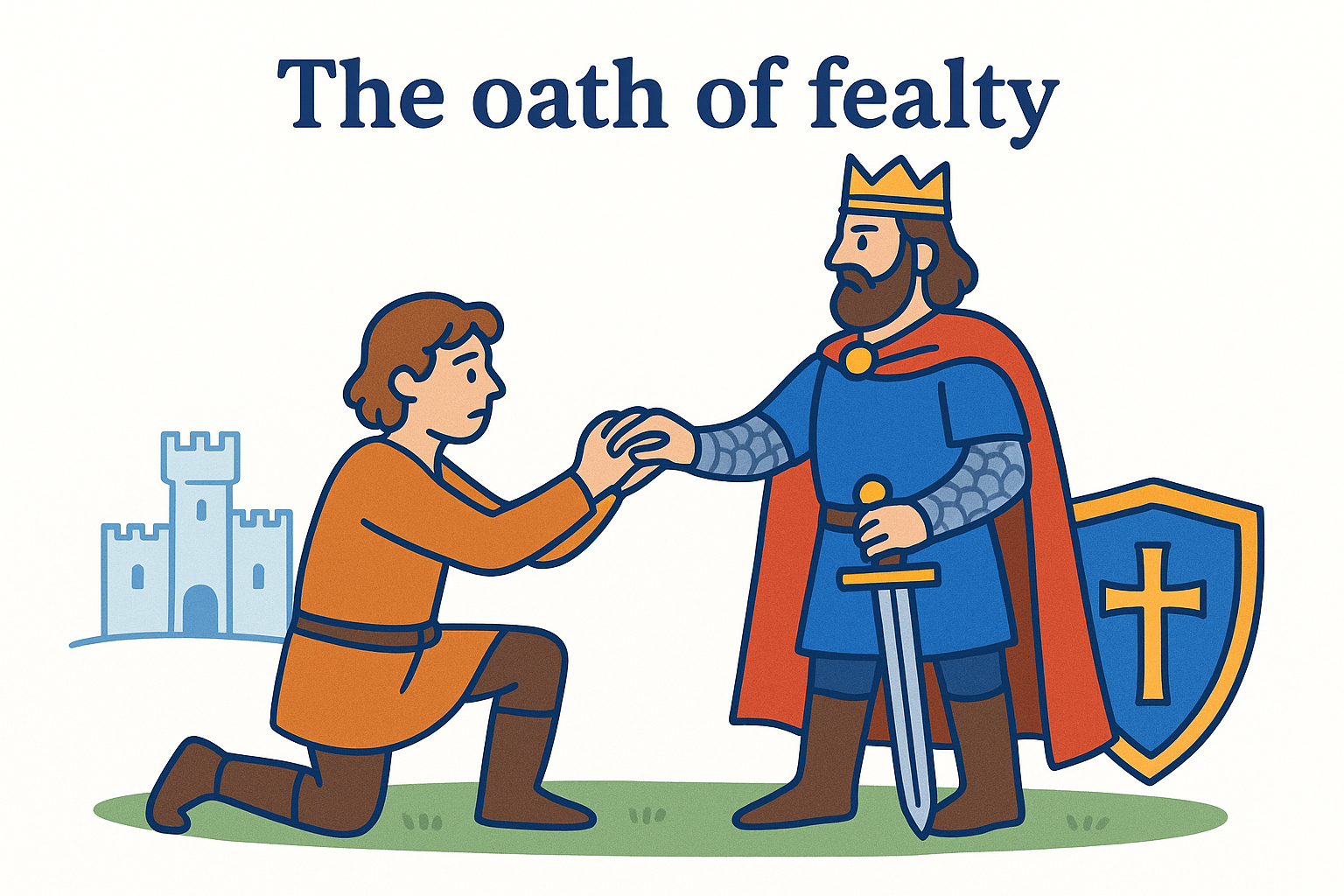
Breaking that oath was not simply a personal failure. It was treated as a betrayal that could justify war, seizure of land, and permanent loss of status.
Labor, taxes, and the harvest cycle
Below the knights and lords, peasants and serfs structured their entire year around the demands of the manor. They worked the lord's land for a fixed number of days each week, known as labor service, before they could tend their own strips of farmland. They paid dues in grain, livestock, or eventually coin at harvest time, and they owed fees for using the lord's mill, oven, and winepress.
Serfs could not leave the land without permission, marry without approval, or pass property to their children without paying a fee to the lord. Their daily lives were governed by the agricultural calendar and the lord's demands, leaving very little room for individual choice or mobility.
The feudal hierarchy: kings, lords, vassals, serfs
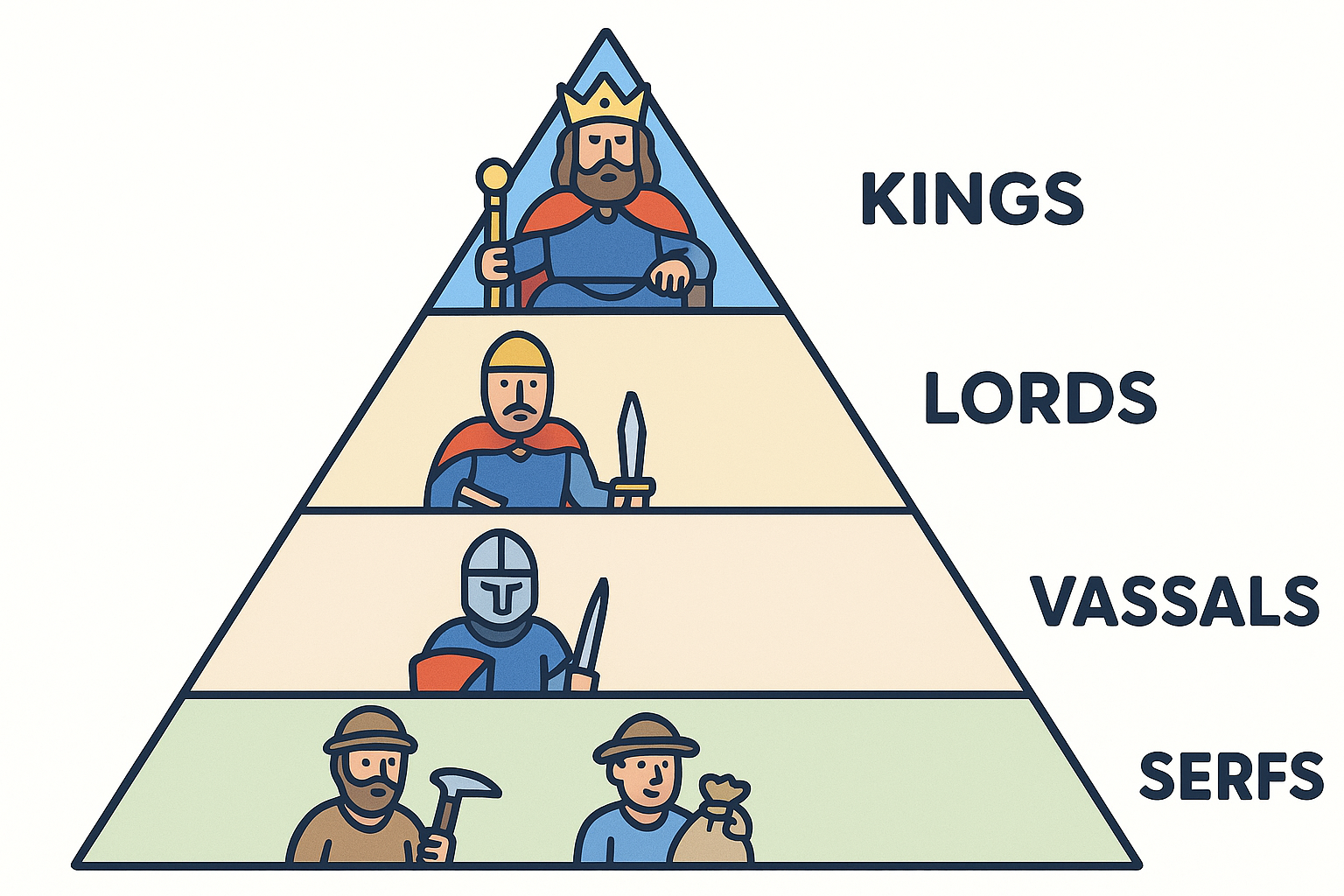
One of the clearest ways to understand what is feudalism is to look at who occupied each level of the pyramid and what obligations tied them together. The hierarchy was not rigid in every region or era, but it followed a recognizable pattern: power and land flowed downward, while labor and loyalty flowed up.
Kings and greater lords
At the top sat the king, who held ultimate ownership of all land in theory but rarely controlled it in practice. Kings granted large territories to powerful lords, called barons or great lords, who swore oaths of military support and political loyalty in return. These lords commanded armies large enough to pose a genuine threat to royal authority, which meant kings spent as much time managing their nobility as they did governing their realm.
The king's real power depended on how effectively he could enforce loyalty from lords who were often better armed and locally more influential than the crown itself.
Vassals and knights
Below the great lords sat vassals, a broad category that included knights and lesser nobles. A vassal received a fief directly from his lord, pledged military service in return, and could then grant portions of that land to his own sub-vassals. This chain of obligation is sometimes called subinfeudation, and it meant that a single piece of land could carry layered debts of service running up and down the hierarchy at the same time.
Serfs and free peasants
At the base of the pyramid sat the people who actually worked the land. Serfs were legally bound to the manor and could not leave without their lord's permission. Free peasants held a slightly better position, but both groups paid rents, owed labor, and lived under the jurisdiction of the local lord rather than any distant king or royal court.
Feudalism vs manorialism and common myths
People often use feudalism and manorialism as interchangeable terms, but they describe different layers of medieval life. When you ask what is feudalism, you're asking about the political and military structure of power, meaning who owed loyalty to whom and how land grants secured military service. Manorialism, by contrast, describes the economic system that operated within that structure, specifically how lords managed their estates and extracted labor and goods from the people who worked them.
How manorialism differed from feudalism
Manorialism focused on the manor as a self-contained economic unit. A manor produced food, collected rents, and administered local justice. The lord ran it as a business, and peasants supplied the labor that kept it functioning year after year. Feudalism was the framework that determined who owned the manor and to whom that owner answered militarily and politically. You can think of feudalism as the skeleton and manorialism as the muscle operating on top of it.
The two systems overlapped constantly, which is exactly why historians and students alike have spent centuries conflating them.
Common myths about the feudal system
One persistent myth is that every medieval person lived inside a strict, uniform pyramid with the king at the top and serfs at the bottom. In reality, the system varied enormously by region, era, and local custom. Consider a few other misconceptions that distort the picture:
- Feudalism was not a term medieval people used to describe their own world. Historians coined it later.
- The system was not universally imposed by conquest. Most of Europe developed it gradually through informal arrangements.
- Not all peasants were serfs. Free peasants existed at the base of the hierarchy and held more rights than serfs did.
Treating feudalism as a single, rigid system flattens a far messier and more regional historical reality.
How feudalism declined and what replaced it
If you want to fully understand what is feudalism, you also need to understand why it stopped working. The feudal system did not collapse in a single dramatic moment. It eroded gradually as the conditions that had made it necessary began to change, and new economic and political forces pulled authority away from local lords and toward centralized monarchies and emerging merchant classes.
The Black Death and peasant uprisings
The bubonic plague that swept Europe between 1347 and 1351 killed roughly one-third of the continent's population. That catastrophic loss of labor fundamentally shifted the bargaining power between lords and peasants. With far fewer workers available, surviving serfs could demand better conditions, higher wages, and greater freedom of movement. Lords who refused faced deserted manors and collapsing harvests. The scale of that mortality, and how it reshaped European society, is laid out in our ranked guide to the best books about the Black Death.
The Black Death did more to loosen the grip of feudal obligation in a few years than centuries of political reform had managed.
Peasant revolts followed across Europe, including the English Peasants' Revolt of 1381 and the French Jacquerie of 1358. These uprisings were violently suppressed, but they signaled that the old system of unquestioned deference was cracking under real economic pressure.
What rose in feudalism's place
Centralized nation-states gradually absorbed the military and judicial functions that feudal lords had previously controlled. As kings developed standing armies funded by taxation, they no longer needed to rely on lords supplying knights in exchange for land. Gunpowder weapons further undermined the dominance of mounted knights, making the entire military logic of the fief system obsolete.
Meanwhile, expanding trade networks and growing cities created a merchant class that operated outside the feudal hierarchy entirely. Commerce generated wealth through exchange rather than land, which meant that power could accumulate in towns and ports instead of in castle estates, permanently reshaping how European society organized itself.
Final takeaways
Understanding what is feudalism means looking at a system that was never as clean or uniform as textbooks suggest. Medieval feudalism grew from collapse, not from ambition. Roman infrastructure fell apart, raiders hit from every direction, and local lords stepped in to fill the gap. The result was a layered structure of land grants, loyalty oaths, and inherited obligations that defined daily life for millions of people across centuries.
The system worked until it stopped making sense. The Black Death shifted labor power, growing trade created wealth outside castle walls, and centralized monarchies absorbed the military functions that lords had once monopolized. Feudalism did not disappear overnight; it was displaced by forces it could not adapt to.
If history like this pulls you in, browse the wider history category on Skriuwer, the related medieval history sleep stories, our reading guide on the best books about the Spartans for a contrasting earlier military society, and the new Spartans reading list. For the immediate predecessor of feudal Europe, see our best books about ancient Rome.
Your next good book, in your inbox
We only write when we find a book worth your time. Hand-picked recommendations across history, mythology, true crime and more.
Books You Might Like

Sapiens: A Brief History of Humankind
Yuval Noah Harari
The Last Kingdom (The Saxon Stories, Book 1)
Bernard Cornwell

Meditations
Marcus Aurelius

The Hiding Place
Elizabeth Sherrill, John Sherrill Corrie ten Boom