What Is Humanism? The Philosophy of Reason, Ethics, and Human Agency (2026)
If you've ever asked what is humanism, you've probably encountered a dozen vague answers ranging from "being a good person" to "rejecting religion." Neither captures the full picture. Humanism is a philosophical tradition rooted in reason, ethics, and human agency, one that shaped Western thought from the Renaissance onward and continues to influence how millions of people approach morality without appealing to the supernatural.
At its core, humanism places the responsibility for meaning and ethics squarely on human shoulders. No divine authority. No sacred text as the final word. That kind of intellectual independence made humanism dangerous to established power structures centuries ago, and it still ruffles feathers today. It's exactly the type of subject we publish about at Skriuwer, ideas that challenge dominant narratives and ask readers to think for themselves rather than accept what they're handed.
This article breaks down humanism's definition, its central beliefs, and its origins during the Renaissance. You'll learn how early humanist thinkers shifted Europe's intellectual center of gravity away from theological dogma and toward classical learning and critical inquiry. By the end, you'll have a clear, grounded understanding of what humanism actually stands for, and why it still matters.
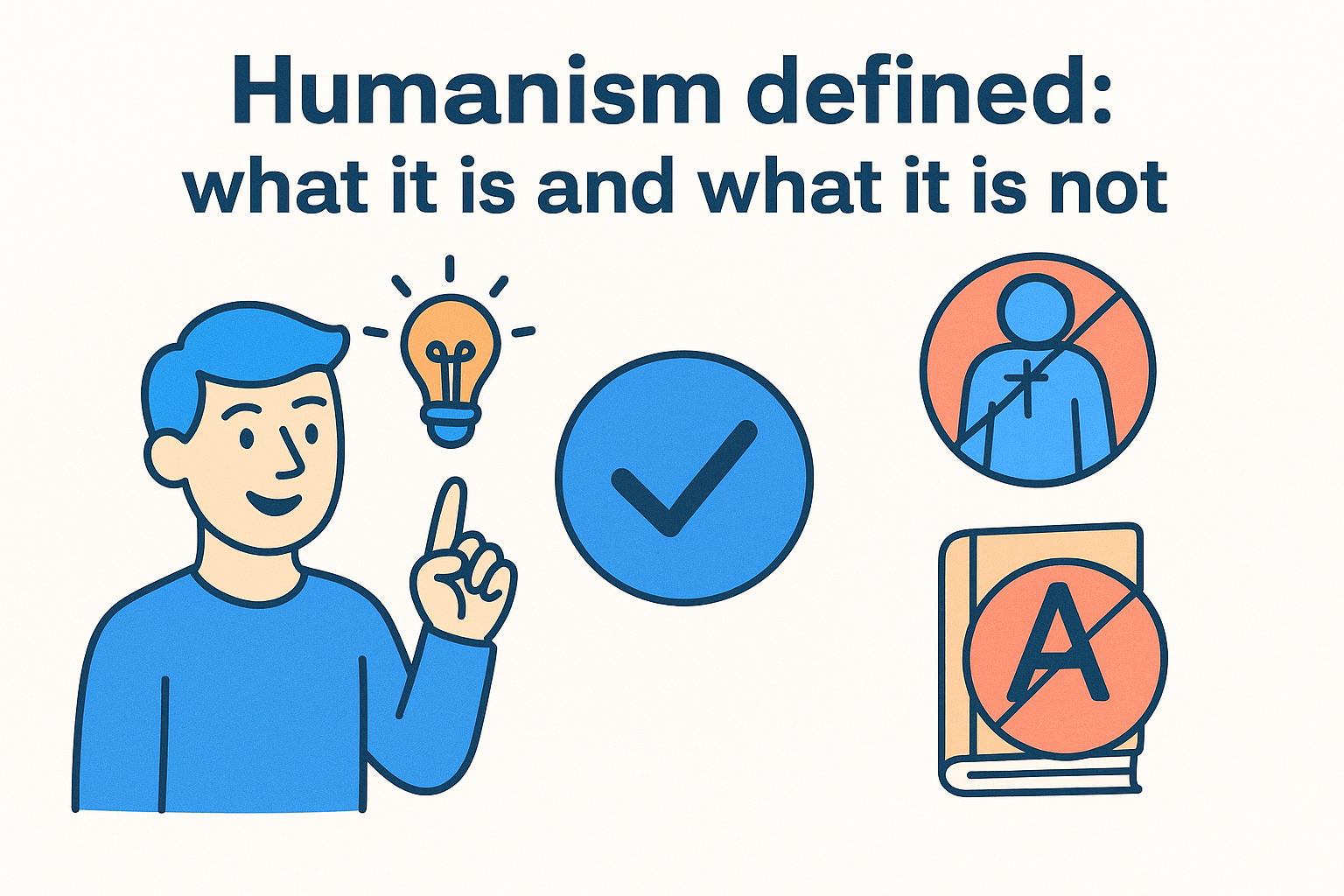
Humanism defined: what it is and what it is not
When people ask what is humanism, they often expect a single sentence answer. The reality is that humanism operates on several levels at once: as a philosophical worldview, as a historical movement, and as a practical ethical framework. Understanding it properly means separating what it actually claims from the distorted versions that float around in popular discourse. Before you can assess whether humanism aligns with your own thinking, you need a clear definition to work from.
The working definition
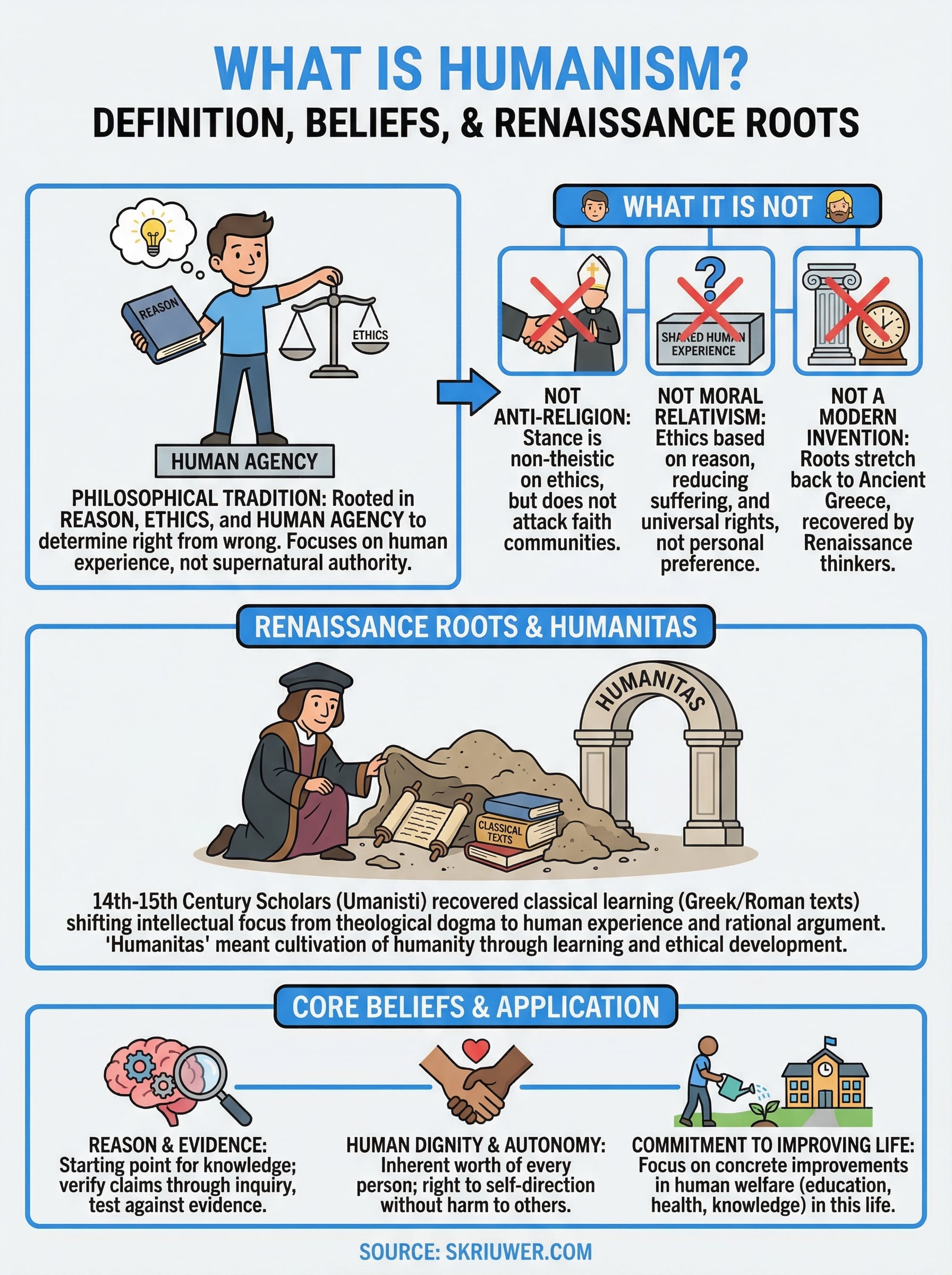
Humanism holds that human beings are capable of determining right from wrong through reason and experience without needing divine instruction. It treats humans as the starting point for ethical thinking rather than scripture, tradition, or supernatural authority. You build your moral framework from observation, empathy, and critical reasoning. That foundation does not require you to be an atheist, though many humanists are, because humanism is primarily about how you construct meaning, not whether you believe in a god.
Humanism does not tell you what to conclude; it tells you how to think through the question.
Organizations like the American Humanist Association define humanism as a progressive life stance that affirms human dignity, autonomy, and the capacity for ethical growth without relying on religious doctrine. The Stanford Encyclopedia of Philosophy situates modern humanism within a broader intellectual tradition that prizes scientific inquiry and secular ethics as the most reliable tools for navigating human life. You are the author of your own values in this framework, and that authorship carries real weight because no external authority absorbs the responsibility for the choices you make.
Three things humanism is not
People frequently confuse humanism with ideas it does not actually endorse. Clearing up these misconceptions gives you a sharper understanding of the tradition and prevents you from arguing against a version of it that humanists themselves would not recognize.
Humanism is not anti-religion. It takes a non-theistic stance on the basis of ethics, but it does not campaign against religious individuals or demand that others abandon their beliefs. The distinction matters: humanism rejects supernatural authority as the foundation for moral reasoning, not the people who hold religious views. You can engage respectfully with humanist ideas without treating them as an attack on faith communities.
Humanism is not moral relativism. Some assume that removing religious authority leaves nothing in place, as if ethics collapses into purely personal preference. Humanists reject that conclusion firmly. They argue that reason and shared human experience generate genuine ethical commitments that apply broadly across cultures and contexts, things like reducing suffering, protecting individual rights, and pursuing honest inquiry.
Humanism is not a modern invention. While the formal movement took shape in the 19th and 20th centuries, humanist ideas stretch back to ancient Greece, to thinkers like Protagoras who argued that man is the measure of all things. Greek and Roman philosophy provided the intellectual raw material that Renaissance scholars later recovered and rebuilt into something that would reshape European civilization. That historical depth is exactly what makes humanism worth taking seriously rather than dismissing it as a recent cultural trend.
Why humanism matters today
Understanding what is humanism matters more now than it did fifty years ago, and the reason is straightforward: the forces that humanism has always pushed back against, dogma, institutional authority, and the suppression of critical inquiry, have not disappeared. They have simply changed shape. Today you encounter them in the form of misinformation ecosystems, ideological tribalism, and media narratives designed to bypass your capacity for independent judgment. Humanism hands you a set of tools to resist that pressure by returning the authority for ethical reasoning back to where it belongs: your own mind.
Thinking clearly in an age of competing narratives
Modern life bombards you with competing claims about history, science, politics, and identity. Each source insists it holds the authoritative interpretation, and many of those sources lean on emotional manipulation rather than evidence. Humanist thinking trains you to ask the right questions before accepting a conclusion: What is the evidence? Who benefits from this framing? Is my response driven by reason or by reflex? These are not complicated questions, but they require consistent practice and intellectual discipline to apply honestly.
The humanist habit of examining your own assumptions before judging the assumptions of others is more useful today than at any previous point in history.
Applying that discipline does not mean you walk away from every conversation with a tidy answer. Sometimes the honest outcome is admitting what you do not know. Humanists treat that admission as a strength rather than a weakness because it keeps the door open for better evidence to change your conclusions. That kind of intellectual flexibility is rare in a media environment built to reward certainty over nuance.
Ethics without a universal institution
One of humanism's most practical contributions is demonstrating that people from vastly different cultural backgrounds can reach common ethical ground without sharing a religion or a governing ideology. Research in moral psychology, including work published through institutions like the National Institutes of Health, consistently finds that humans share core intuitions around fairness, harm reduction, and cooperation regardless of belief system. Humanism formalizes what your own experience likely already suggests: empathy and reason are sufficient to build a workable ethical framework, and you do not need a single institution to sanction that framework for it to hold.
That shared ethical ground becomes especially important when you engage with people whose cultural background differs sharply from your own. Humanism gives you a framework for finding common cause without demanding ideological uniformity, which is genuinely useful in a world where disagreement often slides into contempt.
Core humanist beliefs and ethical commitments
When you ask what is humanism at the level of actual beliefs rather than broad philosophy, you get a surprisingly specific set of commitments. Humanists are not simply people who like humans or feel warmly about the species. They hold defined positions on how to acquire knowledge, how to treat other people, and what obligations arise from living in a shared world. Those positions form a coherent system, not a loose collection of feel-good attitudes.
Reason and evidence as the starting point
Humanism places empirical inquiry and rational thought at the foundation of everything else. You accept claims about the world based on evidence that can be examined and tested, not on authority or tradition alone. This does not mean humanists reject all inherited wisdom. It means they evaluate inherited claims against current evidence and update their views when the evidence shifts. That willingness to revise is not weakness; it is what separates genuine inquiry from ideology.
Accepting that you might be wrong is not a flaw in your reasoning process; it is the whole point of the process.
Human dignity and individual autonomy
Humanists hold that every person carries inherent worth regardless of national origin, belief system, or social position. That is not a sentimental claim. It is a foundational premise that shapes how humanists think about law, education, and political organization. You treat people as ends in themselves rather than instruments for achieving someone else's goals. From that premise flows a strong commitment to individual autonomy, the idea that you have the right to direct your own life as long as you are not causing harm to others.
This position puts humanists in direct tension with systems, religious or secular, that demand conformity as the price of belonging. Humanists see that demand as a violation of the basic dignity they consider non-negotiable.
The commitment to improving human life
Humanism carries a forward-looking ethical orientation. Because there is no afterlife to compensate for suffering endured in this one, reducing that suffering now carries full moral weight. Humanists direct their ethical energy toward concrete improvements in human welfare, things like access to education, protection from arbitrary power, and the advancement of knowledge through science. That orientation makes humanism less a passive worldview and more a call to active engagement with the world around you.
Renaissance humanism and the idea of humanitas
Any serious attempt to answer what is humanism eventually leads you back to 14th and 15th century Italy, where a group of scholars began recovering ancient Greek and Roman texts that the medieval church had pushed to the margins. These scholars, known as umanisti, did not frame themselves as revolutionaries. They described their project as the revival of classical learning, but the intellectual shift they triggered reshaped European civilization from the ground up.
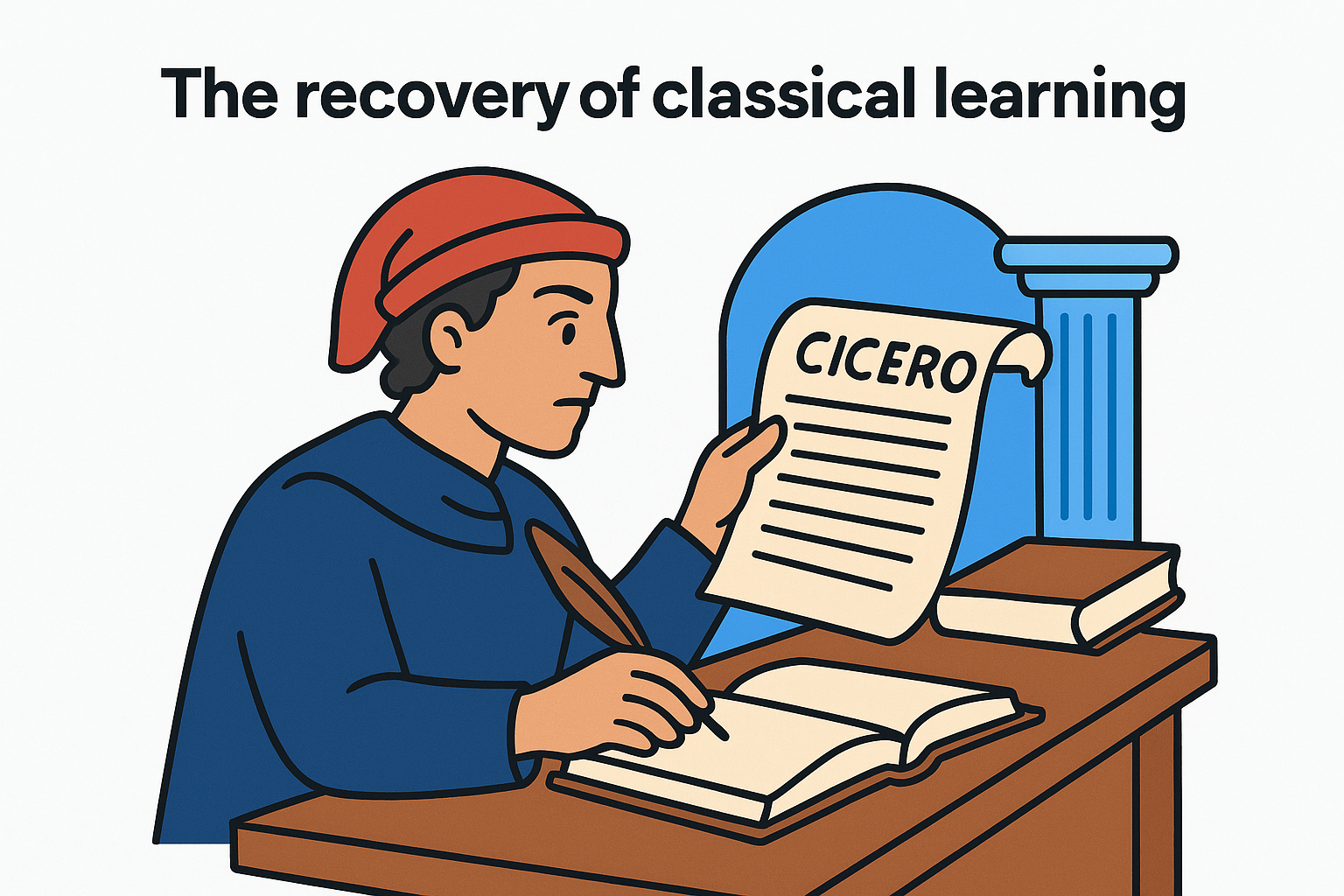
The recovery of classical learning
Renaissance humanists were working against a dominant intellectual culture in which theological interpretation controlled almost every area of knowledge, from astronomy to ethics to political theory. When scholars like Petrarch began reading Cicero and Seneca directly rather than through church-approved summaries, they encountered a tradition of thought that placed human experience and rational argument at the center of inquiry. That encounter did not produce instant conflict. It produced a slow, persistent reorientation of what counted as authoritative knowledge.
The Renaissance did not reject the past; it chose a different past to build from.
Petrarch is often called the first humanist precisely because he modeled this shift in his own work, moving between classical sources and his own observations about human feeling and moral life. Other figures followed, including Lorenzo Valla and Pico della Mirandola, who pushed the method further into questions of language, dignity, and the boundaries of human potential. By the time the Renaissance reached its peak, the idea that you could study grammar, rhetoric, poetry, history, and moral philosophy as a coherent curriculum had taken root across European universities.
What humanitas actually meant
The Latin term humanitas carried a specific set of meanings in the Roman tradition that Renaissance scholars self-consciously inherited. It referred not just to the quality of being human, but to the cultivation of that humanity through learning, refinement, and ethical development. Cicero used it to describe a kind of educated, morally serious engagement with the world that distinguished a thoughtful person from someone who simply reacted to circumstances without reflection.
Renaissance humanists borrowed that conception and applied it to their curriculum. When you studied the classical texts they valued, you were not just acquiring information. You were actively shaping your own character through exposure to the best thinking the ancient world had produced. That idea, that education transforms the person rather than merely informs them, became one of humanism's most lasting contributions to Western intellectual life.
How to apply humanist thinking in daily life
Knowing what is humanism as a concept is one thing; putting it into practice is another. Humanist thinking is not an abstract academic exercise. You can build it into specific, repeatable habits that change how you evaluate information, treat other people, and make decisions under real pressure.
Examine your assumptions before reaching a conclusion
When you encounter a claim, whether in the news, from a colleague, or in a book, your first instinct may be to accept or reject it based on how well it fits what you already believe. Humanist thinking interrupts that reflex. You train yourself to ask: What evidence supports this claim? and What would change my mind? Those two questions alone separate honest inquiry from confirmation bias.
Applying this habit takes practice and patience, but the payoff is significant. You make fewer decisions driven by emotional reflex, and you hold your own positions with more justified confidence because you have actually tested them against alternatives.
Treat moral problems the way you would treat factual ones
Most people apply critical thinking to factual claims but drop it when ethical questions arise. Humanists close that gap. When you face a moral decision, you gather relevant information, consider the likely consequences for everyone affected, and weigh competing interests honestly. You do not appeal to a fixed rulebook; you reason through the situation.
The goal is not to find the most comfortable answer but to find the most defensible one given what you actually know.
This approach produces better moral reasoning because it keeps you accountable to outcomes rather than tradition alone. If your reasoning produces consistently bad results, you revise it. That willingness to self-correct is the most direct way to apply humanist ethics in your daily life.
Build relationships on the basis of shared dignity
Humanist thinking changes how you engage with people who hold different beliefs. Instead of treating disagreement as a threat, you approach it as information about how another person reasons. You stay curious rather than dismissive, and you extend the same basic respect to the person even when you reject their conclusions, because humanist ethics grounds dignity in humanity itself, not in agreement.
That shift in how you listen and respond makes conversations more productive and reduces the contempt and reflexive dismissal that shuts dialogue down before it can start.
Wrap-up and next steps
You now have a clear answer to what is humanism: a philosophical tradition that grounds ethics, meaning, and knowledge in human reason and experience rather than supernatural authority. It stretches from ancient Greek thinkers through Renaissance scholars who revived classical learning, and it continues to shape how thoughtful people approach moral questions today. The core commitments are consistent across time: reason over dogma, human dignity as a non-negotiable starting point, and the ongoing work of improving life in the world you can actually see and touch.
Putting these ideas into practice means building habits of honest inquiry, treating moral problems with the same rigor you apply to factual ones, and extending basic respect to people even when you disagree with them. That kind of thinking takes real effort, and it gets sharper the more you read. If you want books that challenge comfortable assumptions and dig into history on its own terms, explore the catalog at Skriuwer.
Keep Reading on Skriuwer
Humanism sits at the crossroads of philosophy and religion. These guides go deeper:
- Our ranked list of the best philosophy books, from ancient Greece to modern thought.
- What is agnosticism? A companion explainer on doubt, belief, and knowledge.
- The full curated religion book collection for the traditions humanism grew alongside and challenged.
Your next good book, in your inbox
We only write when we find a book worth your time. Hand-picked recommendations across history, mythology, true crime and more.
Books You Might Like


Through the Language Glass
Guy Deutscher

How to Learn Any Language
Barry Farber