What Are Banned Books? 2026 Guide: Who Decides, Why It Happens, Latest PEN Data
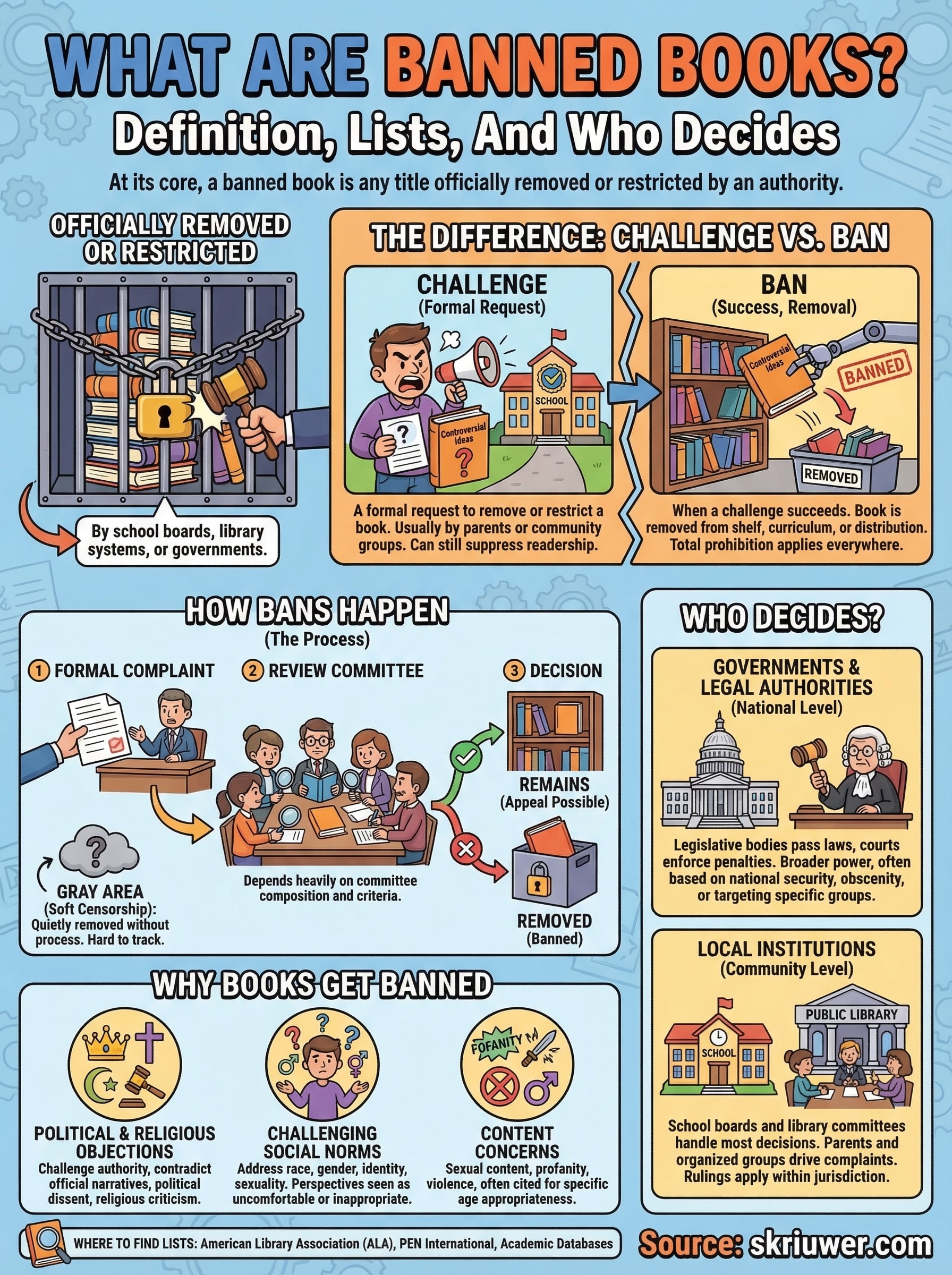
Every year, hundreds of books get pulled from library shelves, removed from school curricula, or outright prohibited by governments. But what are banned books, exactly? The term gets thrown around a lot, sometimes accurately, sometimes not. At its core, a banned book is any title that has been officially removed or restricted by an authority, whether that's a school board, a library system, or an entire country. The reasons range from political and religious objections to claims of obscenity or "dangerous" ideas.
The history of book banning is as old as the printed word itself. Authorities have always feared what happens when certain ideas reach the wrong hands, or rather, any hands at all. Some of the most celebrated works in literature, from 1984 to To Kill a Mockingbird, have spent time on banned lists. The pattern is consistent: the books that challenge power tend to be the ones power tries to silence.
This is exactly why Skriuwer exists. As an independent publishing house, we specialize in the kind of non-mainstream literature that major publishers shy away from, books covering untold history, controversial subjects, and perspectives that don't fit neatly into approved narratives. We believe readers deserve access to unfiltered information and the freedom to decide for themselves what's worth reading.
In this article, we break down what qualifies as a banned book, who makes the decision to ban them, and which titles have faced the most challenges throughout history. We'll also look at the difference between a challenge and an outright ban, and why the list of targeted books keeps growing. Whether you're a longtime advocate for intellectual freedom or just starting to pay attention to censorship trends, this guide covers what you need to know.
What counts as a banned book
A book earns the label "banned" when an authority officially removes or restricts access to it. This sounds straightforward, but in practice the definition gets fuzzy fast. When people ask what are banned books, they often conflate books that are legally prohibited by a government with books that have simply been removed from a specific school district's reading list. Both situations involve censorship, but they carry very different weight and very different consequences for authors, publishers, and readers.
The key distinction is between restriction of access in one place versus a total prohibition that applies everywhere.
The difference between a challenge and a ban
A challenge is a formal request to remove or restrict a book, usually filed by a parent, a community group, or a religious organization. A ban happens when that challenge succeeds and the book is actually removed from a library shelf, a classroom, or a national distribution channel. Most challenges never become full bans, but the process itself can still suppress readership even without an official ruling.
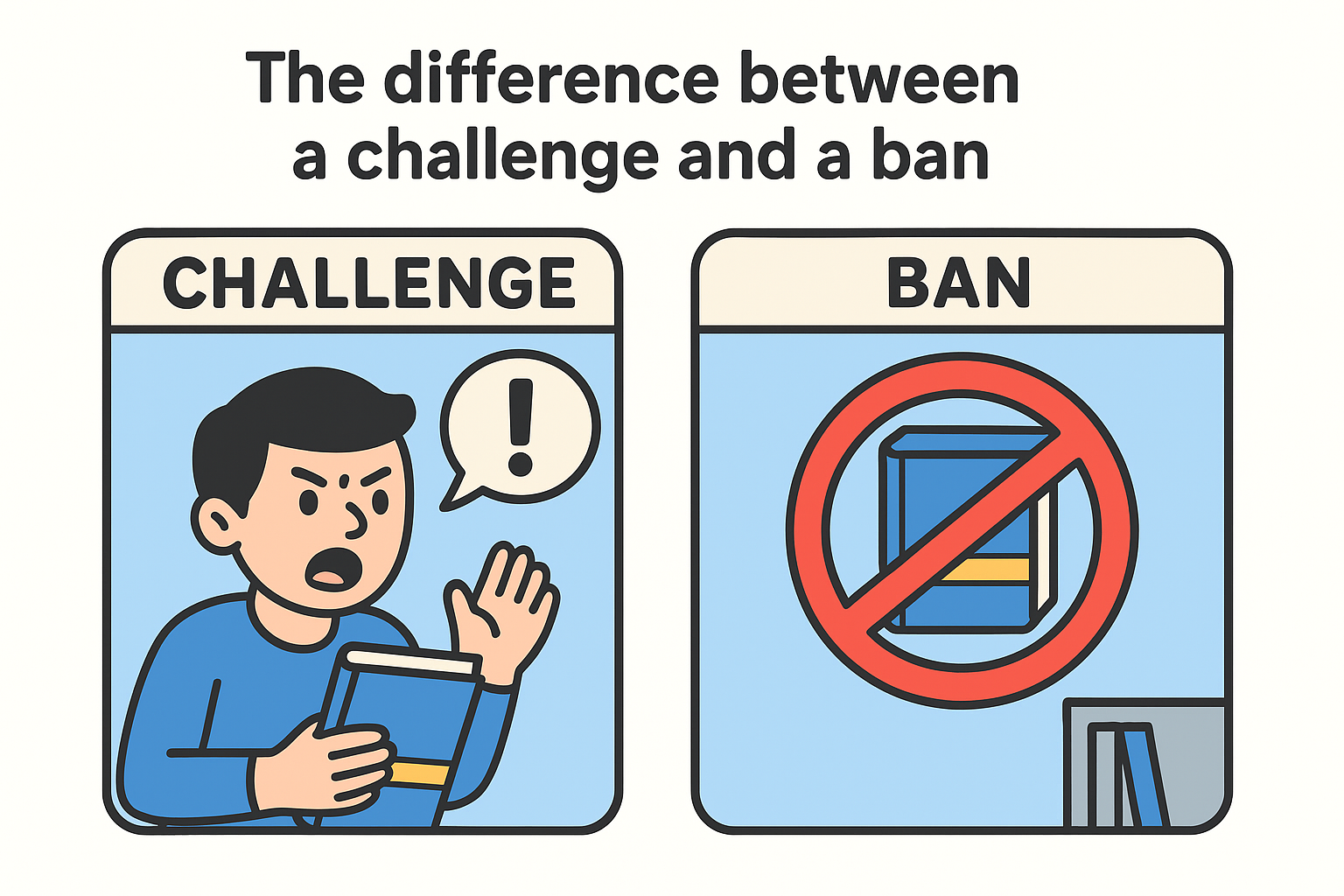
The distinction matters because reported numbers often count challenges as bans, which inflates the data. A book that receives hundreds of formal complaints across different school districts over several decades is not the same as a book that is illegal to own or sell in a country. Both deserve scrutiny, but they are not equivalent.
Books that exist in a gray area
Some books occupy a complicated middle ground. They are not formally banned, but they are quietly removed from shelves, dropped from curricula, or refused by distributors without any public process. This kind of soft censorship is harder to track and easier to deny. Publishers and booksellers may self-censor to avoid controversy, which produces the same effect as an official ban without leaving a paper trail.
Other titles are banned in some countries but freely available in others. Works covering political dissent, religious criticism, or explicit content frequently fall into this category. What you can legally read in the United States might be a criminal offense to possess in another country, which means the same book can appear on both a bestseller list and a banned books list depending on where you live.
How book challenges and bans happen
The process that leads to a book being banned usually starts with a single formal complaint. Someone, often a parent or community member, files an objection with a school board, a library committee, or a government body. That complaint then triggers a review process that varies widely depending on the institution and the country. Understanding how that process works helps clarify what are banned books in practice versus what are simply books that someone found objectionable.
The formal complaint process
Most institutions in the United States have a written procedure for handling book challenges. A complainant fills out a form describing the specific content they find objectionable and submits it to the relevant authority. From there, a review committee typically made up of educators, librarians, and sometimes parents evaluates the book against a set of criteria before making a recommendation.
The outcome of a challenge depends heavily on who sits on the review committee and what criteria they apply.
From challenge to removal
If the committee rules in favor of removal, the book gets pulled from the shelf or dropped from the curriculum. This decision can be appealed, and many challenged books survive because the process includes multiple review steps by design.
Schools and libraries without clear written policies are more vulnerable to informal pressure. A vocal group can push a book out without any formal process at all, which is why you will often hear about books disappearing quietly rather than through any official ruling. That informal removal is harder to document and easier to deny than a decision made through a structured review process.
Who decides to ban a book
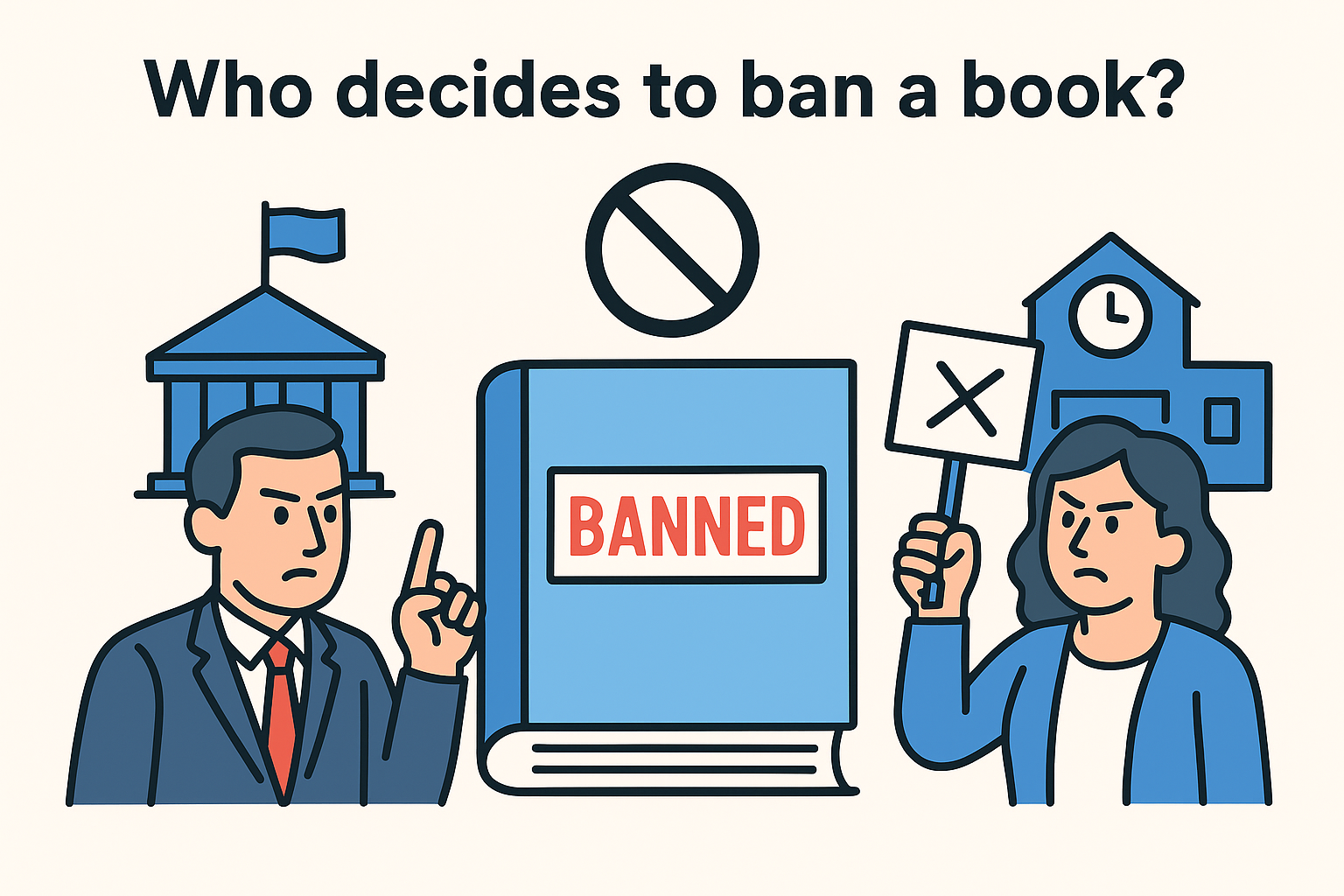
The answer to who decides what are banned books depends entirely on the level of authority involved. No single body controls book banning globally, which means the rules you run into depend heavily on where you live and what kind of institution holds the book. Decisions happen at multiple levels, from national governments down to individual school boards, and each operates by different rules and priorities.
Governments and legal authorities
At the national level, governments hold the broadest power to restrict books. Legislative bodies pass laws prohibiting specific content, and courts enforce those restrictions through legal penalties for possession or distribution.
In democratic countries, government-level bans still occur, particularly around national security content, obscenity laws, or material that targets specific groups.
Government-level restrictions can come from several sources:
- National parliaments and legislative bodies
- Courts and judicial systems
- Regulatory agencies overseeing media and publishing
Local institutions and community groups
School boards and library committees handle most book removal decisions in the United States. They vote on formal challenges and their rulings apply to every school or branch within their jurisdiction. Members evaluate challenged titles against institutional guidelines that vary widely from one district to the next.
Individual parents and organized advocacy groups drive the majority of formal complaints. They attend board meetings, submit written objections, and apply sustained public pressure. Their success depends heavily on how responsive local institutions are to community concerns and whether structured review policies exist to keep informal pressure from bypassing the official process.
Why books get banned
The reasons behind book banning follow predictable patterns across history and geography. When you look at which titles keep appearing on restricted lists, the same categories surface repeatedly. Understanding why books get banned helps clarify what are banned books in practical terms, beyond the legal definitions.
Political and religious objections
Governments and institutions ban books when the content directly challenges their authority or contradicts the beliefs they want to reinforce. Political dissent, criticism of religious doctrine, and accounts of historical events that contradict official narratives all trigger removal requests regularly. Books that give readers an alternative framework for understanding power structures are especially vulnerable.
The titles that face the most sustained opposition are almost always the ones that ask readers to question authority rather than accept it.
Common reasons cited in formal complaints include:
- Undermining national identity or government legitimacy
- Contradicting religious teachings or values
- Depicting historical events in ways that conflict with official accounts
Content that challenges social norms
A large portion of book challenges targets sexual content, profanity, or depictions of violence, particularly in school settings. Parents and advocacy groups argue that certain material is inappropriate for specific age groups, which is the most common justification you will see in formal complaints to school boards and library committees.
Other challenges focus on books that address race, gender, or identity in ways that some communities find uncomfortable or politically objectionable. This category has driven a significant share of recent removal requests, with titles being pulled not for obscenity but for the perspectives they present on contemporary social issues.
Where to find banned book lists and data
If you want reliable data on what are banned books and which titles face the most challenges, a few organizations track this systematically. The quality of the data varies between sources, so knowing where each organization gets its numbers saves you time and keeps you from citing inflated or misleading figures.
The American Library Association
The American Library Association publishes the most widely cited annual data on book challenges and removals in the United States. Their Office for Intellectual Freedom compiles reports based on documented complaints submitted by librarians and educators nationwide. They also release the annual list of the most challenged books, which gives you a clear picture of which titles draw the most sustained opposition in any given year and the specific reasons cited.
The scale is easy to underestimate. PEN America's Index of School Book Bans for the 2024-2025 school year recorded 6,870 instances of book bans across 23 states and 87 public school districts, affecting nearly 4,000 unique titles. That figure is down from the 10,046 bans logged in 2023-2024, but still far above the roughly 3,000 annual incidents seen in the 2021 to 2023 period. Just three states, Florida, Texas, and Tennessee, accounted for about 80 percent of the 2024-2025 total, and horror writer Stephen King was the single most-targeted author with 206 recorded bans.
The ALA consistently notes that reported challenges represent only a fraction of total incidents, since most removals go unreported by the institutions involved.
Government and academic databases
Beyond the ALA, you can find country-specific restriction data through national library associations and university research archives. Academic libraries often maintain detailed records of censorship cases that go back decades, giving you historical context that annual reports cannot provide on their own.
For international coverage, organizations like PEN International document book bans and author prosecutions across multiple countries each year. Their reports capture government-level restrictions that fall entirely outside the scope of school board complaints, making them a practical supplement when you need a global view rather than a purely domestic one.
Key takeaways
Understanding what are banned books means separating legal prohibitions from informal removals, and formal challenges from actual bans. The same title can sit freely on a shelf in one country while remaining illegal to own in another. The process starts with a single complaint, moves through a review committee, and results in removal only when the challenge succeeds. Books in the gray area, quietly pulled from shelves without any official process, are the hardest to track and the easiest to deny.
Books get targeted because they challenge authority, contradict approved narratives, or present perspectives that make powerful institutions uncomfortable. That pattern holds across centuries and political systems. The organizations best positioned to track this data are the ALA and PEN International, though both acknowledge that reported numbers reflect only a fraction of actual incidents.
Your reading shouldn't be limited by what school boards or governments decide is acceptable. If you want independent literature that covers untold history and controversial perspectives, browse the Skriuwer catalog for titles that major publishers choose not to touch.
Where to Go Next on Skriuwer
For the deeper question of motive, the ranked guide to why books are banned walks through the political, religious and moral patterns. For the canonical list, see the most banned books in history. For the broader genre of suppressed history, our best books about unsolved mysteries guide covers the cases the public record never closed. The full dark history category covers the rest of the catalogue.
Your next good book, in your inbox
We only write when we find a book worth your time. Hand-picked recommendations across history, mythology, true crime and more.
Books You Might Like


Through the Language Glass
Guy Deutscher

How to Learn Any Language
Barry Farber