Best Books About Aging and Longevity in 2026: 10 That Could Add Years to Your Life
Updated June 2026. Peter Attia's Outlive has been on the New York Times nonfiction bestseller list for over 80 weeks as of June 2026, making it one of the most sustained health-science bestsellers since The Body by Bill Bryson. A 2025 meta-analysis in Nature Aging confirming that caloric restriction extends lifespan in primates has also pushed the Longo and Levine books back into the conversation. The longevity field is moving faster than most science popular writing can track; the books below are the ones where the core argument has held up under subsequent scrutiny rather than being overtaken by later research.
Longevity writing has a specific quality problem: a large portion of it is written to sell supplements or clinics, and the science is often presented in ways that obscure the difference between a correlation in observational data and a causally demonstrated intervention. The books on this list were selected partly by asking how clearly each author distinguishes between what the evidence supports and what they believe is likely true. That turns out to be a useful filter.
Skriuwer ranks by scientific grounding and reader reach. For the broader science and human performance thread, our guides to the best books on stoicism and best books about space exploration cover related territory on human capacity at its limits.
Start Here: The Biology of Aging Reframed
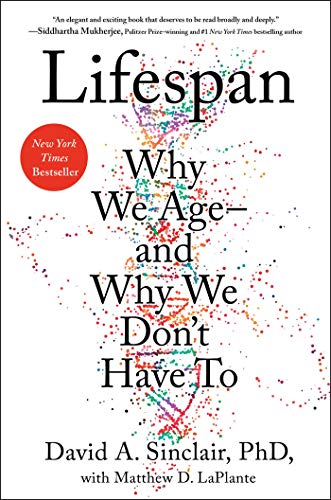 Lifespan: Why We Age and Why We Don't Have To by David Sinclair. Sinclair is a professor of genetics at Harvard Medical School and one of the most prominent voices in the longevity research community. His central claim in this 2019 book is that aging is not an inevitable consequence of biology but a disease with identifiable mechanisms, and that several of those mechanisms, particularly the loss of epigenetic information in cells, are potentially reversible. The book covers sirtuins, NAD+ metabolism, mTOR signaling, and the specific interventions Sinclair has experimented with on himself. The self-experimentation sections are the most controversial: several Sinclair critics in the research community argue that he presents his personal regimen as more evidence-based than the trials support. Read with that caveat in place, the molecular biology chapters are the clearest account of the current information-theory-of-aging hypothesis available for a general reader.
The Clinical Practitioner's Framework
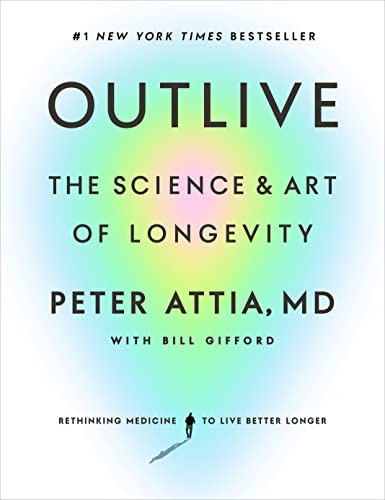 Outlive: The Science and Art of Longevity by Peter Attia. Attia is a physician who spent years at the National Institutes of Health studying cancer and now runs a clinical practice focused on longevity medicine. His angle on the same science is different from Sinclair's in a way that matters: where Sinclair is primarily a molecular biologist arguing from bench research, Attia is a clinician arguing from patient outcomes, and his insistence on distinguishing between what trials prove and what seems likely in clinical practice is the most useful intellectual habit in the longevity literature. The book's core argument is that the four horsemen of chronic disease (cardiovascular disease, cancer, neurodegenerative disease, and metabolic dysfunction) are not independent problems but share upstream causes that can be addressed decades before diagnosis. The exercise chapters are the most practically useful section; Attia's framework for what kinds of physical capacity matter at 80 and how to build them at 40 is more specific than anything comparable in print.
The Population Evidence
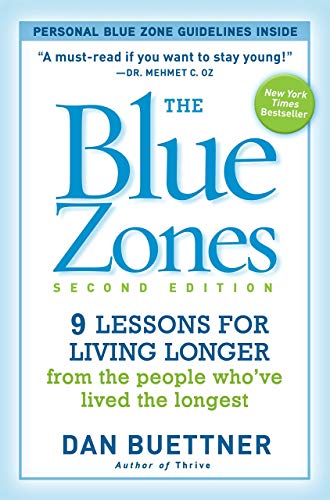 The Blue Zones: Lessons for Living Longer from the People Who've Lived the Longest by Dan Buettner. Buettner identified five geographic regions, Okinawa in Japan, Sardinia, Nicoya in Costa Rica, Ikaria in Greece, and Loma Linda in California, where people live measurably longer than the global average and where centenarians are significantly more common. The book is the account of what Buettner and his team of demographers and medical researchers found when they spent extended time in each place. The nine common factors they identified, plant-heavy diet, moderate and consistent physical activity, sense of purpose, stress management, moderate alcohol intake, belonging to a faith community, prioritising family, belonging to a social network, and eating to 80 percent fullness, have been debated extensively since. Some critics argue the Blue Zones data has been inflated by poor birth-record keeping; Buettner's updated editions address the specific objections. Even discounting the most contested claims, the patterns he documents are real and consistent with the experimental evidence.
The Biological Age Measurement
 True Age: Cutting-Edge Research to Help Turn Back the Clock by Morgan Levine. Levine is an assistant professor of pathology at Yale and was a principal investigator on the work that produced PhenoAge and GrimAge, two of the most widely used epigenetic clocks for measuring biological age. The practical implication is that two people with the same chronological age can have biological ages that differ by fifteen or twenty years, and that the gap is not fixed. True Age explains how epigenetic clocks work, what drives biological aging faster or slower, and what the evidence says about specific interventions. It is the most technically grounded book on this list after Sinclair, and Levine is more careful than Sinclair about separating correlational from causal evidence. Read alongside Lifespan to get the molecular biology from two researchers who agree on the basic science and disagree on some of the conclusions.
The Radical Case
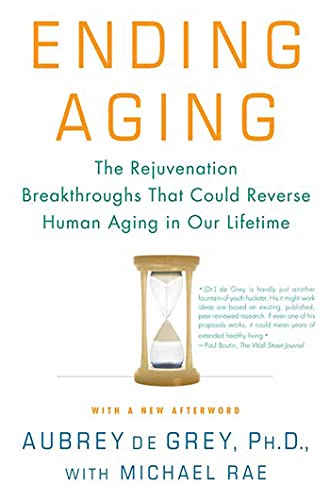 Ending Aging: The Rejuvenation Breakthroughs That Could Reverse Human Aging in Our Lifetime by Aubrey de Grey. De Grey is the most prominent advocate for the position that aging is an engineering problem that can be solved, not a biological constant that must be managed. His SENS (Strategies for Engineered Negligible Senescence) framework identifies seven categories of cellular and molecular damage that accumulate with age and proposes specific biotechnological approaches to repairing each. The book was published in 2007 and the specific timelines de Grey predicted have not held up; several of the SENS approaches that seemed speculative in 2007 have since received serious investment, while others have made less progress than he expected. Read as a map of the problem rather than a forecast, the framework remains the most systematic treatment of aging-as-engineering in the popular literature. The contrast with Attia's clinical conservatism is useful: both approaches are responses to the same problem.
The Dietary Intervention Evidence
The Longevity Diet: Discover the New Science Behind Stem Cell Activation and Regeneration to Slow Aging, Fight Disease, and Optimize Weight by Valter Longo. Longo is the director of the Longevity Institute at USC and the researcher who developed the Fasting Mimicking Diet protocol, which has been through clinical trials for cancer risk reduction, metabolic health, and aging markers. The book covers the evidence behind periodic fasting, the role of protein intake timing, and the Mediterranean-adjacent dietary pattern his epidemiological research identified in the Cilento region of southern Italy. Longo is more conservative than Sinclair about what the trials prove; his specific protocols are closer to what a physician would recommend than most longevity books, partly because he has the human clinical data to back them.
The Journalistic Survey
 Spring Chicken: Stay Young Forever (or Die Trying) by Bill Gifford. Gifford is a science journalist who spent several years investigating the longevity research community, attending conferences, visiting labs, and interviewing researchers ranging from the credible to the frankly eccentric. The result is the most critical and the funniest book on this list: Gifford is genuinely persuaded that some of the science is important and genuinely skeptical about much of the surrounding culture, and the combination makes for better reading than either pure enthusiasm or pure debunking. The chapters on the history of anti-aging medicine, which stretches from nineteenth-century testicle transplants through the HGH clinics of the 1990s, are the best account of the field's checkered record available in popular form. Read this last, after the more sympathetic accounts, and the longevity field will look more complicated and more interesting than either its advocates or its critics suggest.
What the Other Lists Miss
Longevity reading lists are overwhelmed by the big-name practitioners: Attia, Sinclair, Huberman, Rhonda Patrick. Two areas get consistent short shrift. The first is the evolution of aging: Steven Austad's Why We Age is the best account of why natural selection produces organisms that senesce rather than repairing indefinitely, which is the necessary background for evaluating any claim that aging can be reversed rather than just slowed. The second is the demography: Stuart Jay Olshansky and Bruce Carnes's The Quest for Immortality is a careful actuarial analysis of what the maximum plausible lifespan extension from known interventions would actually be. Their answer is considerably more conservative than Sinclair's or de Grey's, and the reasoning is sound.
The Reading Order
Attia first for the clinical framework and the clearest thinking about what the evidence actually supports. Then Buettner for the population data, which requires no laboratory to evaluate. Then Sinclair and Levine as a pair, both arguing from molecular biology with different levels of caution about translating bench research to individual practice. Longo alongside Sinclair if dietary intervention is your primary interest. De Grey as a thought experiment: the engineering framework is useful regardless of whether the timeline holds. Gifford last, as the journalist who has read all of the above and retained his skepticism.
Where to Go After the Longevity Books
The longevity literature connects to several Skriuwer categories. For the psychological component of long, healthy lives, the best books on stoicism cover the mental frameworks that appear in every Blue Zones population and in Attia's healthspan framework. For the broader science of human performance and exploration, the best books about space exploration cover what happens to the human body and mind when pushed to its limits in a different direction.
Your next good book, in your inbox
We only write when we find a book worth your time. Hand-picked recommendations across history, mythology, true crime and more.
Are you an author?
Get your book in front of readers like these, for free.
- Free book listing →Your own book page with an Amazon button
- Author page →Photo, bio and links to your site
- Featured placement →A spot in our best-of lists, from €29
Free tools we recommend
Get free honest reviewsReview exchange on iWrity, free to join
Books You Might Like

Sapiens: A Brief History of Humankind
Yuval Noah Harari

The Body Keeps the Score
M.D. Bessel van der Kolk

Why We Sleep
Matthew Walker

Astrophysics for People in a Hurry
Neil deGrasse Tyson