Best Books About Ancient China for Beginners: 10 That Make 5,000 Years Accessible
Most people approach Chinese history and almost immediately retreat. The dynasties blur together, the names are unfamiliar, and every overview seems to assume you already know what the Warring States period was. That is a shame, because the actual story is gripping. A civilization that lasted longer than Rome and Greece combined, that invented bureaucracy, paper money, gunpowder, and printing, and that produced two of the most widely read books in human history. The problem is not the material. It is finding the right books to start with. This list is that shortcut: ten books that open up ancient and early modern China for readers who are genuinely starting from zero.
The list covers both ancient China and key events in the centuries that followed, because understanding the Boxer Rebellion or the Silk Road requires knowing what came before. If you want the historical context first, the history of ancient China gives you the full arc. And if you want to see where Chinese civilization sits in the bigger story, our ancient civilizations timeline puts it alongside Egypt, Mesopotamia, and Rome.
Start Here: The Best Entry Points
Before anything else, you need a map of the whole thing. These two books give you that without demanding prior knowledge.
- The Search for Modern China by Jonathan Spence: the standard one-volume account of China from the late Ming dynasty to the late twentieth century. Spence was a Yale historian who spent decades making Chinese history readable for Western audiences, and this is his masterpiece. It is long, but every chapter moves. If you read only one book from this list, read this one first to understand the world that ancient China eventually became.
- The Story of China by Michael Wood: written to accompany Wood's BBC documentary series, this book covers the whole sweep of Chinese history in a narrative style built for general readers. Wood is a storyteller first, and it shows. The chapters on ancient dynasties are particularly strong for beginners who need an entry point that feels like reading a story rather than a textbook.
The Silk Road: How China Connected the Ancient World
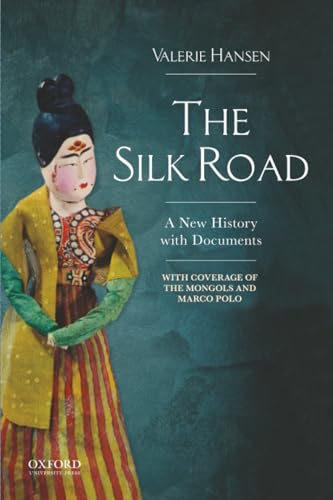 The Silk Road: A New History by Valerie Hansen is the book that changed how historians think about the route that connected China to the Mediterranean for a thousand years. Hansen based the book on documents and artifacts found at specific oasis towns along the road, which means the account is grounded in real objects and real people rather than the romantic myth of camel caravans carrying silk to Rome. What she found surprised even specialists: the Silk Road was not a single highway but a web of local trade networks, and silk was often the least of what moved along it. Ideas, religions, diseases, and technologies traveled faster than any luxury good.
For a beginner this is the right level of detail. Hansen writes clearly, the chapters are focused, and by the end you have a genuine sense of how China sat at the center of the ancient world's longest supply chain without ever needing to send an army west.
The Crisis That Ended Imperial China: The Boxer Rebellion
 The Boxer Rebellion by Diana Preston covers the 1900 uprising in which Chinese nationalist groups, known to Westerners as Boxers, besieged the foreign legations in Beijing for 55 days. Preston tells the story from multiple angles: the Boxer fighters who believed they were invulnerable to bullets, the Empress Dowager Cixi who encouraged the uprising and then tried to disown it, and the foreign diplomats and missionaries trapped inside the compound. It is history written as drama, and it works.
This is also one of the best entry points into why modern China thinks about foreign interference the way it does. The Boxer Rebellion and its aftermath, in which eight foreign powers divided up China's indemnity payments, left a wound that runs through Chinese foreign policy to this day. Preston gives you that context without making the book feel like a political lecture. It belongs on this list because you cannot understand China without understanding the century of humiliation that ended the imperial era.
The Primary Sources: Reading Ancient China in Its Own Words
The reward of studying ancient China is that its primary texts survived and are available in excellent modern translations. These two are the obvious place to start.
- The Art of War by Sun Tzu, translated by Thomas Cleary: written during the Warring States period, this is the oldest military treatise in the world and still required reading in business schools and military academies. Cleary's translation is the most readable of the major English versions. The book is short enough to finish in a single sitting and dense enough to reread for years. What most beginners do not expect is how much of it has nothing to do with war and everything to do with understanding situations before acting in them.
- Analects by Confucius, translated by Edward Slingerland: the collected sayings of Confucius, compiled by his students in the fifth century BCE. Slingerland's translation is the best available for readers coming to the text for the first time because it includes facing-page commentary that explains what each passage meant in its original context. Without that commentary the Analects can feel like fortune cookies. With it, the book reveals the complete social philosophy that shaped every Chinese dynasty for the next two thousand years.
Reading these two together changes how you see ancient China. Sun Tzu and Confucius were both responding to the same crisis: a world of competing states where violence was constant and the old social order had collapsed. Confucius argued that the solution was a return to ritual, family duty, and rulers who led by moral example. Sun Tzu argued that victory came through understanding your opponent better than they understood themselves. The tension between those two answers, moral persuasion versus strategic advantage, runs through Chinese history from the Qin unification to the present.
Going Deeper: Four More Books Worth Reading
Once you have the map in place, these four titles take you further into specific periods and questions.
- The Shortest History of China by Linda Jaivin: when you want the full dynastic story told fast, Jaivin's book does it better than anything else at this length. Every major dynasty from Shang to the People's Republic gets its turn, and the book never slows to academic pace. Read this after Wood's Story of China to fill in the gaps.
- Early China: A Social and Cultural History by Li Feng: the best scholarly survey of the formative period from the first oracle-bone inscriptions to the early empires. More detailed than the books above, but clearly written and grounded in current archaeology. This is the book to read when you want to know what life actually looked like in a Zhou dynasty village.
- The Early Chinese Empires: Qin and Han by Mark Edward Lewis: the standard account of the two dynasties that turned a patchwork of warring states into a single empire with shared script, currency, and bureaucracy. The institutions built under the Qin and Han lasted in some form until 1912. Lewis explains how they worked and why they survived so long.
- China's First Emperor and His Terracotta Warriors by Frances Wood: the most accessible book on Qin Shi Huang, the ruler who unified China and ordered an army of 8,000 life-sized clay soldiers to guard his tomb. Wood separates the documented history from the legend, including the emperor's fatal search for an elixir of immortality. Farmers digging a well discovered the site in 1974 and excavation is still going on today.
What Beginners Get Wrong About Chinese History
The most common mistake is treating Chinese history as monolithic. The word "China" covers dozens of distinct states, cultures, and peoples across three thousand years of documented history. The Shang and the Qing had about as much in common as ancient Athens and modern Greece. When you read Spence, Wood, or Hansen, notice how often the authors point out that "Chinese" identity was constructed and contested rather than fixed.
The second mistake is skipping the philosophy. Western readers often treat the Analects and The Art of War as bonus material after the main history. They are not. They are the primary sources that explain why Chinese civilization worked the way it did. Reading Confucius after reading about the Han dynasty is like reading the Gospels after studying the Roman Empire. The philosophy is not separate from the history; it is the operating system that ran underneath it.
Your Reading Order for Ancient China
Start with Michael Wood's Story of China for the narrative overview, then read Jonathan Spence's Search for Modern China to understand how the ancient world became the modern one. Pick up Valerie Hansen's Silk Road next for a focused look at China's place in the ancient global economy. Read The Art of War and the Analects in parallel, short books that repay slow reading. Then go back to the deeper titles, Li Feng for the early dynasties, Lewis for Qin and Han, Frances Wood for the Terracotta Army, and Diana Preston for the moment the imperial era ended. That sequence takes you from complete beginner to genuinely well-read on the subject, and it does it in books that are worth reading for themselves rather than just for the information they contain.
More picks in our full ancient China reading list and the broader Skriuwer history collection.
Your next good book, in your inbox
We only write when we find a book worth your time. Hand-picked recommendations across history, mythology, true crime and more.
Are you an author?
Get your book in front of readers like these, for free.
- Free book listing →Your own book page with an Amazon button
- Author page →Photo, bio and links to your site
- Featured placement →A spot in our best-of lists, from €29
Free tools we recommend
Get free honest reviewsReview exchange on iWrity, free to join
Books You Might Like

Sapiens: A Brief History of Humankind
Yuval Noah Harari
The Last Kingdom (The Saxon Stories, Book 1)
Bernard Cornwell

Meditations
Marcus Aurelius

The Hiding Place
Elizabeth Sherrill, John Sherrill Corrie ten Boom