Best Books About Climate Change and the Environment in 2026: 10 You Need to Read
Environmental writing carries an unusual burden. It has to persuade readers to care about something that often operates on timescales longer than human attention, using evidence that is genuinely complex, against the resistance of industries with enormous financial interest in people remaining uninformed. The books that succeed at this task do not do so by being simple. They do it by being so precise, so deeply reported, and so well written that the complexity becomes compelling rather than alienating.
The titles on this list span more than sixty years, from Rachel Carson's 1962 Silent Spring to recent work by David Wallace-Wells and Andreas Malm. Together they trace the arc of environmental thought from its origins to the present, covering the science, the politics, the economics, and the specific ways that human activity is reshaping natural systems. If you read all of them, you will understand the environmental crisis at a level that most commentary, even well-intentioned commentary, does not reach.
Why This Reading List Exists
Climate and environment are subjects that produce more heat than light in most public conversation. People who have not engaged with the primary sources often hold positions that are either too optimistic, the problems will solve themselves through technological innovation, or too fatalistic, nothing can be done. The books here are written by people who spent years, in some cases careers, studying specific aspects of what is actually happening. Their conclusions are more nuanced and ultimately more useful than either extreme.
Understanding the problem at this level does not guarantee you will know what to do about it. But it does make you a more accurate thinker about one of the most consequential issues of the next century.
Silent Spring by Rachel Carson

Rachel Carson's Silent Spring, published in 1962, is the book that created the modern environmental movement. Carson was a marine biologist who had spent years writing accessibly about the natural world. Silent Spring was her account of what synthetic pesticides, particularly DDT, were doing to bird populations, ecosystems, and the food chain.
The book faced an immediate and well-funded counter-campaign from the chemical industry. Carson was attacked personally and professionally. She died of cancer two years after the book's publication and did not live to see DDT banned in the United States in 1972, a direct consequence of the public pressure her work created.
Silent Spring established several patterns that all subsequent environmental writing would follow: the detailed scientific documentation, the accessible prose that translated technical findings for general readers, the political analysis of why dangerous practices were being permitted to continue, and the underlying argument that the natural world had its own integrity that human economic activity was not entitled to destroy.
The End of Nature by Bill McKibben
Bill McKibben published The End of Nature in 1989. It was the first book about climate change written for a general audience. McKibben's central argument was philosophical as much as scientific: that human activity had changed the atmosphere so fundamentally that no part of the natural world could any longer be understood as existing independently of human influence. The idea of nature as something separate from and prior to human civilization was no longer accurate.
The book is not primarily about predictions or policy. It is about loss: the loss of the idea of a world that existed on its own terms. McKibben wrote it from Vermont, and the passages about watching weather patterns change in familiar landscapes remain among the most affecting pieces of environmental prose in the language.
The Sixth Extinction by Elizabeth Kolbert
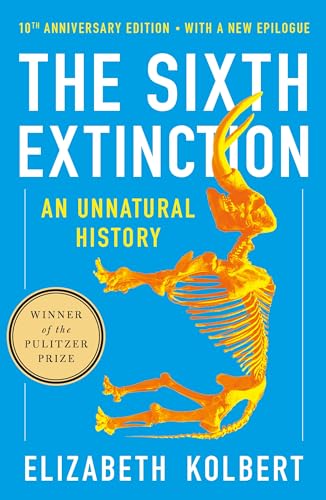
Elizabeth Kolbert won the Pulitzer Prize for The Sixth Extinction in 2015. The book is an account of the current mass extinction event, the sixth in the planet's history, the previous five having been caused by asteroid impacts, volcanic events, and other geological catastrophes. This one is caused by human activity.
Kolbert structures the book around specific species and specific places: a colony of white-nosed bats in upstate New York being killed by an introduced fungal disease, a population of great auks that human hunters drove to extinction in the nineteenth century, coral reef systems bleaching as ocean temperatures rise. Each chapter is reported on location, with the scientists studying that particular extinction. The cumulative effect is overwhelming in the precise way that the best journalism achieves: not through argument but through specific, documented fact after specific, documented fact.
This Changes Everything by Naomi Klein
Naomi Klein's This Changes Everything, published in 2014, is the most politically explicit book on this list. Klein's argument is that climate change cannot be addressed within the existing framework of market capitalism because the necessary speed and scale of transition conflicts fundamentally with the logic of markets. The book is not primarily a scientific account but a political economy analysis of why the response to climate change has been so inadequate despite such clear evidence.
Klein traveled extensively for the book, reporting from communities fighting coal extraction in Montana, from Greece during the financial crisis, from Bolivia, and from communities along the Alberta tar sands pipeline routes. Her point is that the people most immediately harmed by extractive industry are also the ones most committed to opposing it, and that understanding climate politics requires understanding whose land and water and health are being traded for whose profits.
The Botany of Desire by Michael Pollan
Michael Pollan's approach to environmental writing is oblique rather than frontal. The Botany of Desire tells the story of four plants, apples, tulips, cannabis, and potatoes, and the specific human desires each one exploited to spread itself across the world. The book inverts the usual perspective: instead of asking how humans shaped these plants, Pollan asks how these plants shaped human history and culture.
The potato chapter is a study in agricultural monoculture. Industrial potato farming in the United States produces potatoes of extraordinary uniformity because McDonald's requires it, and that uniformity makes the entire crop vulnerable to a single pathogen in ways that diverse traditional cultivation never was. The Irish Famine was caused partly by the same dynamic on a much smaller genetic base. Pollan shows how the industrial food system creates fragilities that are not visible in the product that arrives in the grocery store.
The Uninhabitable Earth by David Wallace-Wells
David Wallace-Wells published The Uninhabitable Earth in 2019. It is the most comprehensive account of what the scientific literature on climate impacts actually says if you read it without the hedging that political concern tends to produce in public climate communication. Wallace-Wells is not a scientist but a journalist who spent years reading the research and talking to the researchers.
The book covers heat death, hunger, drowning, wildfire, unbreathable air, plagues, economic collapse, climate conflict, and systems failure: not as worst-case scenarios but as outcomes that are already underway at different degrees of completion depending on how much warming occurs. Wallace-Wells is explicit about his methodology: he wanted to describe the upper range of plausible impacts, not because he thought catastrophism was useful, but because he believed the full range of risk was being systematically understated in public discussion.
Fossil Capital by Andreas Malm
Andreas Malm's Fossil Capital is an academic work that has influenced environmental thought far beyond the academy. Malm is a political ecologist who set out to answer a specific historical question: why did capitalism adopt fossil fuels as its primary energy source in the nineteenth century, when water power was in many cases cheaper and more efficient?
His answer is about labor control. Steam power was movable. You could build a factory anywhere there was coal, including cities where workers had nowhere else to go. Water power required locating factories near rivers, which gave workers geographic leverage and access to land that made total dependence on wage labor harder to enforce. The capitalist adoption of fossil fuels was not primarily a technological choice but a political one, made because it increased the power of capital over labor. Malm's argument is that understanding this history is essential for understanding why the fossil fuel economy is so difficult to dismantle.
Reading These Books as a Sequence
Carson establishes the foundational argument that economic activity does not have an unlimited license to destroy natural systems. McKibben extends that argument to the atmosphere and gives it a philosophical dimension. Kolbert documents the current extinction event with forensic precision. Klein analyzes the political economy of why adequate responses have not happened. Pollan shows the same dynamics operating in food systems. Wallace-Wells assembles the impact science into a single picture. Malm provides the historical analysis of why fossil capital is so structurally entrenched.
Each book answers a different question. Together they produce a complete understanding of how we got here and why it is so difficult to change course.
Where to Start
- Silent Spring by Rachel Carson - The founding text of environmental writing. Still essential sixty years after publication, both for what it argues and for how Carson established the genre.
- The Sixth Extinction by Elizabeth Kolbert - The best reported environmental book of the past decade. Pulitzer Prize-winning journalism at its best: precise, specific, and genuinely alarming in ways that are earned rather than rhetorical.
- The Uninhabitable Earth by David Wallace-Wells - The most complete account of what the climate science actually says about impacts. Read this if you want to understand the scale of what is being discussed when scientists talk about different degrees of warming.
Your next good book, in your inbox
We only write when we find a book worth your time. Hand-picked recommendations across history, mythology, true crime and more.
Are you an author?
Get your book in front of readers like these, for free.
- Free book listing →Your own book page with an Amazon button
- Author page →Photo, bio and links to your site
- Featured placement →A spot in our best-of lists, from €29
Free tools we recommend
Get free honest reviewsReview exchange on iWrity, free to join
Books You Might Like

Sapiens: A Brief History of Humankind
Yuval Noah Harari

The Body Keeps the Score
M.D. Bessel van der Kolk

Why We Sleep
Matthew Walker

Astrophysics for People in a Hurry
Neil deGrasse Tyson