Best Books About Politics and Democracy in 2026: 10 That Explain the System
Most political commentary ages fast. A book that felt urgent during one election cycle reads as historical artifact four years later. The books on this list are the exceptions: works that identified something structural about how power operates, how democracies weaken, and what citizens need to understand if they want to engage with politics as it actually exists rather than as civics textbooks describe it.
These books span several centuries and multiple continents. What connects them is that each one gave its readers a framework that outlasted the specific moment in which it was written. Alexis de Tocqueville visited the United States in 1831 and wrote observations about democratic culture that political scientists still cite. Robert Caro spent decades following a single political career and produced the most detailed account of how power is accumulated and used that anyone has written in the English language.
What are the best books about politics and democracy?
The best books about politics and democracy are Robert Caro's The Power Broker for how power accumulates, Hannah Arendt's The Origins of Totalitarianism for how institutions collapse, Alexis de Tocqueville's Democracy in America for democratic culture, Steven Levitsky and Daniel Ziblatt's How Democracies Die for modern erosion, and Timothy Snyder's On Tyranny for what citizens can do. Start with How Democracies Die.
Why Political Books Are Worth Your Time
Understanding politics requires understanding history, institutions, psychology, and the specific ways that concentrated power tends to behave. These are not things you absorb from news coverage, which by nature focuses on individual events and individual actors rather than the systems that produce them.
The books here teach you to see the systems. After reading The Power Broker, you will never look at urban infrastructure the same way. After reading How Democracies Die, you will recognize the early warning signs of democratic erosion regardless of which country you are observing. These frameworks are durable because they describe patterns that recur across very different historical contexts.
The Power Broker by Robert Caro
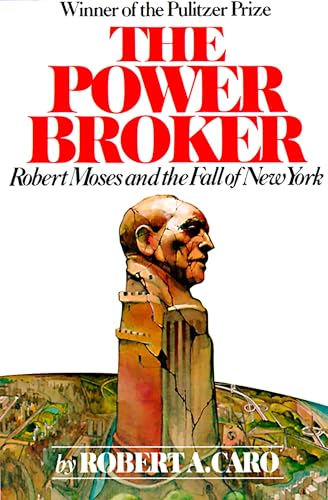
The Power Broker, published in 1974, is a 1,200-page biography of Robert Moses, who held no elected office yet shaped New York City and its surrounding region more decisively than any mayor or governor who served during his fifty-year career. Moses controlled parks, highways, bridges, housing projects, and public authorities, and he used that control to accumulate more control, deliberately building institutions that could not be dismantled without enormous cost.
Caro's central argument is about the nature of power itself. Moses taught himself, through decades of practice, how to make himself structurally indispensable. He wrote the legislation that created his authorities in ways that made removing him effectively impossible. He held multiple positions simultaneously so that eliminating one position did not touch the others. He maintained control of funding streams that no governor wanted to lose. By the time any single politician understood what he had built, Moses had already made himself too embedded to remove.
The book is also about what unaccountable power does to a person. The young Moses of the 1920s had genuine ideals about public parks and democratic access to recreation. The Moses of the 1950s was running highways through working-class neighborhoods, deliberately building bridges too low for buses so that poor New Yorkers could not reach the beaches he had built. Power, Caro shows, changes what people want from it.
The Origins of Totalitarianism by Hannah Arendt
Hannah Arendt published The Origins of Totalitarianism in 1951, just six years after the end of World War II. She had fled Nazi Germany herself and spent years as a stateless refugee. The book is an attempt to understand how totalitarian regimes, specifically Nazism and Stalinism, were able to emerge, gain mass support, and do what they did.
Arendt's analysis is not comforting. She argues that totalitarianism was not simply an extreme version of older political forms like tyranny or dictatorship. It was something genuinely new, made possible by specific conditions of modern mass society: the collapse of traditional institutions that had given people a sense of belonging, the creation of atomized individuals who were politically homeless, and the availability of ideological movements that offered total explanations for total alienation.
The book is difficult but essential. No other work does as much to explain how ordinary people come to support extraordinary political violence.
Homage to Catalonia by George Orwell
George Orwell went to Spain in 1936 to fight for the Republican side in the civil war. He arrived as a journalist and ended up enlisting in the POUM militia, a Marxist formation that the Soviet-backed Communist Party later tried to destroy. Homage to Catalonia is his eyewitness account of what happened.
The book matters because Orwell was watching something he had believed in, the international left's commitment to anti-fascism, turn into something he could not defend. He saw comrades denounced as fascist agents on fabricated charges. He watched the party he was fighting alongside get systematically suppressed by supposed allies. He went to Spain as an idealist and came back knowing that political movements, including ones he sympathized with, were capable of the same tactics they claimed to oppose.
That experience directly produced Animal Farm and Nineteen Eighty-Four. Reading Homage to Catalonia is reading the source material for two of the most important political allegories of the twentieth century.
Democracy in America by Alexis de Tocqueville
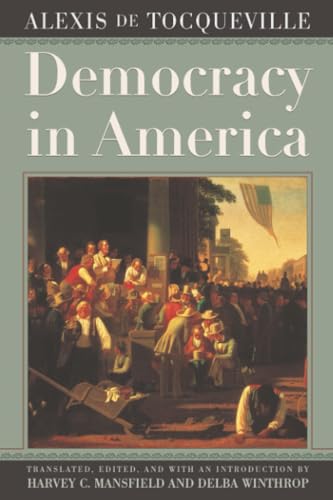
Alexis de Tocqueville visited the United States in 1831 when he was twenty-five years old. He spent nine months traveling the country and then spent several years writing Democracy in America, which was published in two volumes in 1835 and 1840. It is one of the most astute pieces of political observation ever produced.
Tocqueville was interested in how democratic culture worked at the level of everyday life, not just at the level of formal institutions. He noticed that Americans formed voluntary associations for almost every purpose, civic, religious, charitable, professional, and he argued this habit was what made democracy functional. People who were used to organizing themselves collectively did not need the government to organize things for them. He also noticed something he called tyranny of the majority, the way democratic culture could produce conformism, a pressure to hold approved opinions, that was more insidious than the pressure of an autocrat because it came from peers rather than from above.
Almost everything Tocqueville identified in 1830s America remains observable in American political culture today, which is either a tribute to his insight or an observation about how slowly cultures change.
How Democracies Die by Steven Levitsky and Daniel Ziblatt
Published in 2018, How Democracies Die is the most practically useful political science book of the past decade. Levitsky and Ziblatt are Harvard professors who study democratic breakdown. They looked at every case they could find in which a democracy transitioned to authoritarianism during the twentieth century and identified the consistent patterns.
The central finding is that most modern democracies do not end with a coup. They end through a slow process in which elected leaders dismantle the institutional guardrails, the norms and rules that constrain the use of power, while maintaining the appearance of democratic legitimacy. The leaders who do this share specific behavioral indicators early in their careers: refusing to accept the legitimacy of political opponents, encouraging violence, willingness to use legal mechanisms to suppress critics. The book gives you a checklist that works across very different political contexts.
On Tyranny by Timothy Snyder
Timothy Snyder is a historian of Eastern Europe and the Holocaust. On Tyranny is a short book, 128 pages, structured as twenty lessons drawn from the political history of the twentieth century. Each lesson is a specific practice: defend institutions, beware the one-party state, believe in truth, be kind to the language.
The brevity is the point. Snyder was trying to produce something that people would actually finish and remember. The lessons are grounded in concrete historical examples, cases where specific practices either prevented or enabled the rise of authoritarian government. The book is not theoretical. It is a practical manual drawn from cases where getting these things wrong had catastrophic consequences.
The End of History and the Last Man by Francis Fukuyama
Francis Fukuyama published The End of History in 1992, shortly after the collapse of the Soviet Union. His argument was that liberal democracy had defeated its major ideological competitors and represented the endpoint of political development. The book was immediately influential and immediately controversial, and it has been misquoted and misread ever since.
Fukuyama was not predicting the end of events or conflicts. He was arguing about ideology: that no serious alternative to liberal democracy as a political framework had survived the twentieth century's experiments. The book is worth reading now not because Fukuyama was right, the subsequent thirty years have generated serious challenges to that thesis, but because understanding his argument is necessary for understanding why the political debates of the 2010s and 2020s felt so disorienting to people who had assumed liberal democracy was the default stable outcome.
Why These Books Together
Read as a group, these books give you something that any single one of them cannot: a layered understanding of how political systems function, fail, and sometimes recover. Caro shows you how power accumulates at the institutional level. Arendt shows you what happens when institutions fail completely. Tocqueville shows you the cultural prerequisites for democracy that no constitution can simply create. Levitsky and Ziblatt show you the specific mechanisms through which democracies erode in contemporary conditions. Snyder shows you what individuals can do about it.
Where to Start
- How Democracies Die by Levitsky and Ziblatt - The most immediately useful book on the list. Short, well-organized, and applicable to current events without being tied to any specific moment.
- The Power Broker by Robert Caro - The deepest account of how power works at close range. Long, but every hundred pages teaches you something you will not find anywhere else.
- Democracy in America by Tocqueville - The foundational text for understanding what makes democratic culture, as opposed to democratic institutions, actually function.
Your next good book, in your inbox
We only write when we find a book worth your time. Hand-picked recommendations across history, mythology, true crime and more.
Are you an author?
Get your book in front of readers like these, for free.
- Free book listing →Your own book page with an Amazon button
- Author page →Photo, bio and links to your site
- Featured placement →A spot in our best-of lists, from €29
Free tools we recommend
Get free honest reviewsReview exchange on iWrity, free to join
Books You Might Like

Sapiens: A Brief History of Humankind
Yuval Noah Harari
The Last Kingdom (The Saxon Stories, Book 1)
Bernard Cornwell

Meditations
Marcus Aurelius

The Hiding Place
Elizabeth Sherrill, John Sherrill Corrie ten Boom