Best Books About the Ocean and Deep Sea in 2026: 10 That Plunge Into Earth's Final Mystery
Updated June 2026. The OceanGate Titan implosion of June 2023 pushed deep-sea exploration back into mainstream conversation, and Helen Scales's The Brilliant Abyss has been on Amazon's oceanography bestseller list almost continuously since. More recently, a 2025 NOAA expedition to the Mariana Trench found plastic at 11,000 metres depth, a fact that has pushed Callum Roberts's The Ocean of Life back onto environmental reading lists. Both are on this list for reasons that precede the news cycle.
The ocean covers 71 percent of Earth's surface. We have mapped roughly 25 percent of the seafloor, a smaller proportion than we have mapped of Mars. The books below are the ones that make that fact feel like what it is: one of the stranger aspects of existing on this planet.
Skriuwer orders by readability and subject coverage. This list deliberately mixes scientific nonfiction, environmental writing, and true-story survival because the ocean literature spans all three, and the best understanding of the subject comes from reading across the categories. For the natural-world thread the list connects to, our guides to the best books about ancient civilizations and the best books about World War 2 are part of the broader human-at-the-edge cluster.
Start Here: The Scientific Case for the Deep
The Brilliant Abyss: Exploring the Majestic Hidden World of the Deep Ocean by Helen Scales. Scales is a marine biologist who has also written for the Guardian, the Atlantic, and BBC Science Focus, and the combination shows. The book opens at the bottom of the Mariana Trench and works outward, covering the biology of hydrothermal vent ecosystems, the physics of pressure at depth, the strange creatures that navigate permanent darkness, and the growing commercial pressure on regions of the seabed that humans reached only in the past generation. The chapter on deep-sea mining is the most current account of the specific policy debate in any book-length treatment and holds up better than most journalism on the subject. Read this first and the rest of the list comes into focus.
The Environmental History
 The Ocean of Life: The Fate of Man and the Sea by Callum Roberts. Roberts is a marine conservation biologist at the University of Exeter, and this is the comprehensive account of what humans have done to the ocean since industrialisation. The core argument is that we are using centuries-old mental maps of an abundant sea to make policy for an ocean that has lost the majority of its large fish in fifty years. Roberts covers ocean acidification, dead zones, bottom trawling, plastic accumulation, and the collapse of specific fisheries in detail, but the book is not an obituary. The final section on marine protected areas and the science behind their effectiveness is one of the more grounded arguments for a specific intervention in the environmental literature.
The Classic That Started the Genre
The Sea Around Us by Rachel Carson. Published in 1951, Carson's book spent 86 weeks on the New York Times bestseller list, won the National Book Award, and is still in print. The subject is the ocean itself: its origin, its currents, its floor, its effect on weather, and the life it contains. Carson was a marine biologist for the US Fish and Wildlife Service and wrote with a precision that most science journalists have not matched since. Read in 2026, the book is partly a document of what the ocean looked like before the industrial fishing, plastic pollution, and acidification that Roberts's book describes. The two books make a natural pair.
The Survival Account
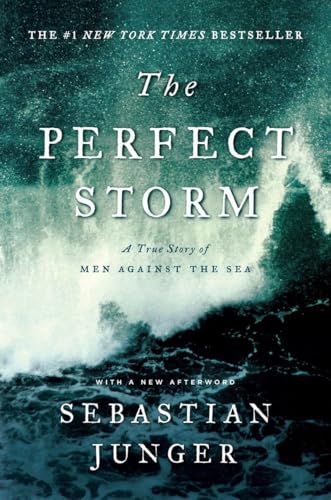 The Perfect Storm: A True Story of Men Against the Sea by Sebastian Junger. In October 1991, the sword-fishing boat Andrea Gail sank in a storm off the coast of Nova Scotia. Junger reconstructed the six-man crew's final voyage from weather records, radio transcripts, and interviews with the families, and produced one of the most read pieces of maritime journalism of the past thirty years. The meteorology chapters are unusually technical for a commercial nonfiction book; Junger explains the convergence of three weather systems that produced the storm with a precision that made the book a standard reference for marine weather education. The human story is inseparable from the meteorology, which is what makes the book work as literature rather than just as a disaster account.
The Conservation Argument
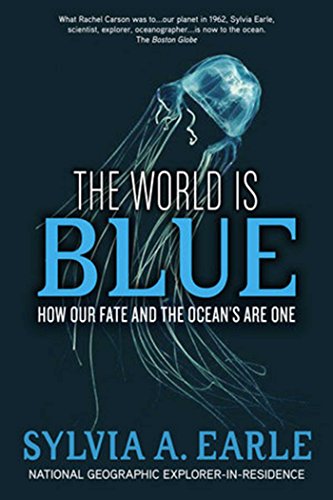 The World Is Blue: How Our Fate and the Ocean's Are One by Sylvia Earle. Earle has spent more time underwater than any other human: over 7,000 hours, including a 1979 solo dive to 381 metres in a JIM suit that remains a record for untethered deep walking. She was the first female chief scientist of NOAA and has been National Geographic's Explorer in Residence since 1998. This book is her case for why ocean health is not a separate environmental issue from climate, food security, and economic stability, but the same issue from a different angle. Earle is a better field scientist than she is a writer, but the accumulated weight of her direct observation gives the argument a grounding that few ocean books can match.
The Novel That Defined the Genre
 Twenty Thousand Leagues Under the Sea by Jules Verne. Published in 1870, Verne's novel imagined a submarine, the Nautilus, capable of traveling the world's oceans at depth, and invented the fictional lexicon of deep-sea exploration that every subsequent writer in the genre has borrowed from. The science is wrong in specific ways that are interesting: Verne's ocean creatures are accurate to the knowledge of 1870, which means several species he describes as monsters are now understood as real animals. Read alongside the scientific books on this list, the novel is a document of what the deep sea looked like to human imagination before we had the technology to actually look. Captain Nemo remains one of the great literary characters: brilliant, alienated, and using technology to escape from a political grievance that Verne deliberately leaves ambiguous.
Twenty Thousand Leagues Under the Sea on Amazon
The Wave Science
The Wave: In Pursuit of the Rogues, Freaks, and Giants of the Ocean by Susan Casey. For most of maritime history, rogue waves, individual walls of water 30 metres or taller that appear without warning in otherwise moderate seas, were dismissed as sailor myth. Then in 1995 the laser altimeter on the Draupner oil platform in the North Sea measured a confirmed 26-metre wave in a sea where the significant wave height was 12 metres. Casey uses the rogue-wave science as a frame for a book that is partly about big-wave surfing, partly about maritime disasters that are now being reanalysed in light of the rogue-wave evidence, and partly about the oceanographers building computer models that can finally predict when and where the largest waves are likely to form. The surfing sections are slower; the disaster and science sections are among the most gripping maritime writing in print.
What the Other Lists Miss
Ocean-book lists tend to cluster around three angles: the environmental catastrophe argument, the adventure memoir, and the popular biology survey. Two categories that deserve more attention are the history of oceanographic science and the economics of commercial fishing. Robert Kunzig's Mapping the Deep is the best account of how the modern scientific picture of the seafloor was assembled, from the Challenger expedition of 1872 through the development of multibeam sonar. For the fishing economics, Charles Clover's The End of the Line is the most precise account of how European and North American fishing policy failed in ways that were entirely predictable, and what a scientifically managed recovery would actually require.
The Reading Order
Scales for the current scientific picture of the deep, then Carson to see what the ocean looked like to a scientist in 1951, then Roberts for the fifty-year record of human impact between the two. Junger and Casey sit alongside rather than in sequence: both are better read for what they reveal about human relationships to sea conditions than as contributions to the environmental argument. Earle and Verne are the bookends, one the most experienced human witness to the ocean alive today, the other the writer who set the imaginative vocabulary for everything that came after.
Where to Go After the Ocean Books
The ocean literature connects to several Skriuwer categories. For the broader environmental and scientific history, the best books about ancient civilizations place human relationship with natural systems in long historical context. For the survival-and-endurance thread that Junger represents, the best military history books cover comparable human-at-the-limit material on land.
Your next good book, in your inbox
We only write when we find a book worth your time. Hand-picked recommendations across history, mythology, true crime and more.
Are you an author?
Get your book in front of readers like these, for free.
- Free book listing →Your own book page with an Amazon button
- Author page →Photo, bio and links to your site
- Featured placement →A spot in our best-of lists, from €29
Free tools we recommend
Get free honest reviewsReview exchange on iWrity, free to join
Books You Might Like

Sapiens: A Brief History of Humankind
Yuval Noah Harari

The Body Keeps the Score
M.D. Bessel van der Kolk

Why We Sleep
Matthew Walker

Astrophysics for People in a Hurry
Neil deGrasse Tyson