Best Sports Books of All Time: 10 That Capture Why We Love the Game
Sports books exist in two completely different categories. The first category is everything you forget by next season: game recaps dressed as books, ghostwritten memoirs that avoid every interesting detail, cash-in titles designed to move units during the playoffs. The second category is something else entirely. These books use sports as a lens to examine money, obsession, failure, class, race, and what it means to give your whole life to something that does not last. The titles on this list belong to the second category.
The best sports writing does not assume you care about the sport being described. Roger Kahn writes about baseball for readers who have never watched a game. Nick Hornby writes about football for people who find football inexplicable. The game is the setting; the subject is always people.
What Makes a Sports Book Last
Great sports writing captures something that pure statistics and highlight reels cannot. A box score tells you who won. A box score does not tell you what the locker room smelled like after a team that had been together for fifteen years played its final game, or what a player thinks about at 3 a.m. when his body has given out but his career has not officially ended yet.
The writers on this list got inside those rooms. Some of them spent entire seasons embedded with teams, living the schedule, eating the food, riding the buses. Others reconstructed events years after the fact with documentary precision. All of them understood that the sporting event is the visible surface of something deeper, and they went after the deeper thing.
Moneyball by Michael Lewis

Published in 2003, Moneyball is the book that changed how people think about sports, business, and expertise simultaneously. Lewis followed Billy Beane, general manager of the Oakland Athletics, through the 2002 season. Oakland had one of the lowest payrolls in Major League Baseball. They were competing against teams with three times their budget. Beane decided the only way to win was to find value that everybody else was ignoring.
What he found was that baseball's established wisdom was wrong on almost every measurable point. The scouts who had run the sport for decades were evaluating players using criteria that had almost no relationship to actual performance. On-base percentage, an unglamorous stat that nobody celebrated, turned out to be more predictive of scoring runs than batting average, the stat that everyone celebrated. Beane built a team around undervalued players and took Oakland to 103 wins.
Lewis is one of the best narrative nonfiction writers alive, and Moneyball is his most perfectly constructed book. It works as a sports story, a business book, an epistemology lesson about how experts systematically misread evidence, and a character study of a man who was supposed to become a star player and did not. If you have not read it, start here.
The Breaks of the Game by David Halberstam
David Halberstam embedded himself with the Portland Trail Blazers for the entire 1979-80 NBA season. The result is a book that uses one basketball team to examine everything wrong with professional sport: the impossible physical demands placed on players' bodies, the toxic relationship between athletes and owners, the way television money was already reshaping the game even before the cable revolution.
Halberstam was a Pulitzer Prize-winning journalist who covered Vietnam and the civil rights movement. He brought that same gravity to basketball. The Breaks of the Game is not a celebration. It is a clear-eyed account of what it actually costs to play sport at the highest level, and what the system extracts from the people it consumes.
A Season on the Brink by John Feinstein
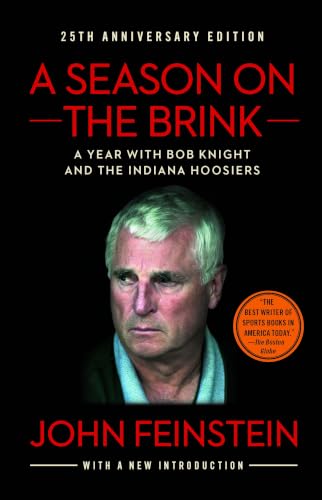
John Feinstein spent the 1985-86 season inside Indiana University's basketball program, following coach Bob Knight. Knight was the most successful college basketball coach of his era and also one of the most volatile. Feinstein documented everything: the practices, the arguments, the moments when Knight's temper crossed lines that most coaches never approached.
A Season on the Brink became the best-selling sports book ever published to that point. Knight reportedly tried to stop its publication. The reason it worked is that Feinstein did not write a profile, he wrote an immersion. He was there for the shouting matches, the strategic brilliance, the genuine care Knight had for some players and the cruelty he directed at others. The book captures a coaching philosophy that produced championships while also being genuinely difficult to defend.
The Boys of Summer by Roger Kahn
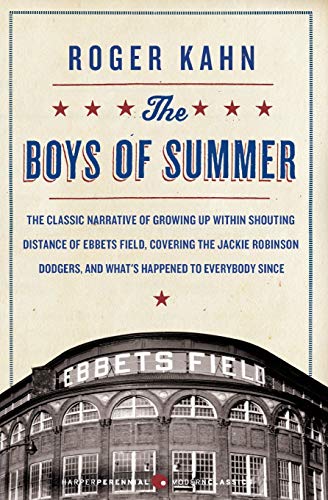
Roger Kahn covered the Brooklyn Dodgers for the New York Herald Tribune in the early 1950s. Those were the years of Jackie Robinson, Roy Campanella, Duke Snider, and Pee Wee Reese. They were also the years just before the Dodgers moved to Los Angeles, taking a piece of Brooklyn's identity with them. The Boys of Summer, published in 1972, interweaves Kahn's memories of covering the team with a present-day portrait of what happened to those same players twenty years later.
What he found was unsettling. Former stars working in grocery stores. Players dealing with health problems their bodies had never recovered from. Men who had been celebrated by millions now living in ordinary obscurity. The book is not sad exactly, but it does not flinch from the mathematics of athletic careers, which is that they are short, the years after them are long, and the world does not stay interested.
Seabiscuit by Laura Hillenbrand
Laura Hillenbrand wrote Seabiscuit while suffering from a severe chronic illness that left her largely housebound. The book is about a horse who should not have been a champion, trained by a man who ran a stable out of a roadside hotel, owned by a businessman who lost his son and then his fortune in the Depression, and ridden by a jockey who was nearly blind in one eye. Every element of the story is improbable, and Hillenbrand renders it with the precision of a historian and the momentum of a thriller writer.
The 1930s backdrop is as important as the racing. Seabiscuit gave Depression-era Americans something to believe in during the worst years of the twentieth century. Hillenbrand shows you exactly why that mattered, and how a single horse could become a national symbol at a moment when the country desperately needed one.
Fever Pitch by Nick Hornby
Nick Hornby's 1992 memoir about supporting Arsenal is not primarily about football. It is about obsession as a coping mechanism. Hornby traces his relationship with Arsenal from age eleven, when he attended his first game with his recently divorced father, through his thirties. The club becomes a fixed point in an otherwise unstable life. When everything else is uncertain, there are always matches, always a season, always something to care about fiercely.
Hornby is honest about how irrational this is. He knows that Arsenal's results have no bearing on the quality of his existence. He also knows that this knowledge makes no difference at all. Fever Pitch works because it accurately describes a feeling that anyone who has ever attached themselves to a team will recognize, and it does so with a self-awareness that makes it funny rather than bleak.
Paper Lion by George Plimpton
In 1963, George Plimpton convinced the Detroit Lions to let him train with the team as a quarterback and then play in an exhibition game. He was a writer, not an athlete. The resulting book is one of the most original pieces of sports journalism ever written, because Plimpton was not observing from the outside. He was inside the experience, and he was genuinely terrible at the actual sport.
Paper Lion launched the participatory journalism genre. Plimpton understood that the most revealing perspective was not the champion's but the outsider's. By putting himself in situations where he would obviously fail, he exposed what professional sport actually demands, and he did it with wit and complete absence of vanity about his own limitations.
Why These Books Hold Up
The common thread is seriousness. None of these writers treated sport as trivial. All of them understood that the moments that happen on fields and courts and tracks carry the full weight of human experience: ambition, failure, time running out, the gap between what you wanted to be and what you became. Sport is one of the few arenas where that drama plays out in public, which is why it produces such good writing when the writers are paying attention.
If you work through this list, you will understand sport better, but you will also understand people better. That is the test. The best books about any subject teach you something that extends beyond the subject itself.
Where to Start
- Moneyball by Michael Lewis - The essential sports business book. Accessible to readers who have no interest in baseball. One of the best popular nonfiction books published this century.
- The Boys of Summer by Roger Kahn - The best book about what happens after the career ends. A meditation on memory, aging, and what sport takes from the people who play it.
- A Season on the Brink by John Feinstein - The gold standard for access journalism in sport. Nobody since has gotten this close to a major program and written this honestly about it.
Your next good book, in your inbox
We only write when we find a book worth your time. Hand-picked recommendations across history, mythology, true crime and more.
Are you an author?
Get your book in front of readers like these, for free.
- Free book listing →Your own book page with an Amazon button
- Author page →Photo, bio and links to your site
- Featured placement →A spot in our best-of lists, from €29
Free tools we recommend
Get free honest reviewsReview exchange on iWrity, free to join
Books You Might Like


THE BET: A Lakeview Wolves Romance Novel
Amal Awad-Jumah