Best Books About Relationships and Love in 2026: 10 That Will Make You a Better Partner
Updated June 2026. Gary Chapman's The Five Love Languages has sold over 20 million copies since 1992 and is one of the best-selling relationship books in history, which makes it simultaneously overexposed and underread: most people know the concept without having engaged with the actual argument. John Gottman's research program, which has been running at the University of Washington since the 1970s, has produced the most scientifically rigorous popular relationship writing available, and his findings on which behaviours predict divorce with high accuracy are among the most reliable results in relationship psychology. The field has no shortage of books; it has a shortage of books that are honest about the limits of what the evidence supports.
Relationship writing fails in a characteristic way: it presents clinical patterns with a universality the evidence does not support, and it tends to assume a particular kind of committed heterosexual partnership as the default. The best books in the field acknowledge that what they are describing is statistical rather than universal, and several of the books on this list are explicitly interested in the ways that the default model constrains people rather than serving them.
Skriuwer ranks by scientific grounding, literary quality, and the degree to which each book accurately represents what is known about how relationships work. For related reading, see our guides to the best books about mental health and therapy and the best books about grief and loss.
The Framework Everyone Knows
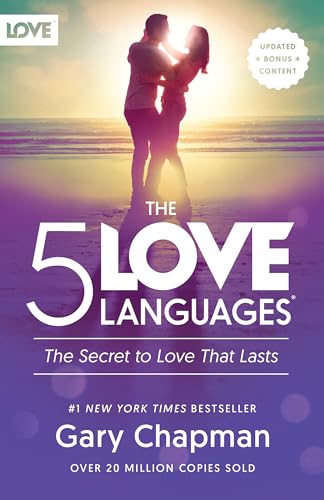 The Five Love Languages: How to Express Heartfelt Commitment to Your Mate by Gary Chapman. Chapman is a marriage counsellor who developed the five love languages framework through three decades of clinical practice: the idea that different people feel loved through different primary channels, which he categorises as words of affirmation, acts of service, receiving gifts, quality time, and physical touch. The framework has attracted criticism from psychologists because it lacks the controlled experimental validation that clinical treatments require, and because the five-category taxonomy is based on clinical observation rather than psychometric research. The criticism is fair. The framework is also genuinely useful for many couples because it gives them a vocabulary for talking about mismatched expectations in a way that is non-accusatory: if your partner expresses love through acts of service and you interpret love primarily through physical affection, the framework names the mismatch without blaming either person. Read it as a useful clinical heuristic, not as a scientifically validated classification system.
The Five Love Languages on Amazon
The Research-Based Standard
The Seven Principles for Making Marriage Work by John Gottman. Gottman and his colleagues at the University of Washington's "Love Lab" have been studying couples in conflict since the 1970s, and their methodology, observing couples in real-time and coding their interactions at high resolution, has produced findings that have held up under replication in ways that most relationship psychology has not. The central finding is that four communication patterns, which Gottman calls the Four Horsemen (contempt, criticism, defensiveness, and stonewalling), predict relationship dissolution with measurably higher accuracy than any other behavioural indicators. Of the four, contempt is the most destructive and the hardest to repair. The positive finding is equally consistent: couples who maintain a ratio of at least five positive interactions to one negative interaction during conflict remain stable at much higher rates than those who do not. The practical exercises in this book are more grounded in observational data than anything else in popular relationship writing.
The Seven Principles for Making Marriage Work on Amazon
The Attachment-Based Approach
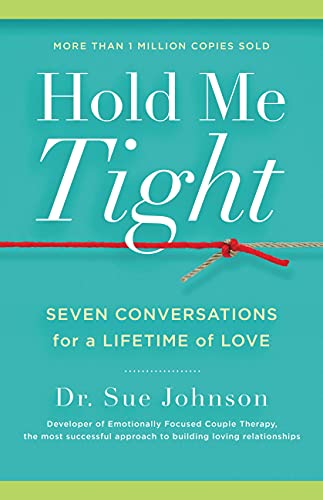 Hold Me Tight: Seven Conversations for a Lifetime of Love by Sue Johnson. Johnson is the developer of Emotionally Focused Therapy, the most thoroughly validated couples therapy approach currently available. The central argument is that romantic relationships are fundamentally attachment relationships, that the same bonding system that operates between infants and caregivers operates between adult partners, and that relationship distress is primarily distress about the security of the attachment bond rather than about the surface-level issues couples typically argue about. This reframing changes the nature of the intervention: instead of teaching communication skills or conflict resolution techniques, EFT targets the underlying emotional responses that drive the communication failures. The seven conversations in the title are a simplified therapeutic protocol for couples to use without a therapist; the clinical version is for trained practitioners. The attachment framework is the most scientifically grounded account of why romantic relationships feel the way they do.
The Question of Desire
 Mating in Captivity: Unlocking Erotic Intelligence by Esther Perel. Perel is a Belgian psychotherapist whose clinical practice in New York gave her access to couples from a wide range of cultural backgrounds, and the cross-cultural perspective shapes this 2006 book's central argument: that the conditions that create emotional security in a long-term relationship, familiarity, predictability, domestic partnership, are not the same as the conditions that create desire, and that the effort to merge the two into a single relationship structure creates a specific tension that Western romantic culture tends to deny rather than address. The book is more clinical than philosophical but is written in a way that makes the argument accessible. It has been criticised for focusing primarily on heterosexual couples and for overstating the universality of the desire-security tension; both critiques are fair. As an analysis of why long-term couples frequently report declining sexual satisfaction and what that actually indicates about their relationship, it remains the most direct popular treatment available.
The Political and Philosophical Account
All About Love: New Visions by bell hooks. hooks was a cultural critic and feminist theorist whose 2000 book on love is the most politically engaged on this list: she argues that the way Western culture defines and practices love is inseparable from the cultural structures of patriarchy, capitalism, and white supremacy, and that genuine love, which she defines following M. Scott Peck as "the will to extend one's self for the purpose of nurturing one's own or another's spiritual growth," is fundamentally incompatible with domination in any form. The argument is philosophical rather than clinical, and the evidence is literary and experiential rather than empirical. What the book offers that the research-based accounts do not is an analysis of the cultural conditions that produce the patterns Gottman and Johnson document: why contempt is so common, why emotional unavailability is so widespread, and what would have to change at the cultural level for love relationships to become more sustaining. It is the most ambitious book on this list and the one that requires the most from the reader.
The Childhood Blueprint
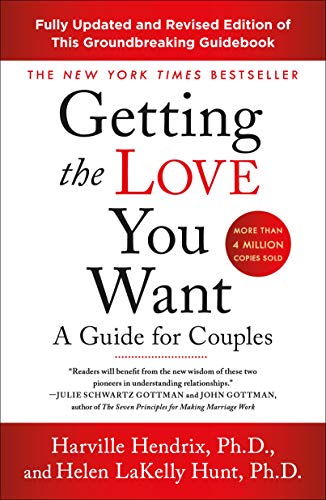 Getting the Love You Want: A Guide for Couples by Harville Hendrix. Hendrix is a psychotherapist who developed Imago Relationship Therapy, which is built on the idea that partner selection is not random: people are unconsciously drawn to partners who resemble the caregivers who wounded them in childhood, because the unconscious mind is trying to resolve the original wound through the current relationship. The framework draws on psychoanalytic concepts but is applied through structured dialogue exercises rather than traditional analysis. Critics of Imago therapy note that the empirical evidence base is thinner than for EFT and that the childhood-wound framework can become reductive when applied too rigidly. As a conceptual account of why relationships trigger such intense reactions that seem disproportionate to the immediate situation, the framework is useful regardless of whether the specific therapeutic protocol is adopted.
Getting the Love You Want on Amazon
The Literary Philosopher's Take
Essays in Love by Alain de Botton. De Botton's 1993 debut novel is presented as a novel but reads as a philosophical essay in the form of a love story: the narrator falls in love, the relationship develops, and the relationship ends, and de Botton uses each stage as an occasion for a philosophical analysis of what is happening, drawing on Proust, Wittgenstein, and the history of Western philosophy. The analysis is witty and precise and occasionally wrong in interesting ways. What the book captures better than any clinical account is the phenomenology of falling in love: the way that being in love involves a massive projection of meaning onto another person that the person cannot possibly sustain, and the specific kind of grief that follows when the projection collapses into the reality of who the person actually is. De Botton is not offering a therapy; he is offering a vocabulary. The vocabulary is more accurate than most clinical frameworks about what the early stages of love feel like from inside.
What the Other Lists Miss
Relationship reading lists are dominated by heterosexual couples therapy models. Two areas get consistent short shrift. The first is solo living: the fastest-growing household type in most developed countries is the single-person household, and the literature on how to build a sustaining life without a primary romantic partnership is thin. The second is long-term friendship as a primary relationship: the research on what makes friendships sustaining over decades is substantial, but it has generated almost no popular literature comparable to the couples therapy genre. Robin Dunbar's work on social networks and friendship is the best entry point if this is your interest.
The Reading Order
Start with Gottman for the empirical baseline: these are the behaviours that predict whether relationships survive, and knowing them changes how you watch everything else. Then Johnson for the emotional architecture underneath the behaviours. Then Chapman for the practical framework, read with appropriate awareness of its limitations. Perel for the desire question, which Gottman and Johnson largely bracket. Bell hooks for the cultural and political context that shapes all the patterns the other books document. Hendrix for the childhood dimension. De Botton last, as the literary counterpoint that describes the subjective experience the clinical accounts necessarily abstract away.
Where to Go After the Relationship Books
The relationship literature connects directly to the mental health and therapy literature, because most couples therapy is also individual therapy conducted in a relational context. The best books about mental health and therapy cover the individual dimension of what relationships bring to the surface. For the experience of losing a relationship through death rather than separation, the best books about grief and loss address what comes after.
Your next good book, in your inbox
We only write when we find a book worth your time. Hand-picked recommendations across history, mythology, true crime and more.
Are you an author?
Get your book in front of readers like these, for free.
- Free book listing →Your own book page with an Amazon button
- Author page →Photo, bio and links to your site
- Featured placement →A spot in our best-of lists, from €29
Free tools we recommend
Get free honest reviewsReview exchange on iWrity, free to join
Books You Might Like
The Psychology of Money
Morgan Housel

Thinking, Fast and Slow
Daniel Kahneman

Man's Search for Meaning
Viktor E. Frankl

The Body Keeps the Score
M.D. Bessel van der Kolk