11 Unexplained Ancient Ruins That Still Confound Archaeologists (2026)
Thousands of years before modern engineering, ancient builders raised structures so precise and so massive that we still can't fully explain how they did it. Across every continent, unexplained ancient ruins stand as direct challenges to our assumptions about early human capability. Some feature stones weighing over a thousand tons, cut with laser-like precision. Others align perfectly with astronomical events that supposedly hadn't been calculated yet. Mainstream archaeology offers theories, but honest researchers will admit those theories often raise more questions than they answer.
That gap between official explanation and physical evidence is exactly the kind of territory we explore at Skriuwer. As an independent publisher, we specialize in books that dig into hidden history and ancient civilizations, the subjects that major publishing houses tend to gloss over or ignore entirely. Our catalog exists because some questions deserve more than a paragraph in a textbook and a dismissive footnote.
This list covers seven ancient sites from around the globe that continue to confound archaeologists, engineers, and historians alike. From megalithic walls assembled without mortar to underground complexes carved from solid rock, each site on this list shares one thing in common: no one can say with certainty how it was built. If you've ever suspected that the ancient world was far more advanced than we've been told, keep reading.
1. Stonehenge
Stonehenge sits on Salisbury Plain in southern England and remains one of the most recognized and most misunderstood sites on Earth. It pulls in over a million visitors every year, yet the more closely you examine it, the less the standard explanations hold up. This is one of those unexplained ancient ruins that continues to generate serious academic debate despite centuries of study.
What it is
Built in multiple phases between roughly 3000 BCE and 1500 BCE, Stonehenge is a circular megalithic monument consisting of large upright stones capped with horizontal lintels, forming a structure that is still partially standing today. The largest stones, called sarsens, were quarried from Marlborough Downs, about 25 miles north of the site, and some weigh up to 25 tons.
What we know for sure
Archaeologists have confirmed through radiocarbon dating and excavation that construction at Stonehenge happened in several distinct phases spanning over 1,500 years. The smaller "bluestones" in the inner ring were transported from the Preseli Hills in Wales, roughly 150 miles away. Researchers have also confirmed that the site has a precise astronomical alignment, with its main axis pointing directly at the midsummer sunrise and the midwinter sunset.
The confirmed transport of multi-ton stones over 150 miles, without wheels or modern machinery, is a feat that modern engineers still struggle to replicate experimentally.
What we still can't explain
No one has produced a fully convincing method for how builders moved the bluestones from Wales or raised the massive sarsen lintels into their current positions. Experimental archaeology has tested log-rolling, sledges, and water transport routes, but none of these methods fully account for the scale and the precision involved at the site.
Your bigger question might be purpose: the exact cultural and ritual function of Stonehenge also remains genuinely open. Archaeologists debate whether it was primarily a burial ground, a place of healing, or a solar observatory, and the physical evidence supports more than one interpretation simultaneously.
Best-supported theories
The leading theory among archaeologists is that Stonehenge served as a ceremonial and burial site, with evidence of cremated human remains dating back to the monument's earliest phases. A competing but widely cited theory proposes it functioned as an astronomical calendar, used to track solstices and lunar cycles. Some researchers also argue it served as a pilgrimage destination for healing, based on skeletal evidence showing people traveled from distant regions carrying signs of serious physical injury or illness.
2. Göbekli Tepe
Göbekli Tepe sits in southeastern Turkey, near the city of Şanlıurfa, and it has completely rewritten what archaeologists thought they knew about prehistoric human civilization. Among unexplained ancient ruins, this site stands in a category of its own because it forces you to rethink the entire assumed timeline of organized human society.
What it is
Göbekli Tepe is a hilltop sanctuary consisting of massive carved T-shaped limestone pillars arranged in circular enclosures. The site dates back to approximately 10,000 BCE or earlier, making it the oldest known megalithic structure on Earth by several thousand years.
What we know for sure
Archaeologists have confirmed through carbon dating that the site predates Stonehenge by roughly 6,000 years and predates the invention of agriculture. The pillars, some standing over 5 meters tall and weighing up to 10 tons, were deliberately carved and arranged with clear intentionality.
The site was intentionally buried around 8,000 BCE, meaning someone went to significant effort to conceal and preserve it.
What we still can't explain
No evidence of permanent settlement has been found at the site, which raises an obvious and still-unanswered question: who organized the massive labor required to build it? The population at the time consisted of hunter-gatherers with no known centralized social structure capable of coordinating this kind of construction.
Best-supported theories
The leading theory is that Göbekli Tepe functioned as a ritual or religious gathering site where nomadic groups convened periodically. Some researchers argue it may have actually driven the transition to agriculture, reversing the long-held assumption that farming had to come before monumental construction.
3. The Nazca Lines
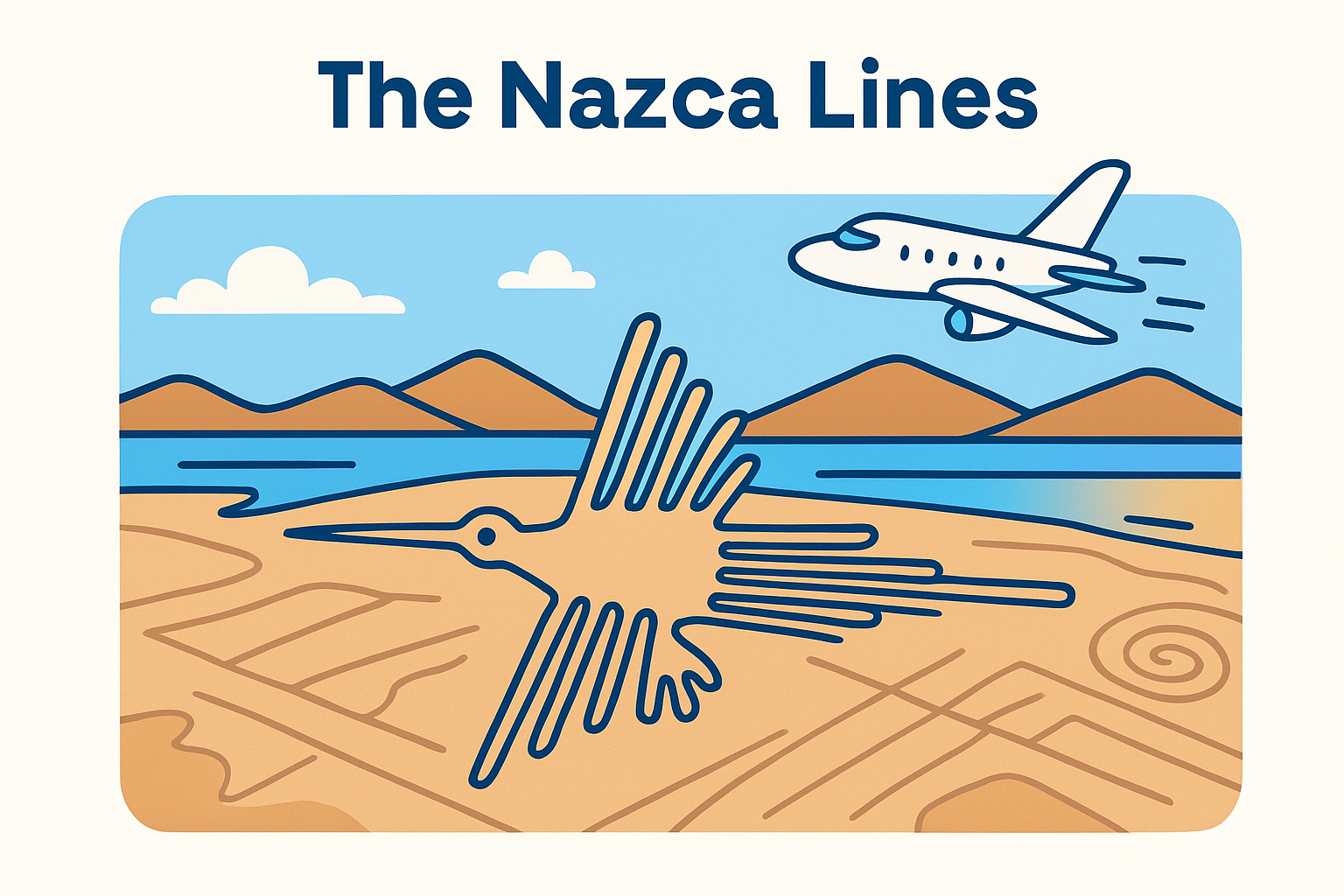
The Nazca Lines spread across a coastal desert plateau in southern Peru and rank among the most visually striking unexplained ancient ruins on Earth. Their core puzzle is immediate: you can only fully appreciate the shapes from the air, yet the people who created them had no known means of flight.
What it is
The Nazca Lines are geoglyphs etched into the Nazca Plateau by removing reddish-brown iron oxide-coated pebbles to expose the lighter ground beneath. The designs range from straight lines and geometric shapes to elaborate animal figures, including a hummingbird, a spider, a monkey, and a condor, with some figures stretching over 300 meters.
What we know for sure
Researchers confirmed through radiocarbon analysis that the Nazca people created the lines between approximately 500 BCE and 500 CE. The lines survive because the regional climate is one of the driest and most windless on Earth, which has kept the exposed ground intact for over a millennium.
The precision of figures extending hundreds of meters proves the Nazca used systematic measurement tools, even without any aerial vantage point during construction.
What we still can't explain
No written record or oral tradition explains why the Nazca people invested this level of labor into designs only visible from altitude. Researchers still have no agreed answer for what purpose the figures served or how builders maintained geometric accuracy across such large distances without any overhead perspective.
Best-supported theories
The most widely supported theory is that the lines served a ritualistic or religious function, likely tied to water and agricultural fertility. A second credible interpretation, backed by astronomer Maria Reiche's extensive fieldwork, proposes the lines functioned as an astronomical calendar aligned with key celestial events.
4. Hal Saflieni Hypogeum
The Hal Saflieni Hypogeum sits on the island of Malta and stands as one of the most remarkable and least-discussed unexplained ancient ruins on the planet. Unlike surface-level megalithic sites, this one goes underground, carved directly into solid limestone across three descending levels that reach nearly 11 meters below ground.
What it is
Built between approximately 3600 BCE and 2500 BCE, the Hypogeum is a subterranean prehistoric complex consisting of a network of chambers, halls, and burial spaces. Archaeologists found the remains of over 7,000 individuals inside when they first excavated the site in the early twentieth century.
What we know for sure
Excavations confirmed that builders used stone tools to hollow out and shape the limestone chambers with striking architectural detail, including corbelled ceilings and smooth walls that mirror above-ground temple construction found elsewhere in Malta. One specific chamber, called the Oracle Room, produces a remarkable acoustic resonance at particular low-frequency vocal tones.
Sound tests have shown the Oracle Room amplifies voices at around 110 Hz in ways that measurably affect brainwave activity, pointing to deliberate acoustic engineering.
What we still can't explain
Researchers still cannot explain how builders achieved such acoustic precision using only basic stone tools, or why so many individuals were interred here over centuries without any written record clarifying the site's original purpose.
Best-supported theories
If you follow the physical evidence, the most credible interpretation is that the Hypogeum served as both a burial site and ceremonial space, with its acoustic properties used deliberately to enhance rituals intended to connect the living with ancestral dead.
5. Nan Madol
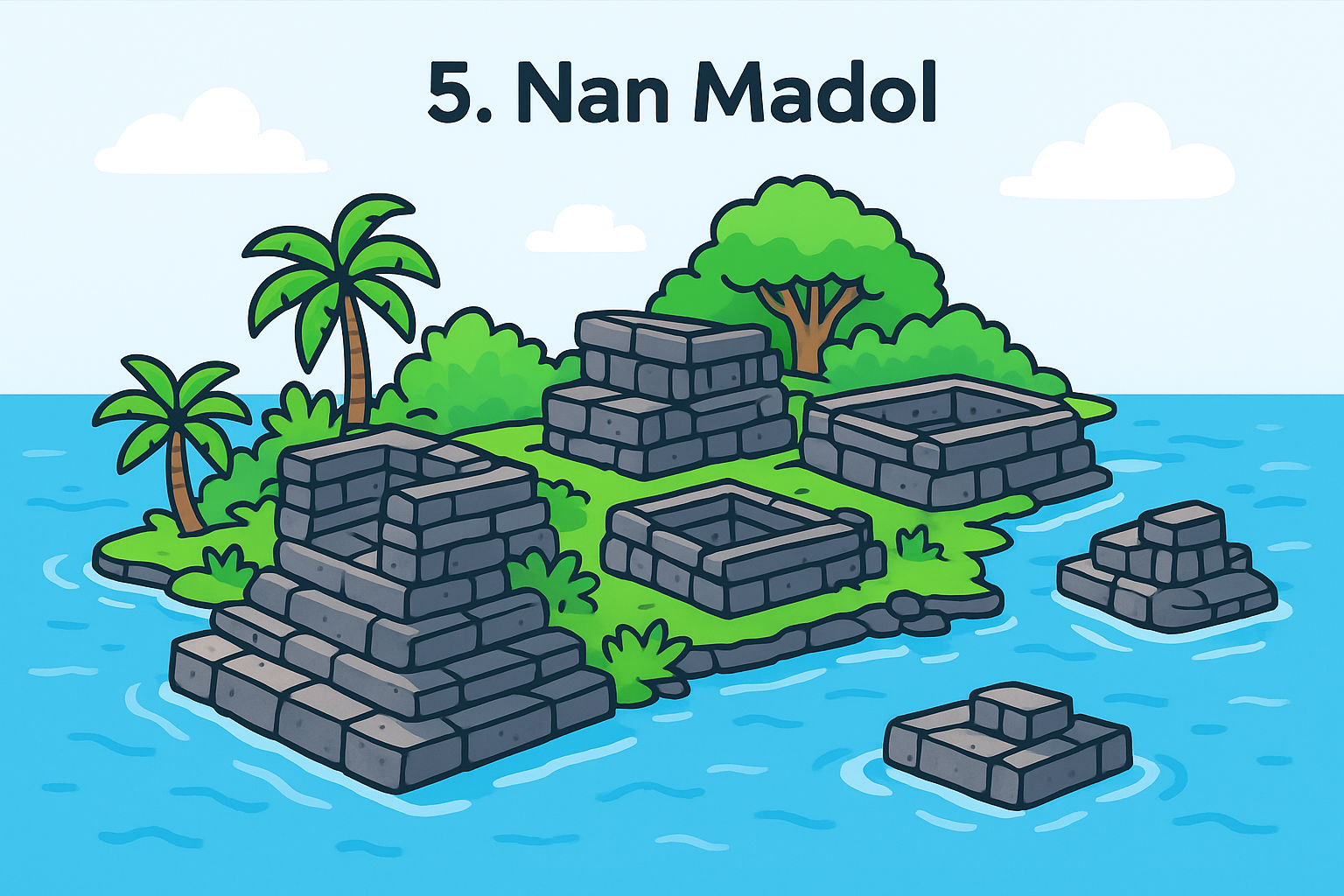
Nan Madol sits off the eastern shore of Pohnpei, a small island in the Federated States of Micronesia, and it ranks among the most logistically baffling unexplained ancient ruins in the Pacific. The city was built on a tidal flat, constructed entirely on artificial islands separated by a network of canals running through open ocean.
What it is
Nan Madol is a ruined ceremonial and administrative center built from stacked basalt columns and coral blocks, forming around 100 artificial islets across a lagoon. The site served as the capital of the Saudeleur dynasty, which ruled Pohnpei from roughly 1100 CE to 1628 CE.
What we know for sure
Researchers confirmed that the basalt columns used in construction were quarried from a location on the opposite side of Pohnpei Island, roughly 25 miles away. Some individual columns weigh between 5 and 50 tons, and builders stacked them in a log-cabin style without mortar across open water.
The total volume of basalt at Nan Madol is estimated at 750,000 metric tons, moved entirely by a pre-industrial society with no identified large-scale water transport technology.
What we still can't explain
No one has identified a credible method for transporting multi-ton basalt columns across open ocean on this scale. The logistics of organizing and sustaining a workforce large enough to complete the entire complex also remain unresolved by current research.
Best-supported theories
Archaeologists generally agree the site functioned as a seat of political and religious authority for the Saudeleur rulers, with specific islets dedicated to ritual, food preparation, and elite burial. The leading transport theories involve rafts and tidal currents, though no experimental replication at scale has succeeded.
6. Puma Punku
Puma Punku lies within the Tiwanaku archaeological complex in western Bolivia, roughly 45 miles from La Paz at an altitude of nearly 12,800 feet. Among unexplained ancient ruins, this site draws particular attention because its stonework precision is difficult to reconcile with the tools its builders are known to have possessed.
What it is
Puma Punku is a ruined temple platform attributed to the Tiwanaku civilization, estimated to date to around 600 CE, though some researchers argue for earlier origins. The site is now largely collapsed, with massive stone blocks scattered across the plateau, including H-shaped interlocking pieces and flat slabs bearing repeating groove patterns cut at consistent angles.
No mortar or adhesive was used anywhere in the structure. The blocks were designed to lock together mechanically.
What we know for sure
Archaeologists confirmed that construction relied on red sandstone and dense andesite, with some individual blocks reaching up to 130 tons. The andesite was quarried near Lake Titicaca, roughly 10 miles from the site.
The flat faces on Puma Punku's stone blocks hold tolerances of less than a millimeter, a standard that stone and copper tools cannot easily produce.
What we still can't explain
No researcher has produced a credible cutting method for the complex H-shaped grooves and interlocking profiles using only the copper chisels and stone tools the Tiwanaku are documented to have used. How builders moved 100-plus-ton blocks to altitude remains unresolved.
Best-supported theories
The prevailing view is that the Tiwanaku applied organized labor and accumulated craft skill across long construction periods. Some researchers argue the interlocking block system reflects deliberate prefabrication planning, pointing to engineering sophistication that standard accounts of pre-Columbian Andean culture consistently underestimate.
7. Longyou Caves
The Longyou Caves in Zhejiang Province, China represent one of the most disorienting unexplained ancient ruins in East Asia. A local farmer discovered them in 1992 by pumping out what appeared to be a pond, revealing a vast hand-carved subterranean complex that nobody in the surrounding region had any recorded knowledge of.
What it is
The Longyou Caves consist of at least 24 large artificial caverns carved from siltstone, covering a total area of roughly 30,000 square meters. Every cave features carved walls, pillars, and ceilings covered with a repeating pattern of parallel grooves arranged at a consistent 60-degree angle.
What we know for sure
Researchers confirmed through sediment analysis and tool mark studies that the caves were carved by hand, most likely during the Qin Dynasty period around 212 BCE. Despite their enormous scale, no written record or historical document from any Chinese dynasty mentions their construction.
The uniform 60-degree groove pattern appears across every surface in all 24 caves, indicating one coordinated construction effort rather than work completed across separate phases.
What we still can't explain
No imperial records document a construction project of this scale, which is striking given how thoroughly Chinese administrations documented major public works during that era. You would expect at least one reference to survive across 2,000 years of archival history.
Best-supported theories
Most researchers believe the caves served as underground storage or shelter, potentially for military use during the Qin period. The leading alternative theory proposes they functioned as systematic quarries, with the hollowed chambers being a direct byproduct of organized stone extraction.
Where to go next
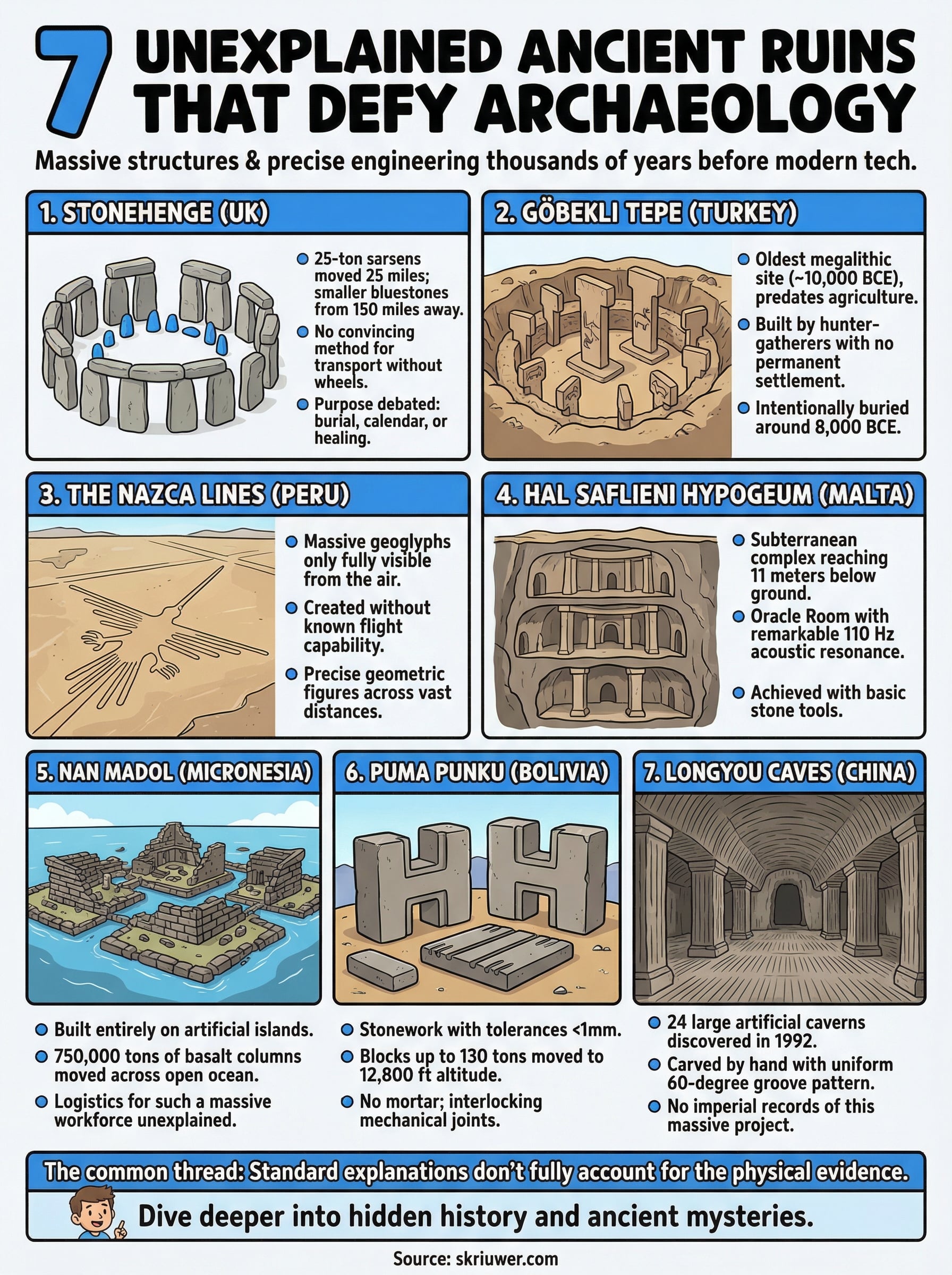
These seven sites share one uncomfortable truth: the standard explanations don't fully account for the physical evidence. Whether you're looking at multi-ton stones moved across open ocean or underground chambers carved with sub-millimeter precision, the gap between what ancient people supposedly could do and what they actually built keeps widening the more closely you examine it. Every site on this list has something the textbooks quietly leave unresolved.
If these unexplained ancient ruins have pulled you deeper into questions about hidden history and forgotten civilizations, you're exactly the kind of reader we publish for. The gaps in the official record are real, and they deserve more than a footnote. Browse the curated Skriuwer history book collection and the dark history book collection for books that take these questions seriously.
Recommended Reading
Fascinated by ancient civilizations? Explore more with these book lists on Skriuwer:
- Best Books About Ancient Rome. From the Republic to the Empire, the definitive reading list on Rome's full arc.
- Best Books About Ancient Egypt. Pyramids, pharaohs, and what 2026 archaeology has added to the picture.
- Best Greek Mythology Books. The myths and legends that shaped ancient Greek culture and still shape modern fiction.
- Best Books About Ancient China. From oracle bones to the Han Dynasty, the ranked reading list on China's ancient past.
Your next good book, in your inbox
We only write when we find a book worth your time. Hand-picked recommendations across history, mythology, true crime and more.
Books You Might Like

Sapiens: A Brief History of Humankind
Yuval Noah Harari

The Last Kingdom (The Saxon Stories, Book 1)
Bernard Cornwell

Meditations
Marcus Aurelius

The Hiding Place
Elizabeth Sherrill, John Sherrill Corrie ten Boom